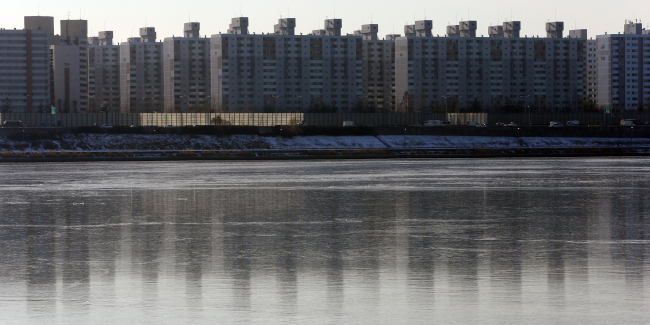
Apartment prices in Seoul dropped 4.1 percent in the first 11 months of this year, marking the sharpest fall since 14.6 percent in 1998 when the property market was hit by the Asian financial crisis.
Unlike how apartment prices rebounded by 12.5 percent in 1999, prospects for a rise next year are low this time.
Whereas home prices nosedived over a short period of time due to an external shock in 1998, the current fall was caused by structural market changes such as reduced demand as people moved to Sejong City, the newly developed “innovative cities,” retirement of baby boomers and supply of state-funded, inexpensive homes.
“The bubble that was formed by a rush to buy homes in Pangyo (a new suburb southeast of Seoul), new towns and areas designated for redevelopment is now going away,” said Park Won-kap, chief of the real estate team at KB Kookmin Bank.
In a survey of 105 real estate experts by the Korea Chamber of Commerce and Industry, 53.3 percent said housing prices would fall further next year by 2.9 percent on average.
Nine out of 10 said that if the government fails to respond appropriately, the property market could enter a long-term depression on declining demand due to the aging population and homes’ loss of appeal as an investment.
The incoming administration must take policy measures to resolve the imbalance in housing supply and demand (37.2 percent) and improve the property tax rules (35.2 percent), the experts said.
Regarding plans to boost real estate transactions, 40 percent of the respondents said the government must extend support for people buying their first own homes.
“Since the country is no longer short of homes, the government must control the speed of housing supply projects such as new town developments and instead adjust property tax rules and regulations that were introduced during property market booms,” the KCCI said.
By Kim So-hyun ()
koreaherald@heraldcorp.com