Analyst skeptical of chaebol’s recent moves to cut size, calls for more reforms
Saenuri Party leader Park Geun-hye’s latest decision to steer clear of some of the key policies for reforming chaebol touched off harsh criticism about her true intentions, but the head of Chaebul.com chose to adopt a more realistic perspective on the matter.
“The shift reflects a two-track policy for simultaneously pursuing economic growth and fair competition, and frankly, the most realistic methodology for keeping the economy on track while at the same time, promoting fair competition,” said Chung Sun-sup, chief executive of Korea’s only company that collects and selectively releases exclusive information on local conglomerates.
Chaebol-bashing was one of the key methods for pursuing “economic democratization,” a term adopted by all presidential candidates as their main goal for the Korean economy.
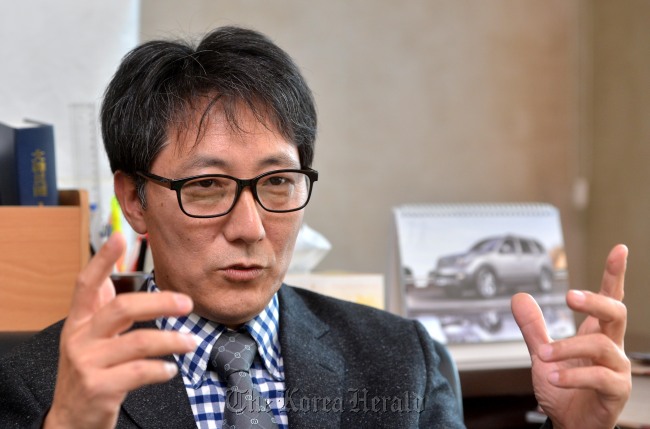
Chaebul.com CEO Chung Sun-sup (Lee Sang-sub/The Korea Herald)
Park, who is running for president on the Saenuri Party ticket, announced a set of economic policy pledges last week that pointedly omitted the idea for enacting a new set of stringent laws exclusively for controlling the nation’s top industrial groups.
She immediately came under fire from liberals for kowtowing to the conglomerates.
But it has become difficult how to judge her actions, as even Moon Jae-in, the candidate on the opposition Democratic United Party ticket, on Wednesday said on air that he does agree that chaebol must be fostered and are necessary for global competition.
Independent Ahn Cheol-soo also admitted that the chaebol cannot be left to tank.
“We must remember that we might end up burning down the whole house trying to get the bedbugs,” Chung warned. “I do understand the dilemma we face, since if we put on the brakes, such as by banning the limit on the stakes a company can hold in another, we can curtail the reckless expansionist policies at major companies, but at the same time, we would be suffocating them and preventing further growth,” Chung said. “On the other hand, if they are left to their own devices, they may end up swallowing up the entire economy.”
The key to molding and implementing the right economic policies is knowing to compromise between ideals and reality, the CEO advised.
“When policies start to lose the realistic touch, that’s when they start to become accused of populism,” he said.
The conglomerates, meanwhile, have a long way to go in terms of reforms, Chung said, dismissing the recent pledges from Samsung, LG, SK and others to shed their affiliates: “This is nothing more than a preemptive attack being staged to avoid future regulations.
“They said they will cut down the number of their subsidiaries, and not the industries they operate in, which means that essentially, they still have their finger in every pie they want, just that their presence will be toned down a bit,” he said.
More than a handful of conglomerates have recently vowed to liquidate or merge some of their affiliates, a move interpreted by many here as a silent concession of their reckless expansion, which has been knocking their smaller counterparts out of the playing field.
“A faster way for promoting fair competition between the chaebol and the smaller companies is to completely overhaul the current fair trade laws,” he said.
Current laws are written in such a way as to be advantageous for the larger companies, and these firms lobby hard for their rights, which is why conglomerates usually walk away from government penalties unharmed because they immediately file lawsuits against the Fair Trade Commission and win.
The conglomerates claim that they are being sacrified for the sake of the elections.
By Kim Ji-hyun (jemmie@heraldcorp.com)
Economic democratization Indicates the main economic policy pledge issued by major candidates for the Dec. 19 presidential election. Its central goal is to create equal opportunities for all parties of the economy.
<관련한글기사>
koreaherald@heraldcorp.com