Assembly Voice looks into key issues and controversial bills through a series of interviews with rival lawmakers who lead the legislative debate at the National Assembly. ― Ed.
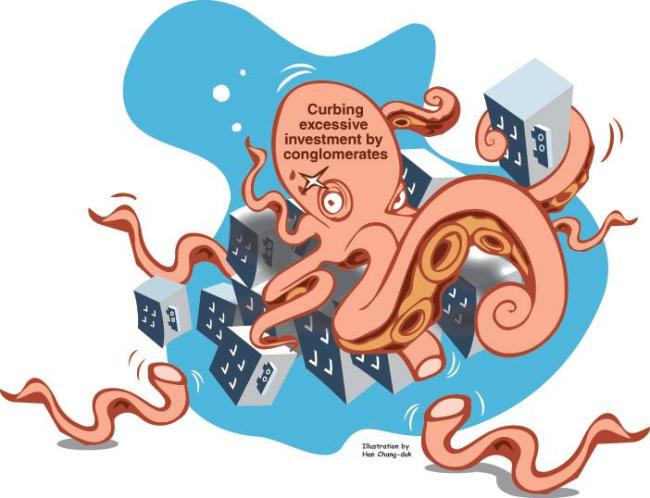
The ceiling over conglomerates’ equity investment in other companies has been in and out of the Korean economic system repeatedly since the late 1980s. It was installed when calls to decentralize economic power overrode the need to foster businesses’ growth, and vice-versa.
The regulation was first introduced in the Fair Trade Act in December 1986 banning top conglomerates ― with 400 billion won ($354 million) or more in total assets ― from making an investment worth more than 40 percent of their own net value in other firms.
The restraint aimed to prevent large companies’ reckless diversification and fleet-type management by severing the convenient investment chain among the affiliates.
The cap was tightened in 1994. But in the wake of the Asian financial crisis the control was scrapped in Feb. 1998 to promote investment and beef up self-protection against hostile merger and acquisition bids.
The cycle repeated again. It was resurrected in 1999 and jettisoned again in March 2009 as the nation was struggling with the global financial crisis. The criteria were also constantly adjusted.
Now, in 2012, as the political circles are overreaching themselves to galvanize voters with scores of “economic democratization” bills, the investment cap, along with the ways to reign in cross-shareholding, is once again being put on a pedestal as measures to curb over-centralized chaebol, or conglomerates, especially by the opposition forces.
The main opposition Democratic United Party, while admitting that the ceiling system is not perfect, has selected restoring the investment cap as one of the key chaebol reform projects. DUP Chairman Lee Hae-chan reiterated the stance during his parliamentary speech last Wednesday.
They even go as far as to suggest overhauling the perception of chaebol by enacting a law on corporate groups in which one member’s rights and duties will be attributed to another or the entire group, as done in some countries of Europe.
The ruling Saenuri Party and its presidential candidate Park Geun-hye initially toyed with the idea during the April general elections in their efforts to discard their image as a party for the rich. But the party opposes the system for potentially hindering business growth, and instead suggests some ex-post regulations.
Experts have been equally split about the efficacy of the system.
Supporters argue that the investment limit is necessary because ex-post regulations fail to prevent economic domination. They also view that by blocking reckless investments among the affiliates of a conglomerate, businesses can remain specialized in their own turfs. Those in favor also contend that investment of equity is separate from investment of capital, and hence it would not bog down the overall market.
Opponents counter that the ceiling system would make local firms vulnerable to hostile mergers and acquisitions by foreign firms, and that adjustments to corporate governance structure are enough to prevent business centralization. They believe that equity investment naturally leads to capital investment and therefore putting a cap on it would drag down the market.
It is, however, a very widely shared opinion that the equity investment ceiling has a structural weakness, and is short of being an ultimate solution on its own.
Too high a limit would weaken the binding force, while too low a limit would restrict conglomerates’ restructuring ability. Loopholes also exist for businesses that have already become holding companies and are hence able to escape having to get rid of the portion that is considered excessive investment under the ceiling.
By Lee Joo-hee (jhl@heraldcorp.com)
History of equity investment ceiling
● Dec. 1986 ― Introduced to limit conglomerates from investing more than 40 percent of net assets
● Dec. 1994 ― Lowered to 25 percent
● Feb. 1998 ― Scrapped upon foreign exchange crisis
● Dec. 1999 ― Reintroduced to restrict investment worth more than 25 percent of net assets
● April 2007 ― Applied to conglomerates with over 2 trillion won of assets, ceiling expanded to 40 percent
● March 2009 ― Scrapped upon global financial crisis
koreaherald@heraldcorp.com