Festival underscores government’s 5-year project to renovate river basins
The government hosted an event last weekend to celebrate the revitalization of the country’s four major rivers as its multi-billion-dollar project nears its end.
The Ministry of Land, Transport and Maritime Affairs opened on Saturday four out of 16 reservoirs to the public along the four rivers ― Han, Geum, Yeongsan and Nakdong. It has already introduced six reservoirs since September and will open the remaining six next month.
Around 10,000 residents and public officials attended the festival in Yeoju, some 105 kilometers east of Seoul on the South Han River, which entailed a celebratory concert, tours, exhibitions and sports events for locals, such as windsurfing, kayaking, canoeing and cycling.
“I am very delighted to return the rivers to the people, which will now bring back life and provide residents with happiness and safety from natural disasters,” President Lee Myung-bak said at a ceremony.
“These rivers are reborn not just to secure water resources and protect against floods but to revitalize every nook and corner of Korea.”
Launched in 2009, the five-year mega-program aims to prop up water security, flood control and ecosystems by refurbishing some 900 kilometers of tributary streams and adjacent wetlands and setting up anti-disaster prevention facilities.
The United Nations designated Korea a water-stress nation, meaning there is an imbalance between use and resources.
The 22 trillion won ($19.1 billion) project is one of Lee’s flagship policies under his “low carbon, green growth” vision, which seeks to harmonize environmental sustainability and economic growth.
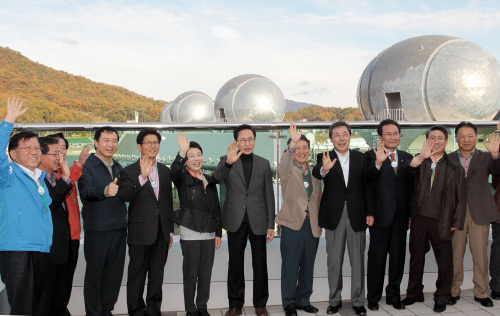
South Korean President Lee Myung-bak (seventh from left), first lady Kim Yoon-ok (sixth from left), Land Minister Kwon Do-youp (fifth from right), Public Administration and Security Minister Maeng Hyung-kyu (fourth from right), Gyeonggi Gov. Kim Moon-soo (fifth from left) and other government officials wave at a ceremony on Saturday in Yeoju, Gyeonggi Province, to mark the near-completion of the government’s project to revamp the country’s four main rivers. (Yonhap News)
He set the goal of curbing the nation’s greenhouse-gas emissions 30 percent below business-as-usual projections by 2020 and created a five-year plan to spend 2 percent of the annual gross domestic product on research and development of clean infrastructure.
The ministry said it is finishing off work on the main courses of the four rivers with a completion rate of 93 percent. The establishment of small-scale hydropower plants, solar panels and windmills in the weirs is still in progress.
“In the river project, renewable energy is pivotal in fostering green growth and coping with hastening climate change,” Shim Myung-pil, head of the Office of National River Restoration under the Land Ministry, told The Korea Herald early this month.
“Even after the whole project is finished, we’re planning to install extra wind power plants along the Geum, Yeongsan and Nakdong Rivers if they prove feasible.”
Government data showed that hydraulic turbines in the areas alone will be able to generate 271 million kilowatt hours of electricity a year. That could offset 183,000 tons of emissions and 454,000 barrels of crude imports annually, saving some 50 billion won.
The ministry said it will also be able to produce electricity from solar panels in 12 reservoirs with total daily output of 109 kilowatt hours and save 1.25 billion tons of water through small and mid-sized dams and reservoirs.
It also projects the river project to bring about 190,000 new jobs in the construction sector, which takes up nearly 20 percent of Korea’s GDP.
While advocates tout the program as a means to help boost water supplies and tourism, however, Lee and his administration have failed to calm controversy over its potential side effects on the environment.
Some policymakers, scholars and civic activists slammed the government for its massive marketing budget and self laudation over the project’s “unproven” efficacy, claiming that it strangles local wildlife and ecosystem dynamics.
On the sidelines of Saturday’s event, members of an environmental group held a press meeting to denounce the festival, calling it “false propaganda.”
“I think the program had been taken too politically,” Shim said, adding that his agency protected the habitats of endangered species and looked to reinforce protection for them.
Shim also claimed that some opponents have changed their tunes after witnessing the restored waterways’ ability to cope with torrential rains last summer.
The ministry estimates the country’s total flood damage during the rainy season at 94.5 billion won, about 9 percent of the cost in 1998 and 6 percent compared with 2006.
“It is fortunate that the government has been building four times as many anti-disaster facilities as the current ones in preparation for a rainstorm that might come once in 200 years,” Lee said earlier.
“Thanks to this project, many waterside areas can prevent recurrent flood damage.”
By Shin Hyon-hee (heeshin@heraldm.com)