Fear indicator down, KOSPI makes back recent losses
South Korea’s financial markets have been shifting back to normal faster than earlier predicted after suffering a series of shocks sparked last month by fears of a global recession.
Investment sentiment, though still cautious, is turning positive at a steady pace, with the market indicators signaling that the worst may be over.
Although the KOSPI lost some ground on Tuesday, it staged a recovery of nearly 200 points in eight sessions through Monday.
The much-awaited signs of a turnaround came after the local stock, bond and foreign exchange markets took a pummeling for nearly a month by foreign investors who shifted part of their holdings out of the country in the face of the worsening eurozone debt crisis and concern about a possible double-dip for the U.S. economy.
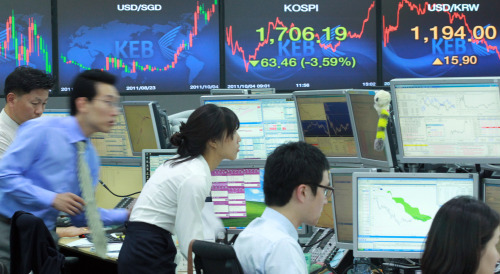
Foreign currency dealers work at a dealing room of the Korea Exchange Bank in Seoul. (Yonhap News)
The volatile Korean won, in particular, had sent distressed investors at home and abroad turning extremely conservative about the Korean market at large, with the key indicators spiraling downward, even below those of the troubled European countries.
According to the Korea Center for International Finance, credit default swap premium for the foreign currency denominated bonds issued by the Korean government stood at 153bp (1bp equals 0.01 percent) as of Oct. 14, based on the closing price of New York. The figure is markedly better than two weeks earlier when the CDS premium spiked at 229 bp.
The 30 percent drop of the CDS premium means the credit risk for Korea has lessened and the cost of issuing bonds has dropped. The indicator also suggests that Korea’s recovery is as fast as its descent compared with other advanced countries.
During the same period, Japan’s CDS premium went down 19.73 percent. The U.S. and Germany saw their risk premium lower by 15.18 percent and 9.62 percent, respectively, while France, which is in the middle of the eurozone debt crisis, ended up with a 2.14 percent drop of its CDS premium during the cited period.
In the banking sector, Korean lenders are also getting a breather thanks to a recovery in the outlook measured by CDS premiums. Korea Development Bank’s CDS premium slid 20.65 percent this month, while Woori, KB, Shinhan and Hana managed to lower the risk figures by 14-17 percent.
The spread on Korean government-issued foreign exchange stabilization bonds which mature by 2019 rose from 195bp at the end of last month to 201bp on Oct. 4 before receding to 147bp on Oct. 14.
The volatility index of KOSPI200, the so-called fear factor for the Korean stock market, hit 45.64 on Oct. 5 amid growing uncertainties over the eurozone crisis but dropped about 33 percent to 30.61 as of Monday. Although Monday’s figure is still far higher than 19.31 recorded on Aug. 1 shortly before the bearish run started on the Seoul bourse, it is deemed to be at a safer level than the peak in early August.
The fast-paced recovery of market indicators and investor sentiment is largely driven by the heightened expectations that the severity of the eurozone sovereign debt problem will lessen in the coming weeks as European governments seek to find a solution to the crisis that gripped the global financial markets in the past two months.
By Yang Sung-jin (insight@heraldm.com)
insight@heraldcorp.com