MILAN (AFP) ― Italian financial markets fell sharply on Monday, with investors finding no reassurance in the adoption of a huge austerity budget as the eurozone debt crisis savaged confidence.
Milan’s main index, the FTSE MIB, fell steadily through the day and closed down 3.06 percent at 17.885,74 points, with bank shares the worst hit.
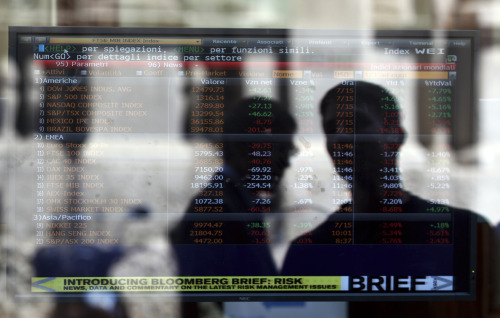
A man looking a stock exchange board monitor is reflected in the window of a bank in Milan on Monday. (AP-Yonhap News)
Italy’s banks ― like others across Europe ― are struggling under the weight of the debt crisis in spite of news Friday that the country’s top five had passed the European Banking Authority’s stress tests.
UniCredit closed down 6.45 percent, with other lenders seeing similar losses as markets across Europe struggled ahead of a crunch eurozone summit on Thursday.
The persistent uncertainty also saw the yield or rate of return paid on Italian 10-year bonds shoot up ― as did Spanish bonds ― reflecting widespread concern that both countries were now at higher risk and could suffer contagion from the debt crisis.
Italy’s 10-year bond was yielding above 6.0 percent, compared to 5.751 percent later Friday, while Spain rose from 6.045 percent to 6.297 percent.
“The austerity budget has nothing to do with it,” UniCredit economist Marco Valli told AFP.
“Investors are waiting for Thursday’s summit,” when eurozone nations will meet in Brussels to discuss ways to tackle the debt crisis and provide fresh aid for Greece.
The government has attempted to stave off the crisis by rushing through a whopping 48-billion-euro ($68-billion) austerity budget aimed at slashing the public deficit by 2014 and reassuring nervous financial markets.
The plan, which includes deep cuts to regional subsidies, family tax benefits and top-tier pensions, is aimed at reducing the public deficit to 0.2 percent of Gross Domestic Product by 2014 from 4.6 percent last year.
Valli said Italy’s bond yields should drop if the Brussel’s meeting is a success.
However, should the rates remain the same or even go up, then “things will get more complicated” for Italy because of the spiralling costs of borrowing, he added.
On Friday, Italy’s central bank warned that if high long-term borrowing rates persist they would have “considerable costs” for public finances and risks for the economy.