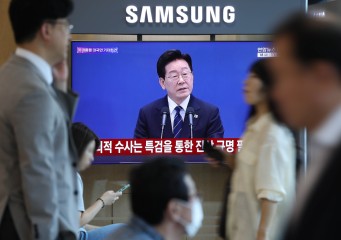
Korea’s two largest electronics makers are vying to get an upper hand in the fast growing market for smart home appliances.
Samsung Electronics and LG Electronics recently rolled out refrigerators, washers and air conditioners featuring improved technology in artificial intelligence, wireless access and efficient electricity control.
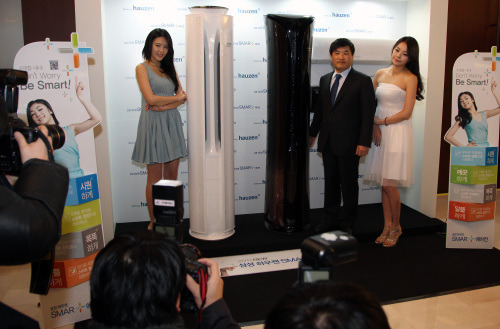
Samsung Electronics’ home appliances division head Hong Chang-wan (second from right) introduces the company’s “smart” air conditioners at its headquarters in Seoul on Jan. 11. (Yonhap News)
Appliances for a “connected” home have long been in the market. But recent hectic advances in mobile computing epitomized by the smartphone and tablet PCs have drastically expanded their potential.
“This year will mark the beginning of a new era of home appliances,” said Lee Young-ha, LG Electronics president of home appliance business. “We’ve reached the tipping point where all the appliances are now run by CPUs (central processing units) and computer codes.”
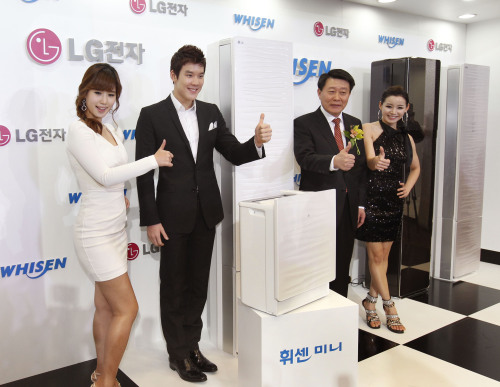
LG Electronics’ air conditioning and energy solutions division head Noh Hwan-yong (second from right) and Korean national team swimmer Park Tae-hwan (second from left) pose at a launch event for the company’s new Whisen air conditioners in Seoul on Jan. 12. (Yonhap News)
In comparison to TVs, phones and display panels, the home appliances portion of their revenue is not so big ― less than 8 percent for Samsung and 27.8 percent for LG.
But the division saw substantial growth last year. Samsung’s sales in the market jumped 21 percent year-on-year to nearly 12 trillion won ($10 billion) and LG’s rose 12 percent to about 15.49 trillion won.
The two electronics giants have engaged in neck-and-neck races at home while dominating the domestic market for decades.
Their rivalry turned testy again last month when they fought over the timing for introducing their new air conditioners.
On Jan. 11 Samsung unveiled its new Hauzen Smart Air Conditioner, which customers can remotely control using their smartphones and tablet computers. At a launching ceremony, an official sent a text message saying “on” in Korean to the host server linked with the air conditioner to turn it on.
Being 33 percent slimmer than the previous model, it may save users up to 87 percent on their electricity bills depending on the size of the home, Samsung claimed.
“It makes smart, fresh indoor environments in all four seasons. With leading technologies and beautiful designs, it will provide genuine smart life for customers,” said Hong Chang-wan, Samsung’s home appliances division chief.
The following day, LG unveiled an upgraded lineup consisting of 42 new air conditioners. One of them is “Marine Boy Special,” which can reduce energy costs by up to 88 percent and is controlled by Android smartphone applications for activation and deactivation as well as temperature change, according to LG.
The two companies used the Consumer Electronics Show, the world’s largest consumer electronics fair, held in Las Vegas last month, to showcase their next-generation home appliances.
LG attracted attention with its various smart devices including refrigerators based on “THINQ” technology, which embodies five core features ― smart grid, smart diagnosis, smart access, smart adaptation and smart food management.
Users can check which food items they put in the machine and where, and how long they have until the items expire on LCD displays or their handsets via Wi-Fi connections, LG said.
“For LG, ‘smart’ means offering ultimate benefits of empowerment and convenience to our consumers,” Lee said.
“The THINQ technology essentially transforms how consumers take care of their home and makes it easier and smarter than ever before.”
THINQ technology is embedded in other appliances, too. At the CES, LG presented its washing machines that can be instructed to work at the most cost-effective times according to a smart grid plan.
When switched on, they suggest options of “recommend time” or “lowest rate” to use the minimum amount of energy at the least expensive rates, LG said.
LG’s “smart access” technology makes it possible for owners to watch washing cycles while they are out. Alert messages will be sent to their mobile devices for the end of a phase or any error during the operation.
In Korea, LG’s “Tromm 6-Motion” drum washer has been a sensational success. As of September, LG sold more than 170,000 units in the year after the launch, in a market where washer sales are around 40,000 units per month on average.
At the tradeshow, Samsung unveiled its Wi-Fi enabled fridge. Using LCD screens, users can search recipes, check the weather, leave notes for their kids or view photo slide shows, it said.
In the local market, Samsung’s Zipel Grande Style 840 has been a top seller, reaching 10,000 units in sales within two months after its launch in October.
The refrigerator boasts a storage capacity of 841 liters with a slender style by renowned designer Karen Little, who worked with global fashion labels Christian Dior and Vivienne Westwood.
Its “smart ecosystem” also guarantees low energy consumption and maximizes the freshness of food, Samsung said.
Samsung also displayed new washers with a larger capacity and quieter operation.
Samsung’s “Bubble Eco” has been a steady-seller among Korean housewives, surpassing 30,000 units in sales two months after launch in April.
The washer is designed to cut electricity costs by half compared with older models by doubling the amount of bubbles generated from the detergent, the producer said.
The robotic vacuums market is emerging as a new battle ground between the top technology players.
In the domestic market, LG claims about 52 percent share with its RoboKing Dual Eye, the fifth-generation cleaning robot launched in late 2009. LG’s first robot cleaner was introduced in 2003.
Running on lithium polymer batteries, the latest version has two cameras and numerous sensors that read surroundings, and sweeps and vacuums 30 percent faster than the previous model, the company said.
It recently began shipping the Dual Eye to France, Italy and Spain, and plans to further target other countries this year, an LG spokesperson said.
With LG’s new cleaner Hom-Bot, unveiled at the CES, users will be able to tidy up homes and feed pets through wireless devices, the company said.
Samsung’s robot cleaner, Tango, which hit the market in November 2009, also carries a camera and features improved navigating capability with 13 sensors that detect obstacles from two centimeters away.
For the next few years, the two companies are looking to double-digit growth in home appliances revenue mainly driven by these smart gadgets.
Samsung announced recently that it is targeting $30 billion in global appliances sales in 2015, for a 10 percent share of the market.
LG aims to garner $20 billion in sales in 2014. It hopes to raise its share in the international market to 14 percent this year from 12 percent now.
On the export front, the companies are pinning their hopes on rising demand from emerging market countries such as China and India.
Samsung’s Hong noted that the appliance markets in developing countries would grow 5 to 8 percent this year, while those in advanced economies are to remain at 2 or 3 percent.
Korea’s home appliances exports to the emerging economies rocketed 42 percent year-on-year for the period between January and September 2010, according to Samsung Economic Research Institute.
By Shin Hyon-hee (heeshin@heraldm.com)