The launch of Ahn Cheol-soo’s official political career as a member of the National Assembly will likely be a catalyst for major change in the political arena.
Despite being a relative newcomer, his victory in Seoul’s Nowon-C constituency was widely expected, with surveys putting him more than 20 percentage points ahead of the Saenuri Party’s Huh Joon-young.
The impact of the former independent presidential candidate’s debut on parliamentary politics will be most concentrated in the progressive bloc, which has been dominated by the pro-Roh Moo-hyun faction of the main opposition Democratic United Party.
Ahn, who trained as a doctor at Seoul National University, came to prominence as a software developer and entrepreneurship professor.
In 2011, popular support projected him into the spotlight as a potential candidate for the Seoul mayoral by-election, in which he instead chose to support Park Won-soon, the current mayor.
Building from there, he became a presidential contender last year, serious enough to give President Park Geun-hye’s election campaign pause, until he forfeited in favor of the DUP’s Rep. Moon Jae-in.
As a first-term lawmaker, Ahn is considered to have two viable options: join the DUP or found his own party.
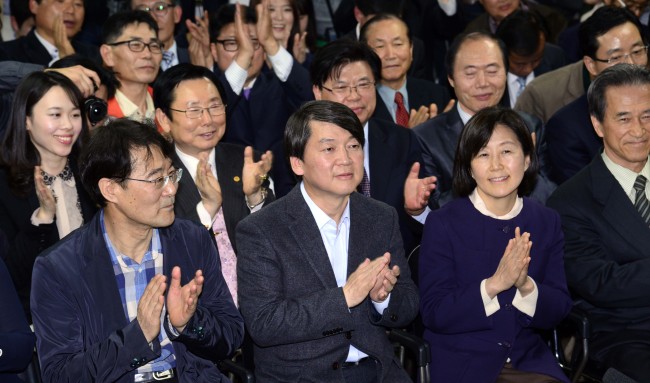
Ahn has been characteristically ambiguous on the issue, saying that time is needed.
“It is not a simple matter than can be done in the span of a few days. If elected, time will be required to observe and conduct parliamentary activities,” Ahn said in a radio interview on Monday.
Ranking DUP members including emergency committee chairman Moon Hee-sang have directly and indirectly called for him to join the party.
But pundits project that Ahn is unlikely to opt for the DUP as the move would be detrimental to his stated purpose of bringing about “new politics.”
Some senior members of the DUP have downplayed the impact he will have.
“If Ahn enters the parliament, there will of course be some impact (on the political arena), but the National Assembly is not that simple,” DUP floor leader Rep. Park Jie-won said in a recent radio interview.
“In the end, as one of 300 (parliamentarians), his role is likely to become that of the second Moon Kook-hyun.”
Moon is a former lawmaker who rose rapidly within the political arena, aided by the reputation he built outside it, much like Ahn.
In 2007, Moon founded the Creative Korea Party and ran for the presidency in the same year. But Moon’s political career was ruined in 2009 when he was found to have received money in the proportional representative nomination process and lost his seat. His party was dissolved last year.
However, surveys paint a different picture for the prospects of a party headed by Ahn.
A survey conducted by Gallup Korea in the first week of March showed that Ahn’s party would gain 23 percent support, while the DUP would attract just 11 percent.
The survey also showed that about 38 percent of current DUP supporters would move over to Ahn’s party, while only 8 percent of Saenuri Party supporters would make the change.
For the DUP, the outcome of the leadership election on May 4 will likely to be critical to its future if Ahn launches a new political party.
The leadership race has boiled down to a competition between the mainstream faction ― represented by Reps. Kang Ki-jung and Lee Yong-sup ― and the nonmainstream faction, championed by Rep. Kim Han-gil.
Although Lee and Kang plan to merge their campaigns in a bid to break Kim’s lead, experts warn that a DUP mainstreamer, and by association a pro-Roh Moo-hyun individual, taking the helm could incite a mass defection.
However, Ahn is not without enemies within the progressive bloc. His choice of Nowon C has been described by progressive academic Cho Kuk of Seoul National University as intended to “step on the progressive parties.”
The Nowon C seat was held by Roh Hoe-chan of the minor opposition Progressive Justice Party until he was removed from office for disclosing illegally obtained information.
As such, Ahn’s move has been heavily criticized by those on the fringes of the progressive bloc.
Along with Ahn, the Saenuri Party’s Kim Moo-sung, who took Busan’s Yeongdo constituency, is another heavyweight to win in Wednesday’s by-elections.
Although Kim will not bring major changes like Ahn in the short term, he is a major player who is likely to once again rise within the ruling Saenuri Party in the long run.
Kim, who returns to the parliament for the fifth time, is a core member of the pro-Park Geun-hye faction within the Saenuri Party. In addition, he served a vital role within President Park Geun-hye’s election campaign, for which he is often referred to as the “No. 1 contributor” behind her victory.
“There will be no immediate changes. He was cast out from the position of the chief of the pro-Park faction for pushing his own politics, so he will not be making a return in the near future,” said politics professor Shin Yul of Myongji University in Seoul.
Shin added that pro-Park members would not rally to Kim for the time being as the president would continue to influence the party’s candidate nominations for future elections.
“But, in a few years, maybe two years down the line when the president’s power begins to wane, then he could become one of a few major players who could exercise his own brand of politics.”
koreaherald@heraldcorp.com