The main parties agreed to vote on the nomination of Hwang Kyo-ahn, the former justice minister, to the Prime Minister’s Office at Thursday’s plenary session, ending days of partisan fighting over the appointment.
Leaders of the ruling Saenuri Party and the main opposition New Politics Alliance for Democracy also agreed to hold this month’s interpellation session next Wednesday. Hwang will attend as the government representative if the National Assembly approves his nomination Thursday.
But hard-liners in the main opposition party could boycott the vote on Hwang’s appointment, to underline their disapproval of Hwang, even though the Saenuri Party’s parliamentary majority likely assures Hwang’s nomination.
The NPAD says Hwang is unfit to serve as prime minister, due to his suspected military draft-dodging in 1980 and the millions he made as a lawyer in allegedly illicit profits by taking on cases that his friends served on as judges and prosecutors.
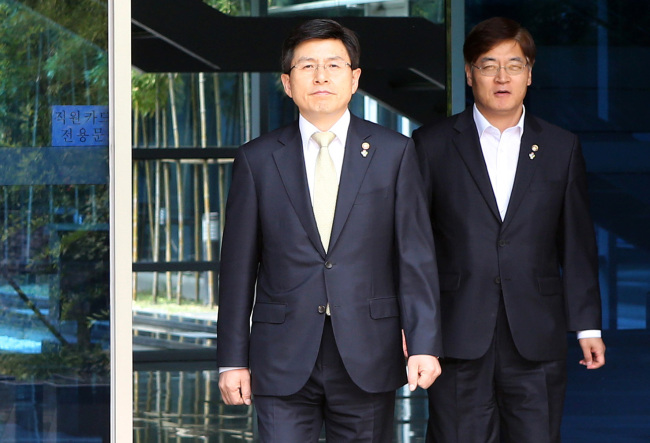
The NPAD had initially opposed holding a vote on Hwang at all, citing allegations against him as well as his reluctance to submit his military and income records during his confirmation hearing earlier this month.
The NPAD only agreed to hold the vote when the ruling party agreed to create a special parliamentary panel in the House Steering Committee that would work to create stricter penalties against future nominees who refused to submit their military and income records.
In his first speech as prime minister, Hwang is also expected to express regret to appease the NPAD hard-liners, ruling party officials said.
But key NPAD lawmakers said they would vote against Hwang at Thursday’s full session, hinting that an all-out boycott by the main opposition party could be avoided.
“I will try to convince our party’s lawmakers to attend the vote and express their opposition by casting votes against (Hwang),” said NPAD Rep. Lee Choon-suak, the NPAD’s senior deputy floor leader.
On top of Hwang’s nomination, the main parties are divided on multiple issues including recent revisions to the National Assembly Act. The changes propose allowing lawmakers to “request” changes to government edicts that appear to violate existing laws.
But President Park Geun-hye has threatened to veto the amendments, saying they violated the principle of checks and balances in the government.
Pro-Park legislators in the Saenuri Party back the president, saying the president has the authority to veto possibly unconstitutional bills. Some Saenuri and NPAD lawmakers strongly oppose the president’s veto, saying the parliament should be ultimately in charge of the legislation process.
By Jeong Hunny ()
koreaherald@heraldcorp.com