President Park Geun-hye enters the third year of her five-year term on Wednesday amid deepening public distrust in her leadership, an escalating feud with her ruling party and repeated failure in personnel appointment.
In her second year in office, Park strived to initiate a series of reform drives to revive the nation’s sluggish economy, to tear down abnormal practices in society and to create a better tomorrow for future generations.
The president has also been calling for public support for her reform drive, stressing that the New Year is the “last golden time” to push ahead with the plan. Contrary to her wishes, Park now faces a political crisis with questions building over her authoritative, top-down leadership, which remains unchanged despite constant demands from the public.
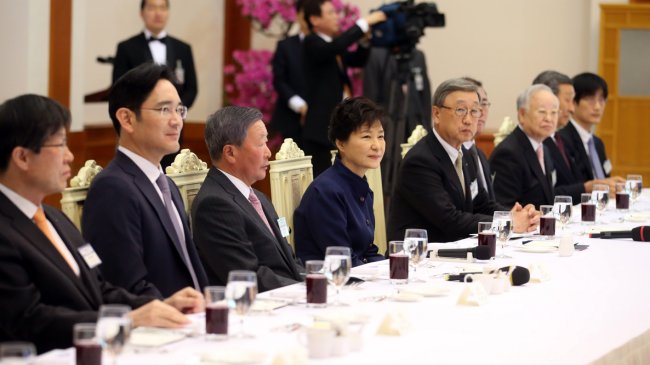
A series of political scandals involving conflicts between groups of aides as well as the government’s inconsistent policies on tax and health insurance has damaged her credibility.
Presidential documents were leaked to media late last year, raising speculation over lax discipline within Cheong Wa Dae. Park also came under fire after she refused to abandon her aides involved in a related influence-peddling scandal.
She continued to struggle over her tax policies as the government backtracked on its initial plan to revise the tax settlement scheme in the face of public worries that the middle class would have to pay more.
Her approval ratings plummeted to below 30 percent on Jan. 27, the lowest rating since she entered office. According to local pollster Realmeter, her job ratings quickly rebounded to 36 percent last week. But the score is still far lower than when her leadership was questioned in the wake of the Sewol ferry accident.
Critics say that her second year was “full of disappointment,” noting that she should have reached out more to the public and given more leeway to the Cabinet to actively work on her reform drives.
“Park handled foreign affairs relatively well during her second year but failed entirely on home affairs, particularly on her promise to bring about national unity,” said Yoon Pyung-joong, a professor at Hanshin University.
Yoon stressed that the people started to “feel heavy” due to perceptions that she is an uncommunicative leader.
“People have suffered from economic downturns for many years, not just this time,” Yoon said.
“It is the leadership that gives hopes to the people in times of difficulty. But with Park, a president only reads reports day and night alone at the presidential office, people started to feel distanced from her and give up seeking hope from her.”
Last week, Park appointed a new prime minister and conducted a partial Cabinet reshuffle, as part of her efforts to restore public confidence.
With a new lineup, however, the president needs to keep her pledge to share more responsibility with the prime minister and minsters by allowing them greater discretion in decision-making and personnel choices, said Yoon of Hanshin University.
But experts say she may have already lost her opportunity to push ahead with her reform drive.
“I think she put too much focus on diplomacy during her first two years in office,” said Choi Young-jin, a political science professor at ChungAng University in Seoul. Choi lashed out by saying that she enjoyed “Cinderella moments” through introducing her mantra of a creative economy and trustpolitik, the centerpiece of her North Korean policies, during her series of presidential trips.
“She missed the right time to push ahead with her reform efforts and other major agendas such as restructuring the public servants’ pension system and health insurance. Now is too late,“ he said.
Despite the pessimistic views, Yoon Hee-woong, head of public opinion research firm Min Consulting, said it was too early to say she had entered lame duck status.
“The possibility is still high that Park will restore public confidence, as she and her governing party hold a strong and loyal base of conservative supporters,” he said. The Saenuri Party currently holds 158 seats in the 295-strong parliament.
As for inter-Korean relations, Park has been praised for her principled approach to forging a normal state-to-state relationship with Pyongyang ― rather than pampering a recalcitrant North with unconditional largesse.
But she has also been criticized for being inflexible in breaking the prolonged cross-border impasse ― a reason why calls have been mounting for her to be more active in tackling bilateral issues including the issue of families separated by the 1950-53 Korean War.
Inter-Korean tensions have remained high due to the North’s provocative behavior and menacing rhetoric. The North has constantly warned of retaliation against South Korean activists who send balloons filled with anti-Pyongyang leaflets to the North and demanded that Seoul and Washington cancel their allied military drills.
Amid its verbal threats and shows of force, the impoverished North has also demanded that the South lift its economic sanctions against it, resume the long-stalled tours to Mount Geumgangsan and agree to reopen the multilateral aid-for-denuclearization talks without preconditions.
Observers say that Park needs to devise creative options to defuse inter-Korean tensions and forge momentum to block Pyongyang from further developing its nuclear weapons, rather than rigidly calling for sincerity in the North’s denuclearization commitments.
On the wider diplomatic front, Park’s pursuit of improved ties with Beijing has been hailed as foreign policy feat.
In a departure from her predecessor’s excessive focus on enhancing relations with the U.S., Park has sought to deepen and broaden the strategic partnership with China, a crucial partner for trade, tourism and efforts to denuclearize the North.
At the same time, Park has made strong efforts to maintain the traditional security alliance with the U.S.
Through the conclusion of free trade negotiations with China, Seoul has strengthened its economic partnership with Beijing. It has also deepened its security cooperation to cope with the North through bilateral summits and various strategic dialogue channels.
Over the course of just two years, Park has met with Chinese leader Xi Jinping six times and with Premier Li Keqiang once, which analysts say reflects the closer partnership she has built with the emergent Asian power.
But the improved relations with Beijing have also posed a diplomatic challenge to Seoul.
Amid the intensifying strategic competition between the U.S. and China, the South was forced to make tough strategic choices on several occasions.
China has pressured the South not to allow the U.S.’ deployment of an additional missile defense asset to the peninsula and to participate in the scheme to establish the Asia Infrastructure Investment Bank, which the U.S. sees as a move by China to exclude it and lead the regional financial order.
Over recent years, the South’s relationship with Japan has worsened due to Tokyo’s failure to fully atone for its wartime misdeeds including its sexual enslavement of Asian women during World War II. Tokyo’s continued claim to South Korea’s easternmost islets of Dokdo has continued to be a source of diplomatic friction between the two neighbors.
Experts say that although the public antagonism against Japan has worsened, Seoul should continue to pursue practical cooperation in security, business and other areas rather than being bound by the past.
By Cho Chung-un, Song Sang-ho() ()
koreaherald@heraldcorp.com