
The first Korea-U.K. Anti-Corruption Seminar was held in Seoul on Tuesday as part of the two countries’ ongoing efforts to strengthen cooperation in fighting corruption.
Korea and the U.K. have been operating a collaborative anti-corruption project since April this year. The project, which will run until March 2015, aims to share the two nations’ related policies and to increase cooperation between concerned government organizations, and to raise awareness about corruption in both the public and private sectors.
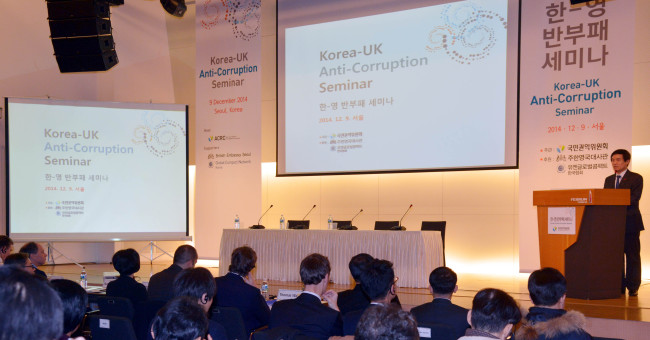
김명섭 기자 msiron@heraldcorp.com Anti-Corruption and Civil Rights Commission chairman Lee Sung-bo speaks at the Korea-U.K. Anti-Corruption Seminar in Seoul on Tuesday. Kim Myung-sub/The Korea Herald
Hosted by Korea’s Anti-Corruption and Civil Rights Commission, the seminar was attended by a number of concerned officials from both sides, with lectures delivered by leading officials.
“In order to execute effective anti-corruption policies, many policies implemented by various countries must be compared and analyzed from multiple angles,” ACRC Chairman Lee Sung-bo said.
“In this regard, today is very meaningful in that it is the first step in strengthening anti-corruption cooperation between the two countries by comparing policies and sharing their know-how.”
The former judge went on to say that despite the ACRC’s efforts to increase transparency and ethical behavior within the public service, the custom of asking for and giving favors remains deeply rooted in Korean society, and that the commission is now seeking legislative means to fight corruption.
Bills the ACRC is currently pushing to have written into law include ones that prohibits favors being asked of public servants, and that toughen monitoring of public finances.
Detective Constable Peter Clark of the London Metropolitan Police’s Proceeds of Corruption Unit, one of the seminar speakers, points out that fighting corruption has implications that go far beyond confiscating ill-gotten wealth and handing out punishment.
Clark was involved in the investigation of James Ibori, a former governor of the Delta State of Nigeria, that led to the confiscation of millions of pounds in assets amassed through corruption.
The case, according to Clark, has had a huge impact on corruption in Nigeria, while at the same time raising London’s image with regard to corruption.
“If you don’t tackle the problem of corruption, it undermines the whole society. It undermines governance, the economic well-being of a country, and the general public will suffer. It is a huge responsibility each country around the world should take and deal with,” Clark said.
Clark also said that fighting corruption “goes hand in hand” with battling poverty, which is the main reason the U.K. government decided to fund his unit.
Regarding how to improve inter-governmental cooperation in fighting corruption, Clark said that the ACRC’s seminar was a step in the right direction.
“These seminars are about meeting people, about who to talk to. You need to have cooperation between countries. If you haven’t got the cooperation then you are fighting a losing battle,” he said, adding that he was able to make valuable connections with Korean officials through the seminar.
koreaherald@heraldcorp.com