Mayor Kim endeavors to turn city into center for high-tech industry, transportation, logistics
Pyeongtaek City, Gyeonggi Province, is stepping up efforts to embrace multiculturalism through an array of programs to boost exchanges among locals and foreigners, as it prepares to host key U.S. military headquarters to be relocated from Seoul and other cities by 2016.
The efforts are led by Mayor Kim Sun-ki, who has pushed to build a global cultural community, where people from home and abroad can mingle together and promote cross-cultural understanding and harmony.
“According to the U.S. military relocation plan, U.S. soldiers will settle here by 2016, amid the increasing influx of foreign spouses and workers. To more actively respond to this, we are preparing to build an exemplary, multicultural city,” he told The Korea Herald.
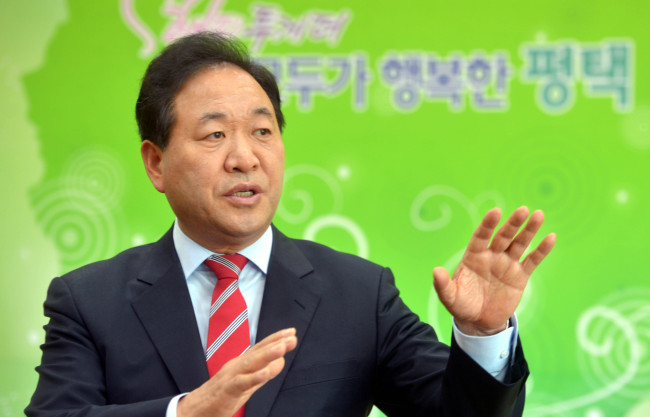
“We plan to create a global cultural zone where U.S. soldiers and their families can enjoy the wealth of cultures here, through which the city could also strengthen the infrastructure for multilateral exchanges and tourism.”
With the plan to designate the area around the K-6 U.S. base, better known as Camp Humphreys, as a global cultural zone, the city has hosted a series of unique events including a cosplay festival as part of its efforts to bridge the “cultural gap.”
In areas near the K-55 U.S. base, or Osan Air Base, the city has formed an international marketplace where foreigners and locals can experience diverse food cultures and purchase clothes and other unique products from various countries.
The planned influx of U.S. military personnel and their families will have a positive economic effect and help bring the city one step closer to the long-cherished status of a metropolis, he said.
“Now, we have a population of around 440,000 and with the influx of U.S. personnel, we will see an increase in population to around 500,000, which is a condition to become a metropolis,” said Kim.
The relocation of the U.S. bases to Pyeongtaek, however, has also raised concerns that the rate of crimes by foreign soldiers could increase.
But Kim was confident that various preventive measures, along with close communication with the U.S. military through various channels, would help address these concerns.
This month, the city and the U.S. military plan to launch an official bilateral consultation group to better communicate with each other. This is in addition to a series of official and unofficial channels to promote mutual understanding, Kim said.
“Like this, we have a host of programs already in place or in the making to minimize any conflicts stemming from cultural differences and strengthen bilateral cooperation and friendship,” he said.
Kim with a doctorate in business administration has also played a critical role in turning the city into a promising industrial hub.
Under his leadership, the city signed a landmark contract to host a major production complex of Samsung Electronics in December 2010. The complex, about 2.4 times bigger than its facilities in Suwon, Gyeonggi Province, is expected to partially begin production in 2017.
In September 2011, the city also signed a contract to expand the production facilities of LG Electronics. The facilities are to begin operation around 2017.
“Another vision I have for the city is to turn it into a high-tech industrial center with two of the world’s top electronics giants running major production facilities here,” he said.
“On top of that, we have a major port and its geographical location links the central and southern parts of the country, and thus boosts its potential as the country’s hub for transportation, logistics and trade.”
As a mayor who has been elected to the post four times so far, he has a “happy together” slogan through which he has underscored the importance of equality among all citizens.
“To realize this vision, I have focused on two crucial principles of public administration ― efficiency and equality. On top of that, I have led the municipality with the holistic and future-oriented perspectives for the long-term development of the city,” he said.
“Another critical point I have focused on is leading an ‘impartial, clean’ administration, which forms public trust for my municipal administration. Last, but not least, I always bear in mind that citizens are at the center of my administration.”
Touching on the U.S. military personnel who will move to the city, Kim expressed hopes that they and the local people can cooperate in creating a new cultural community based on mutual respect and trust.
“We are thankful to them for their dedication to peninsular defense. I hope we can, together, forge a new, beautiful culture here,” he said.
Profile of Mayor Kim Sun-ki ● Mayor Kim Sun-ki, 60, entered public service after passing the national public administration exam in 1980. He has since served for the municipal office of Pyeongtaek as well as the provincial and central governments.
● With citizens’ support for his efforts to develop Pyeongtaek and enhance their well-being, Kim was elected mayor three consecutive times from 1995-2003. In 2010, he was elected again, becoming the sixth mayor of the city.
● Kim has also capitalized on his hands-on experience in municipal administration to further his academic studies and shared that experience with his students. From 2004-2009, he lectured at Pyeongtaek University and Chung-Ang University.
● Kim graduated from the business administration department of Sungkyunkwan University in 1977. He earned his master’s degree in business administration from George Washington University in 1991, and his doctorate in the same major from Chung-Ang University in 2001.
Pyeongtaek at a glance

Establishment: Songtan City, Pyeongtaek City and Pyeongtaek County merged into one city, Pyeongtaek, in 1995
Location: Southwestern Gyeonggi Province
Population: 440,000 including 13,820 foreign nationals
Land size: 457.47 square kilometers
City tree: Pine tree
Future developments:
― Signed agreements to build or expand electronics production factories of Samsung and LG in 2010 and 2012, respectively.
― Yongsan Garrison and U.S. Second Infantry Division to be relocated to the city by 2015 and 2016, respectively.
By Song Sang-ho ()
koreaherald@heraldcorp.com