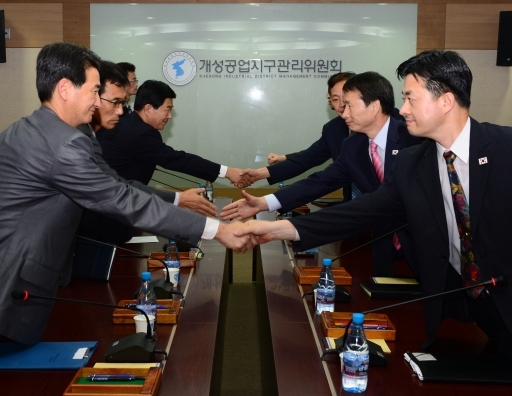
The two Koreas agreed Wednesday to reopen their joint industrial park in Gaeseong next Monday, signing a package deal aimed at improving its operations and attracting overseas firms in the future.
The agreement was reached after talks lasting 20 hours in the North’s border city that will end a five-month suspension of the last remaining symbol of cross-border cooperation.
The delegates issued a five-point statement that outlines plans to set up the panel’s secretariat in Gaeseong this month and install a separate body to settle trade disputes.
The deal also looks to improve efficiency and productivity by adopting an electronic identification system for daily entries of South Koreans and start Internet and mobile phone services within this year.
They also agreed to jointly hold investment promotion events for foreign entrepreneurs next month, according to the statement adopted by an inter-Korean committee tasked with negotiating detailed plans for reopening the factory park.
The South Korean plants will be allowed to resume operations on a trial basis starting Monday. The owners will be exempt from taxes for this year as compensation for the five-month work stoppage, the statement said.
The panel plans to have a third meeting on Monday and its subcommittees are scheduled to gather on Friday, it added.
“This time there was progress in many areas, such as forming a commercial arbitration committee, opening a secretariat, implementing a daily entry system within this year, and providing Internet services,” said Kim Ki-woong, a co-chair of the joint committee and director general of inter-Korean cooperation district support at the Unification Ministry.
“This has significance in that various institutional improvement efforts are making headway, which is vital for the Gaeseong complex to develop into one with an international edge,” he told a news conference in Seoul.
The breakthrough marks the latest sign of thawing relations, though the North remains unwavering in its commitment to develop nuclear weapons.
The two sides restored their military hotlines on the west coast last Friday and are preparing for the first reunions of separated families in three years later this month.
Businesspeople and engineers from state-run power, telecom and water providers have in recent weeks been repairing their facilities that have been idle since the North barred South Koreans’ access and pulled out all its 53,000 workers in early April.
The suspension, which came amid a weeks-long barrage of nuclear threats, was apparently imposed in retaliation for U.N. sanctions over Pyongyang’s third nuclear test and Seoul-Washington military drills. Tension soared sky high, prompting forecasts of a second Korean War and drawing foreign press to Seoul.
Negotiations in Gaeseong have also been riddled with dramatic ups and downs and a heated battle of nerves since the first round in July.
As the gridlock dragged on, Park Chol-su, the North’s chief negotiator, abruptly rushed to South Korean journalists and cried, “the talks are on the verge of collapse.” Seoul, for its part, signaled the complex’s entire shutdown by threatening “grave action” if Pyongyang continued to refuse to cooperate.
The joint committee started as a safeguard against another unilateral closure of the district. With a permanent secretariat in Gaeseong, the 12-member body will set rules and straighten out disputes and errors on a consensus basis.
“After all, it’s a matter of the resolve of each government. From our point of view, we would want to have numerous measures to preclude conflicts or disputes with a written guarantee,” Kim said.
“The joint panel, meanwhile, will serve as a tool to raise, discuss and ultimately resolve any issues, which I believe will help prevent such incidents as those that happened last time.
“If Gaeseong grows into a global industrial park with corresponding institutions and companies, the possibility of such incidents would sharply diminish.”