Last week’s agreement to internationalize the inter-Korean industrial park in Gaeseong has raised hopes for more stability and profitability in its operation. But hurdles lie ahead for the shared goal due to the two Korea’s different calculations and other external factors.
After 133 days of suspension, Seoul and Pyongyang agreed Wednesday to normalize the park and seek to develop it into a globally competitive complex by attracting foreign investors and running it in line with international standards.
By applying international norms and rules, the South seeks to prevent another unilateral freeze of the park by the North and ensure stable operations of its firms free from political influence.
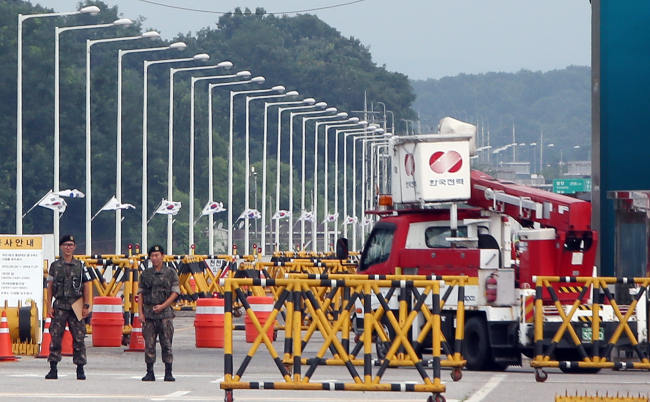
Seoul also believes attracting more foreign enterprises into the reclusive enclave would help prevent an unpredictable Pyongyang from easily backing out of any business deals with investors.
But concerns have risen that the North might push to raise its workers’ wages and taxes for business activities, as well as enhance their welfare including housing facilities in tune with “international standards.”
The average monthly pay for some 53,000 North Korean workers was around $140 each. The North rakes in more than $90 million a year from the park.
“The North could stress transparency in accounting-related issues and call for higher salaries and taxes, which could be a considerable burden given that they run labor-intensive factories there,” said Chang Yong-suk, an analyst at the Seoul National University Institute for Peace and Unification Studies.
Some also argued that North Korean workers could push to establish labor unions like those in most industrialized countries, but Chang dismissed this, saying it was hardly imaginable for the dictatorial regime to allow for autonomous unionized activities.
Above all, the biggest hurdle to globalizing the complex comes from international rules that ban any activities that could help the North further develop nuclear arms and other weapons of mass destruction.
This is why experts say the “internationalization of the park” largely means a “quantitative” expansion of the park rather than diversifying the types of items to be produced there.
“Although it would be cooperation, purely in the economic realm, (political considerations and global sanctions) limit business activities in the Gaeseong complex,” said Yang Moo-jin, professor at the University of North Korean Studies.
“Thus, industries centering on IT, high-tech technologies and strategic industrial items cannot make their way into the complex (due to the possibility that those technologies could be used by the North for military purposes).”
He added that the internationalization of the park would be in the distant future that would come after Washington and Pyongyang normalize ties, and the North reforms its economy and opens up to the outside world.
Among global regulations facing the future of the complex is the “Wassenaar Arrangement.” Aimed at promoting peace and stability, the pact regulates the export of conventional arms and dual-use goods and technologies. Seoul became a signatory to it in 1996.
For Pyongyang, the influx of foreign businesses into the isolated park is a double-edged sword. They could give desperately needed hard currency to the impoverished state, while they could also bring capitalist culture that could threaten the survival of the regime.
But experts largely concurred that Pyongyang was in no position to reject any foreign investment.
“Of course, the Kim regime may feel uneasy about the waves of capitalism that could come from an internationalized park in Gaeseong. But it cannot fend off foreign investment amid worsening economic conditions,” said director of the World North Korea Research Center
“It has been constructing a water park and sky resort ― signs of how desperate it is to gain more foreign currency.”
koreaherald@heraldcorp.com