Two Koreas agree to hold two-day minister-level talks; remain at odds over delegation chief, agenda
Seoul is striving to capitalize on the two-day government talks with Pyongyang, slated to begin Wednesday in Seoul, to restore bilateral ties and begin its peninsular trust-building process in earnest.
Following the 18-hour-long working-level talks that ended on Monday morning, the two Koreas agreed to hold the “high-level” talks, but failed to narrow their differences over the agenda and who would lead their five-member delegations.
Chun Hae-sung, the chief of Seoul’s Unification Ministry’s policy bureau who led the South Korean delegation for the talks, painted a positive outlook for the forthcoming talks, stressing Seoul would work step by step to address issues that were easy to reach agreement on first.
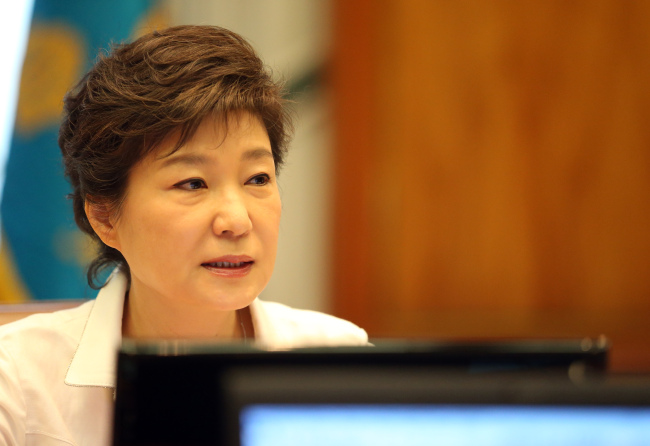
During a meeting of her senior secretaries at Cheong Wa Dae, President Park Geun-hye also expressed hopes that the bilateral talks, which would be the first since 2007, would proceed well in a “progressive” fashion.
But some observers remained skeptical over the talks as the two sides still remain at odds over how to resolve a series of pending issues such as the reopening of the industrial park in Gaeseong and tourism in Mount Geumgangsan.
On top of that, who will lead each delegation was a bone of contention during the working-level talks held at the inter-Korean border village of Panmunjeom.
Seoul demanded that its delegation would be led by Unification Minister Ryu Kihl-jae and the North Korean side should be headed by Kim Yang-gon, the director of the North Korean United Front Department in charge of South Korean affairs.
But Pyongyang expressed opposition, insisting it should be headed by a high-level official ― a reason why what was initially proposed as a ministerial meeting turned into a “high-level” government meeting.
“The North Korean side made the proposal to call the talks a government meeting (instead of a ministerial meeting), and we agreed to that from the perspective that we both seek to set new inter-Korean relations and talks for a new era,” Chun told reporters.
He called the talks a new type of inter-Korean dialogue, adding that the forthcoming talks would be separate from the conventional ministers’ talks.
Issuing two different statements following the marathon working-level talks, the two sides also showed their differences over the agenda.
Seoul’s statement said the two Koreas would consult over “pending urgent” issues such as the resumption of the Gaeseong park, tours to Mount Geumgang and reunions of families separated after the end of the 1950-53 Korean War.
But Pyongyang added to that list issues of jointly holding celebratory events to mark the 13th anniversary of the June 15 South-North Joint Declaration and the 1972 July 4th North-South Joint Statement. Some conservatives here have opposed the joint celebration of the events due to the possibility of their fomenting internal ideological conflicts here.
Pointing out that all these issues would not be settled through this week’s meeting, Chun said the two sides would be able to lead their talks in a “constructive” direction should both sides focus on holding “practical” discussions.
At the upcoming talks, both sides are expected to take caution over the issue of denuclearizing the North as the intractable security issue could hamper the mood for dialogue.
But from Seoul’s perspective, holding talks only about the industrial park and tourism in the mountain resort could draw a public backlash, particularly from conservatives. The talks come after presidents Barack Obama and Xi Jinping clarified their opposition to a nuclear-armed North Korea during their first summit in California last week.
In light of that, observers believe whoever leads the South Korean delegation may touch on the denuclearization issue during a keynote speech and urge the North to return to the long-stalled multilateral aid-for-denuclearization talks.
Park Hyeong-jung, a senior research fellow at the Korea Institute for National Unification, said Seoul is likely to seek to regularize such a government meeting with Pyongyang to boost the trust-building drive.
“Seoul seeks to push forward the bilateral ties through dialogue despite the nuclear issue under the trust-building initiative. So while minimizing tension and presenting a strong opposition to its nuclear armament, Seoul could seek ways to mend fences wit the North by offering humanitarian assistance and others,” he said.
“From the North Korean perspective, it can no longer use the tactic of raising tension at a time when pressure from both China and the U.S. is escalating on it to give up the nuclear program. So it would seek to show to the world that it is trying to improve ties with Seoul, which would help it enhance ties with Beijing and Washington.”
koreaherald@heraldcorp.com