
The six-day ban on the publication of opinion poll results may be insufficient in achieving its aim, with the availability of early voting.
For the first time, the presidential election will include two-day early voting on May 4 and May 5. Some have estimated that up to 15 percent of total voters will cast their ballots during the two-day early voting period, citing early voter turnout in last year’s general elections. In the 2016 general election, about 20 percent of voters took advantage of early voting, with total turnout of 58 percent.
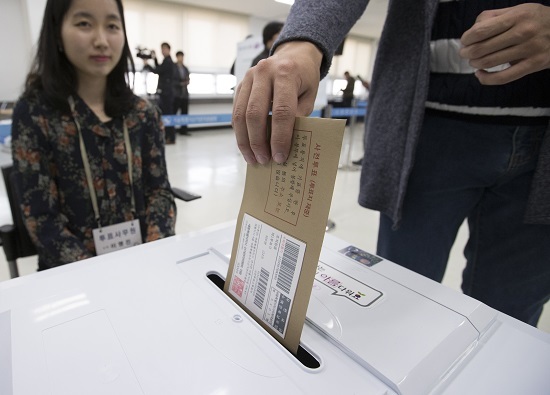
From May 3, the day before early voting begins, the prohibition on the publication of opinion polls takes effect. Under Article 108 of the Public Official Election Act, the results of polls cannot be published from six days prior to Election Day.
The measure is aimed at preventing bandwagon and underdog effects from influencing voters. Although the article has faced criticism, the Constitutional Court ruled in 1999 that prohibiting the publication of poll results for a certain period ahead of an election is not unconstitutional.
In its ruling, the Constitutional Court said the potentially negative effects of poll results are amplified nearer Election Day, saying the concerned parties would lack the time to address unfair or inaccurate poll results.
“For both dates (the May 3-4 early voting and May 9 Election Day), May 2 will be the last date from which poll results are available, so (the object of) the regulation is unaffected,” a National Election Commission official said.
While the NEC sees no problem with the timing of the early voting and prohibition on the publication of polls, the tendencies of voters by region suggest the issue may not be as simple.
Cities and provinces with clear political leanings have also shown higher than average early voter turnout.
While nationally about 12.19 percent of eligible voters voted early in the last general elections, North Jeolla Province’s figure came to 17.35 percent and that of South Jeolla Province hit 18.85 percent.
North Gyeongsang Province recorded early voter turnout of 14.07 percent, while South Gyeongsang Province’s figure was 12.19 percent.
The Jeolla provinces are traditionally left-leaning, while the Gyeongsang provinces have long supported conservatives. In the 2012 presidential election, more than 80 percent of voters from the Jeolla provinces voted for Moon Jae-in of the Democratic Party of Korea. The Gyeongsang provinces went the other way, with 80 percent of North Gyeongsang Province voters choosing Park Geun-hye.
koreaherald@heraldcorp.com


![[Exclusive] Ateez to return in November](https://wimg.heraldcorp.com/news/cms/2026/09/02/news-p.v1.20260902.76162fb0ba55493aad1c076f240d0750_R.jpg?type=h&h=120)