
The Federation of Korean Industries, a lobbying group of leading conglomerates here, apologized Wednesday over the persisting allegation of pulling strings to fund dubious foundations involving a close aide to President Park Geun-hye.
It did not, however, elaborate further on the details, raising suspicions on its alleged connection to the issue and triggering vexed responses from questioning opposition lawmakers.
Lee Seung-cheol, vice chairman of the FKI, attended the parliamentary strategy and finance committee as a witness for the state audit on the political scandal circling the Mir Foundation and K-Sports Foundation.
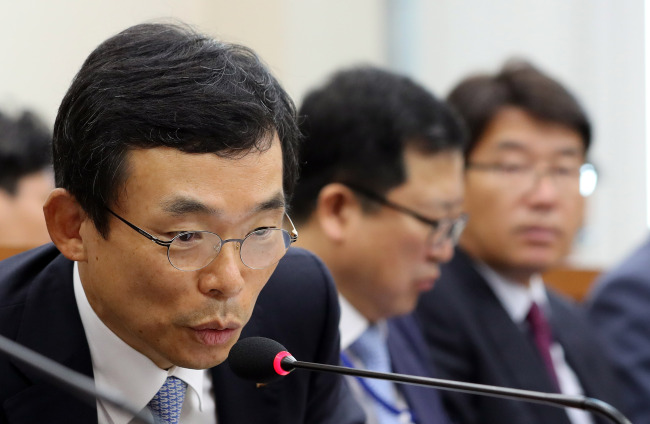
Lee is suspected of being the mastermind behind the establishment of the two organizations which allegedly acted as private fundraising channels for presidential confidant Choi Soon-sil under the slogan of “creative economy.”
Mir and K-Sports, established less than a year ago under the auspices of FKI, raised a combined 75 billion won ($66.8 million) from major conglomerates, including Samsung, Hyundai and LG. The unprecedented amount and speed of the fundraising led to speculation that contributors faced certain pressure.
While opposition lawmakers blasted key witnesses on the launching process of the two foundations, the ruling party mostly defended the FKI’s role as representative arbitrator between the government and the industrial circles.
It was Rep. Park Young-sun of the main opposition Minjoo Party of Korea who spearheaded the inquiry, pushing Lee to clarify his alleged connection to Cheong Wa Dae.
“Where did you get the idea (of establishing the two foundations) and how do you talk to Senior Presidential Secretary for Policy Coordination An Chong-bum?” Park asked during the session.
The lawmaker also raised suspicion that conglomerates would not have contributed such a large sum if not without political pressure, thus alluding to the involvement of higher powers.
The FKI official avoided detailed answers, instead simply offering an “apology” on behalf of the federation.
“Regardless of what happened, (I) apologize to the people for causing trouble,” Lee said.
But when asked for more details, he repeatedly claimed to be “unable to answer” as the issue is currently under prosecutorial investigation.
This immediately provoked protests from opposition lawmakers who pointed out that witnesses on parliamentary floors are obliged to answer.
In a clear contrast, Rep. Park Myung-jae of the ruling Saenuri Party claimed the FKI’s role as fundraising mediator was legitimate and the two disputed foundations have been free from political clout.
“The FKI is practically the only organization which may coordinate and represent the industrial circles in major agendas and for this reason has always been subject to criticism from the opposition,” the Saenuri lawmaker said.
Meanwhile, the federation faced a growing pressure to disband, with some of its significant members gesturing at defection.
Of them is Sejong Center for the Performing Arts, funded by the Seoul Metropolitan Government, which on Wednesday announced its withdrawal from the FKI, citing the recent controversies.
CEOs of key state-run banks -- Korea Development Bank, Industrial Bank of Korea and Export-Import Bank of Korea -- also said earlier this week they are considering doing likewise.
“The disbandment is entirely for the FKI to decide,” said Finance Minister and Deputy Prime Minister Yoo Il-ho during the committee’s audit.
“Even when it comes to public organizations, the government is not entitled to force them to defect.”
Rep. Lee Un-jo of the Minjoo Party that the opposition would unite in submitting a resolution within this week to demand for the voluntary dissolution of the FKI, which she described as a “channel for back-scratching” between the government and the industrial world.
The FKI was established in 1961, supposedly to foster a cozy relationship between big businesses and former President Park Chung-hee, who sought to lift the country out of poverty by supporting big businesses.
By Bae Hyun-jung ()
koreaherald@heraldcorp.com