
[THE INVESTOR] Despite a protracted economic downturn, South Korea’s tax revenues in the first seven months of this year increased by 20.1 trillion won ($18 billion) from a year earlier to reach 150 trillion won, according to recent data from the National Tax Service.
The figure accounts for 67.2 percent of the annual revenue target set by the tax authorities, a 4.8 percentage point increase over the same period last year.
This continuous rise in revenues is attributable to a booming property market, increasing corporate profits and a reduction in tax breaks for companies.
Increasing revenues, however, have not been factored in as opposition parties push to raise tax rates.
The minor opposition People’s Party last month proposed increasing tax rates applied to corporations with annual taxable profits of more than 20 billion won to 24 percent, from the current 22 percent. Its tax code revision bill also called for raising the 38 percent ceiling on income tax rates to 41 percent and 45 percent for individuals who annually earn between 300 million and 1 billion won and those earning more than 1 billion won annually, respectively.
Such proposals marked an about-face from the previous stance that tax rate increases could be considered after efforts to scrap or cut tax breaks were exhausted.
“We have judged that tax rate increases are inevitable to restore fiscal soundness as the budgetary deficit has become chronic under President Park Geun-hye’s administration,” said the party’s chief policymaker Rep. Kim Sung-sik.
The splinter party follows in the footsteps of the main opposition Minjoo Party of Korea that earlier disclosed its own draft revision to the tax code, which proposed raising the maximum corporate tax rate to 25 percent and levying a 41 percent tax on annual personal income exceeding 500 million won.
Opposition parties’ competitive moves toward raising taxes appear aimed at taking the upper hand in the run-up to next year’s presidential election in debates on expanded welfare programs that would require more fiscal expenditure.
The Minjoo Party estimates that its proposal would increase annual corporate tax revenues by 4.1 trillion won, while the People’s Party sees that its bill would result in collecting 2.46 trillion won more from companies annually.
But policymakers in the government and the ruling Saenuri Party remain adamant in opposing tax hikes, which they argue would only undermine efforts to reinvigorate the sluggish economy.
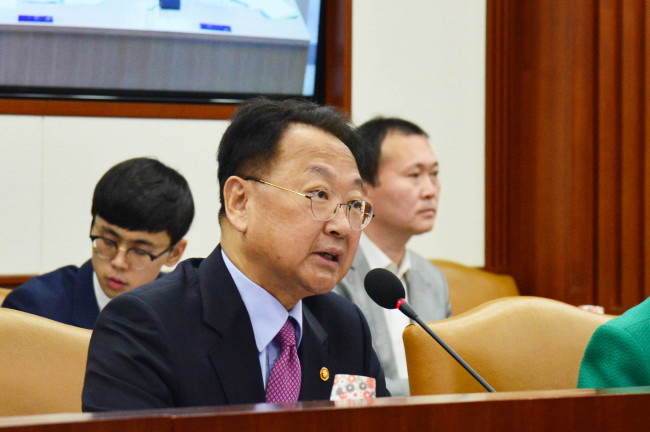
Finance Minister Yoo Il-ho said during a parliamentary audit of his ministry last week that he expects tax rate increases to bring more negative side effects to the economy.
A study by the Korea Institute of Public Finance, a state-funded think tank, forecast that a 1 percent rise in corporate tax rates would reduce annual growth in the country’s gross domestic product by up to 1.13 percent in real terms.
Opponents of a tax increase express concerns the move would cause foreign investors to shun South Korea and push local firms to expand investment abroad. They argue the weakening of economic activities would lead to a cut in tax revenues.
The Korea Economic Research Institute, affiliated with the country’s major business lobby the Federation of Korean Industries, predicts a 3 percent hike in corporate tax rates would cause government revenue to shrink by 2.3 trillion won annually.
Officials at the Ministry of Strategy and Finance say that, if the maximum corporate tax rate is kept at the current level, levies from companies are expected to increase by 6.4 trillion won from last year to exceed 51 trillion won this year and reach 54 trillion won in 2017.
Corporate executives say the increase in corporate profits has resulted mainly from their efforts to reduce costs, not an improvement in the business environment.
An increase in corporate tax rates would also run counter to the worldwide trend of lowering them since the 2008 global financial crisis.
Korea’s ratio of corporate tax to total revenues stands at 14 percent, far above the average of 8.5 percent for the 34-member Organization for Economic Cooperation and Development. The corresponding figures remain at 13.2 percent in Japan, 8.5 percent in the US, 7.7 percent in the UK, 5.7 percent in France and 4.9 percent in Germany.
Some economists are still raising the need to collect more levies from large profitable corporations, which have piled up huge amounts of cash rather than increase investments and wages, to help finance expanded welfare benefits and reduce growing income inequality.
“Over the past decade, tax burdens on corporations have decreased while the ratio of income tax to GDP continues to increase,” said Park Ki-baek, a professor of taxation at the University of Seoul.
The two opposition parties, which combined have a majority in the 300-member parliament, are positioned to pass tax bills compromised between them if National Assembly Speaker Chung Se-kyun decides to put them to a vote as the budget-related bills at the close of the current regular legislative session in December. In a meeting with reporters last month, Chung expressed his intention to do so over objection from ruling party lawmakers.
Many experts say it is time to change the current taxation scheme in such a way the burden of tax increase will be shared by big corporations, the rich and a larger proportion of wage earners.
In this context, they note, the People’s Party has taken the right step by suggesting measures to reduce the proportion of waged workers exempted from taxation, which reaches nearly 50 percent, in its bill.
By Kim Kyung-ho/The Korea Herald ()

![[Exclusive] Ateez to return in November](https://wimg.heraldcorp.com/news/cms/2026/09/02/news-p.v1.20260902.76162fb0ba55493aad1c076f240d0750_R.jpg?type=h&h=120)