
Political parties and the government Tuesday stood at odds over President Park Geun-hye’s recent speech, encouraging North Korean residents to exit the communist regime and seek asylum here.
While opposition circles condemned her remark as “dangerous,” the presidential office asserted -- though indirectly -- that it was a necessary and strategic move in the increasingly tense inter-Korean power struggle.
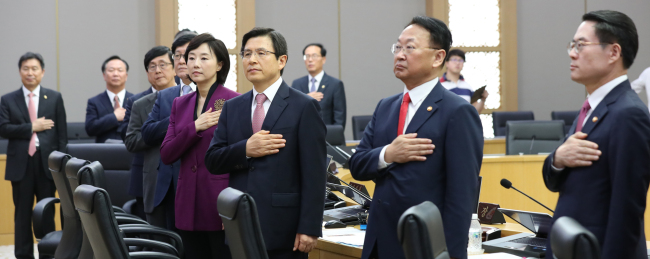
On Saturday, marking the nation’s Armed Forces Day, Park urged the North Korean regime to give up nuclear development and its residents to come “find hope and new lives” in the South.
The comment, seemingly inviting North Koreans to defect, triggered vexed responses from the communist regime.
“(Park) is shameless to overlook the South‘s (negative) reality and speak of ‘defection’ so out loud,” said the North’s official Rodong Sinmun in an editorial Sunday.
“President Park’s words, encouraging North Koreans to defect to the South, are extremely dangerous,” Rep. Woo Sang-ho, floor leader of The Minjoo Party of Korea, said in a party meeting.
The main opposition whip claimed the president thus implied the intention of “bringing down” the North Korean regime, deviating from the original pledge to promote communication and cooperation between the two Koreas.
Rep. Woo also pointed out that a sudden fall of the North Korean regime would inevitably lead to an excessive influx of refugees and the consequent burden upon Seoul.
Rep. Park Jie-won, interim chief of the runner-up opposition People’s Party, echoed the concerns, though he added with precaution that the South needs to ready itself for such a possibility.
“We should always have a contingency plan, should the North Korean regime fall and its residents defect en masse,” he said. “But never, under any circumstances, should we deliberately create such circumstances.”
The ruling conservative Saenuri Party supported the president, stressing that the disputed remark was only an expression of sympathy for North Korean residents.
“North Koreans, too, are nationals of the Republic of Korea as defined by our Constitution,” said floor leader Rep. Chung Jin-suk. “Should they face political and economic difficulties, the (South) Korean government should step up to protect them.”
The president’s intention was to actively embrace those who seek asylum here, not to forcibly bring residents from the North to the South, he added, blaming the opposition for egging on the political quarrel.
The Unification Ministry reiterated the ruling party‘s stance.
“(The president’s remark) was merely to point out the poor human rights situations faced by the North Korean residents, as well as the regime liability for such reality,” a ministry official told reporters.
Cheong Wa Dae remained at a distance from the bipartisan battle of words, refraining from directly commenting.
It did, however, allude to its stance through spokesperson Jung Youn-kuk by pointing to an editorial in the Wall Street Journal titled “Liberating North Koreans -- mass defection may be the key to regime change in Pyongyang.”
“The US hasn’t been able to stop North Korea’s nuclear program, so bravo to South Korean President Park Geun-hye,” said the US-based daily.
“(President) Park deserves credit for ending the last vestiges of the Sunshine Policy, the appeasement of Pyongyang begun under President Kim Dae-jung in 1998.”
The editorial also commended Park for shutting down the Kaeseong industrial park, a facility that yielded some $100 million per year, purportedly funneled into the North’s nuclear ambitions.
By Bae Hyun-jung ()
koreaherald@heraldcorp.com

![[Exclusive] Ateez to return in November](https://wimg.heraldcorp.com/news/cms/2026/09/02/news-p.v1.20260902.76162fb0ba55493aad1c076f240d0750_R.jpg?type=h&h=120)