South Korea's industrial output expanded in September from a month earlier at the fastest pace in more than 15 years, led by chips, data showed Friday, with retail sales and facility investment also gaining ground.
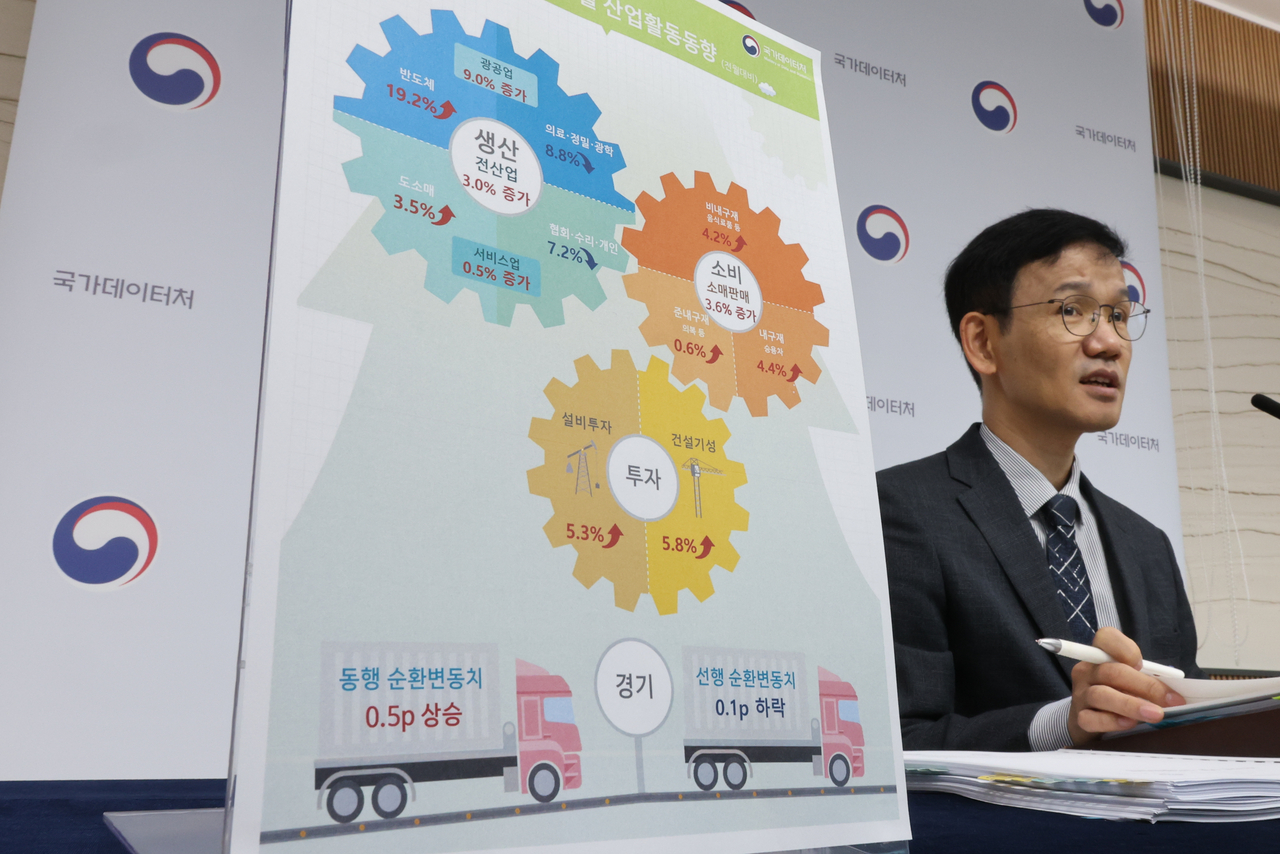
Industrial production rose 3 percent on-month in September, according to data from the Ministry of Data and Statistics. It marked the sharpest gain since the 3.4 percent increase posted in March 2011.
It also marked the first time since June that the three major indicators increased simultaneously.
The overall industrial output grew on-month in June by 2.6 percent, which narrowed to 0.1 percent in July. In August, the output shed 1.2 percent.
Output in the mining and manufacturing sector, a key pillar of the economy, soared 9 percent, the highest in 17 years and seven months, led mostly by semiconductor production, which jumped 19.2 percent. The increase in chip output was the largest since the 28.2 percent gain posted in February.
The data ministry attributed the gains to increased production of memory chips, such as dynamic random access memory products.
Other major gainers included the automobile industry, where output jumped 39.9 percent on the back of increased production of auto parts and hybrid models.
The increase in the automobile sector also came as strikes at local carmakers and the summer vacation season ended.
Production of medical, precision and optical instruments, on the other hand, fell 8.8 percent.
Service output also rose 0.5 percent on-month in September, led by the wholesale and retail segment, along with the transportation and storage industry, which includes maritime shipping.
Retail sales, a gauge of private spending, increased 3.6 percent over the period, with gains made across durable, semidurable and nondurable goods.
Sales of durable goods posted the sharpest growth at 4.4 percent, led by a rise in demand for cars. Sales of nondurable goods, such as foodstuffs, and semidurable goods, such as clothes, also rose 4.2 percent and 0.6 percent, respectively.
"The recovery in automobile sales led (to an improvement in retail sales)," Lee Doo-won, a senior statistics official, said during a press briefing.
"Following (the Chuseok) holiday, sales of nondurable goods such as foodstuffs increased, supported also by major discount events at supermarkets," he added.
Facility investment moved up 5.3 percent on-month in September, the latest findings showed.
Investment in machinery gained 4.7 percent, with investment in transportation equipment also posting a 7.4 percent increase over the period, the report showed.
In a separate release, the Ministry of Finance and Economy said that while there could be some fluctuations in the upcoming report for October, the country's industrial output will nevertheless maintain an upward trend, given solid consumption, business sentiment and exports.
"However, risks also remain, including high oil prices, global interest rate hikes and uncertainties surrounding the US midterm elections," the finance ministry said, noting that such factors are increasing financial market volatility and adding to living costs.
"We plan to make stabilizing living costs our top priority while focusing on three key areas, namely housing, jobs and financial services for vulnerable groups, and identifying measures to address disparities in ways the public can feel improvements," it added. (Yonhap)