
Chung Ki-sun focusing on consolidating core businesses and expanding US shipbuilding ties while betting on AI-driven energy demand
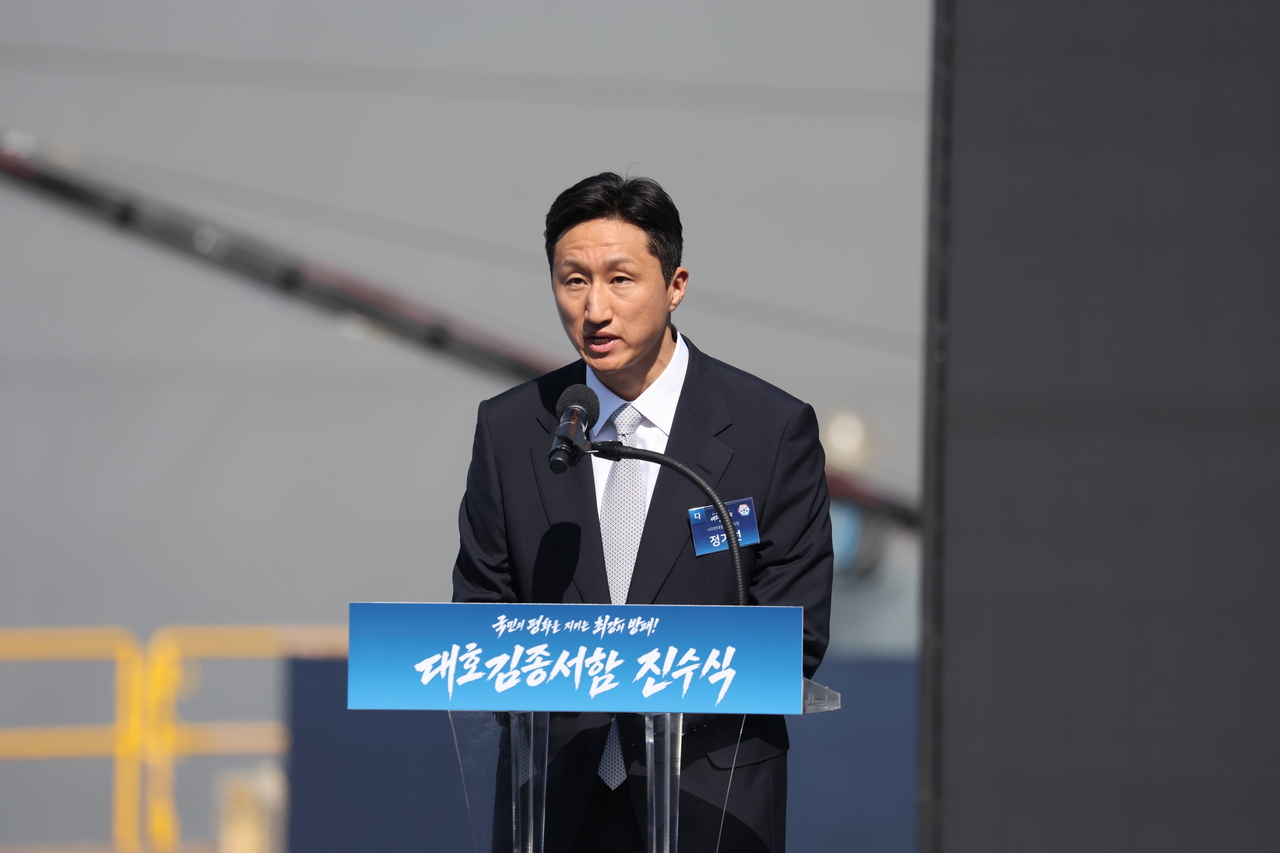
HD Hyundai Chair Chung Ki-sun is set to mark his first year as the helm of the South Korean industrial conglomerate on Saturday, having overseen major mergers, expanded US shipbuilding partnerships and accelerated investment in new growth businesses.
The 44-year old chair, a third-generation member of Hyundai’s founding family, succeeded longtime leader Kwon Oh-gap on Oct. 17, 2025. Kwon became honorary chairman the same day.
Chung's appointment came 16 years after he joined Hyundai Heavy Industries in 2009. Since taking office, Chung has focused on streamlining the group's three core businesses — shipbuilding, construction equipment and energy — while pursuing opportunities beyond its traditional industrial operations.
One of his first major moves was the merger of HD Hyundai Heavy Industries with HD Hyundai Mipo in December, forming an integrated shipbuilder capable of producing vessels ranging from midsize commercial ships to large liquefied natural gas carriers and naval warships.
The consolidation brought together the two companies' engineering, production and research capabilities, with the merged entity targeting annual revenue of 37 trillion won ($27.8 billion) by 2035, including 10 trillion won from defense.
The restructuring has coincided with a stronger push into the US shipbuilding market, as Seoul and Washington deepen maritime cooperation under the "Make America Shipbuilding Great Again" initiative.
HD Hyundai Heavy Industries has been working with US defense technology firm Anduril Industries to develop autonomous surface vessels for commercial and military applications. The group has recently forged a partnership with Kiewit Offshore Services to explore US shipbuilding projects, including domestic fabrication of ship blocks and modules.
Separately, HD Hyundai Heavy Industries has signed an agreement with Huntington Ingalls Industries, the largest US military shipbuilder, to pursue cooperation on naval auxiliary and commercial vessels.
Industry sources say HD Hyundai is also exploring US shipyard acquisitions and equity investments to strengthen its foothold in the market.
Chung has pursued similar consolidation in the construction equipment business.
In January, HD Hyundai Construction Equipment and HD Hyundai Infracore merged to form HD Construction Equipment, bringing the Hyundai and Develon brands under one company. The combined entity is targeting annual revenue of 14.8 trillion won by 2030.
Betting on AI, next-generation energy
Beyond restructuring, Chung has sought to diversify the group's revenue streams by tapping growing demand for artificial intelligence infrastructure and next-generation energy technologies.
In September, HD Hyundai Heavy Industries announced plans to invest 1.07 trillion won in new production facilities for land-based power generation engines and small modular reactors, targeting rising electricity demand from AI data centers.
Of the total, 833.6 billion won will go toward building a new HiMSEN engine production base in Ulsan with an annual capacity of 3 gigawatts. The remaining 238.6 billion won will go toward a plant manufacturing key SMR components, positioning the company to tap demand for carbon-free power generation.
HD Hyundai Electric, the group’s power equipment affiliate, signed a long-term framework agreement in July worth up to 1.12 trillion won to supply power and distribution equipment to a global tech firm for its North American data centers.
Amid strong demand for transformers and other power infrastructure, the company raised its 2026 order target by 22.8 percent to $5.19 billion from $4.22 billion.
It has also expanded its production capacity in South Korea and is scaling up operations in Alabama, aiming to increase its North American ultra-high-voltage transformer capacity by 50 percent.
Challenges ahead
Despite progress in restructuring and diversification, Chung faces mounting challenges as he enters his second year.
Chinese shipbuilders are quickly closing the technology gap with their South Korean competitors, moving beyond standard commercial vessels into higher-value segments such as LNG carriers, an area where Korean firms have long held the edge.
Chung acknowledged these challenges when he assumed office last year.
“The business environment facing our group is extremely challenging, amid an intensifying US-China rivalry, an economic slowdown and industrial overcapacity in China,” Chung said in a message to employees on Oct. 20, 2025.
Labor disputes also remain a concern.
Workers at HD Hyundai Heavy Industries carried out seven rounds of partial strikes during this year’s wage negotiations. Union members then voted down a tentative collective bargaining agreement on Oct.2, with 52.14 percent opposing it, leaving the labor dispute unresolved.
sahn@heraldcorp.com