
Rights group raises concerns over lack of protective measures
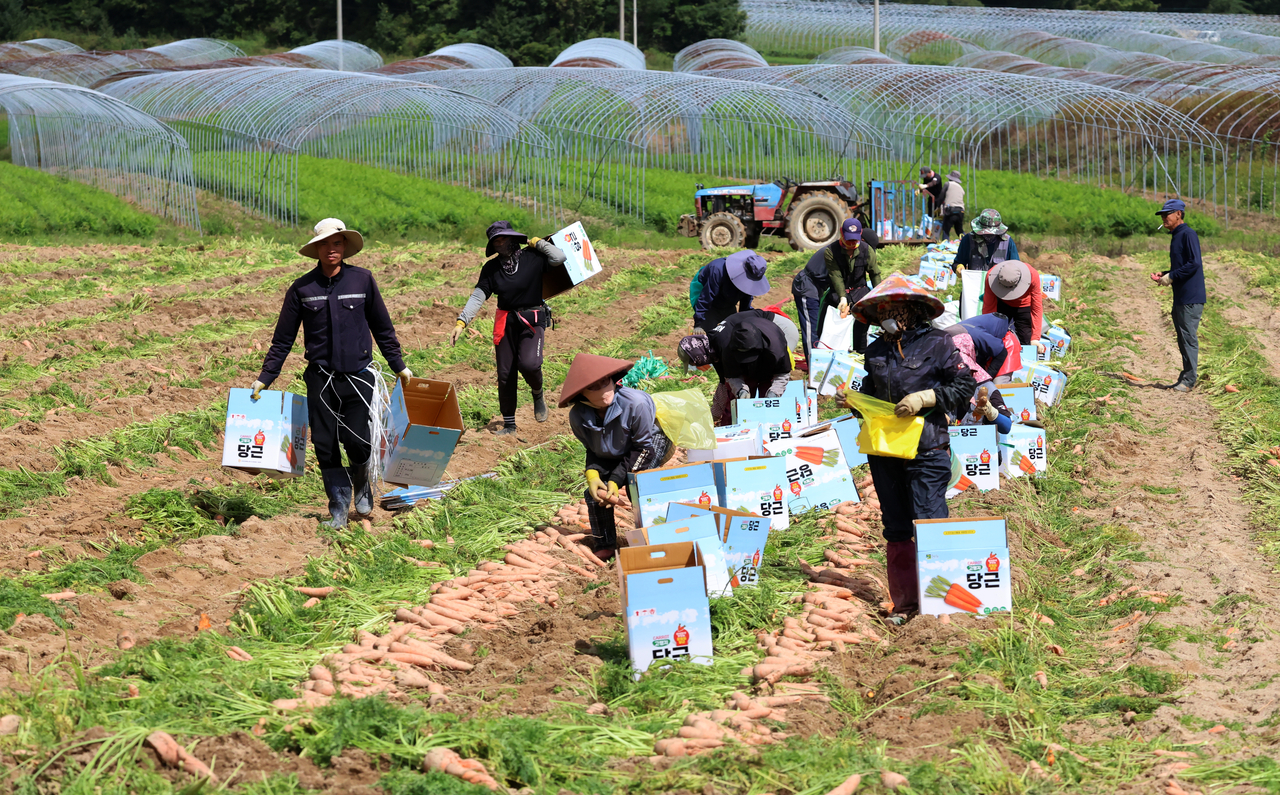
The number of nonprofessional foreign workers on E-9 visas in border regions is growing as much as nine times faster than the national average, data showed Tuesday,
According to Labor Ministry data compiled by Rep. Kim Wi-sang of the People Power Party and obtained by The Korea Herald, the number of E-9 visa holders in 17 administrative divisions along the inter-Korean border came to 35,790 as of August, up 52.4 percent from 23,480 as of the end of 2021.
While the growth rate is slower than the national average of roughly 80 percent over the same period, border regions designated as depopulation areas saw an increase of 118 percent from the end of 2021 until August to 3,307. Of the 17 border regions, nine are designated as depopulation areas.
The E-9 visa, issued to nationals of 18 partner countries, grants the holder permission to work in designated areas including construction, agriculture, livestock, fisheries and hospitality services.
Among the border areas, Ongjin-gun, Incheon, a county that consists of islands close to the North Korean border such as Bangnyeongdo, Yeonpyeongdo and Daecheongdo, saw the steepest rise at 696.4 percent.
It was followed by Gangwon Province's Yanggu-gun at 434.4 percent, Inje-gun at 218.3 percent, Hwacheon-gun with 197.9 percent, and Sokcho with 168.4 percent.
Goseong-gun and Cheorwon-gun, also in Gangwon Province, saw the number of E9 visa workers increase by 160.8 percent and 125.2 percent, respectively. The number of E9 workers in Gapyeong-gun, Gyeonggi Province, rose by 116.3 percent during the same period.
With the exception of Inje-gun and Sokcho, all of the above regions are "depopulation areas" designated by the Interior Ministry.
By nationality, workers from Nepal and Myanmar topped the list, with their combined numbers accounting for a third of the entire E-9 workforce in border areas as of August.
They were followed by workers from Cambodia, Thailand and the Philippines. Workers from the top five countries took up two-thirds of all E-9 workers in the regions.
Protection, rights fall short of increasing reliance on E-9 workers
Statistics show the decline in Korea's working-age population is more rapid in border areas, but its impact has been partly softened by the introduction of more foreign workers.
From 2021 until August, the number of South Korean people aged between 15 and 64 shrank 2.6 percent to 2.22 million in the border areas, while the ratio of E-9 workers to the South Korean population rose from 0.72 percent to 1.09 percent.
Among all 17 border areas, Pocheon, Gyeonggi Province, had the highest ratio of E-9 workers to South Koreans at 3.79 percent, followed by 1.67 percent in Gimpo, Gyeonggi Province, and 1.02 percent in Yangju, Gyeonggi Province.
Despite the increase in the number of E-9 workers and the role they play, measures to ensure their rights remain insufficient, according to a foreign worker rights advocate.
The border area is exposed to threats of not only North Korean provocations but also incidents caused by South Korean military forces.
According to Rev. Kim Dal-sung, a South Korean pastor who leads Pocheon Migrant Worker Center, a Pocheon-based advocacy group, foreign workers have no other options than to continue to work and stay in the region regardless of the conditions as E-9 visa holders have little choice in where they work.
"Under the Employment Permit System, a migrant worker will be unilaterally assigned to a border area, characterized by danger and instability, without having chosen or desired such a placement," Rev. Kim told The Korea Herald.
The EPS is not likely to "accommodate a worker's request to relocate due to safety concerns or anxiety," he said.
Rev. Kim recounted the accidental bombing of a village in 2025 where foreign workers were also injured. Not all of them were eligible for full state compensation based on their visa status.
Some foreign workers are unable to access military exercise alerts due to the language barrier, he said.
"While the military is required to notify residents in advance of live-fire drills, these warnings are issued only in Korean," he said.
"I wish these safety alerts were also provided in various foreign languages such as English so that migrant workers could understand them."
consnow@heraldcorp.com