

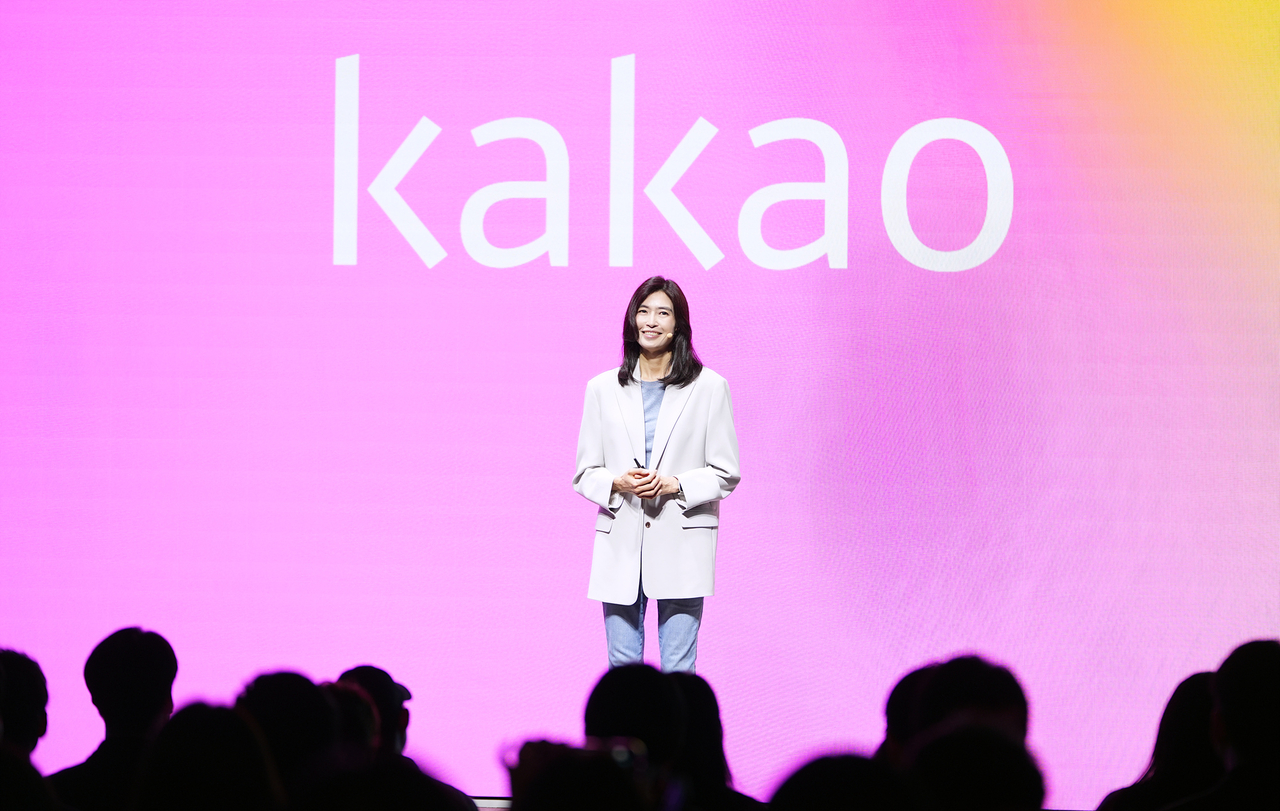
Kakao on Tuesday unveiled an artificial intelligence assistant for its flagship messaging app KakaoTalk as part of a broader push to transform the service into a platform that can handle everyday tasks, from schedule management to shopping and making reservations.
"We want to move from graphical interfaces, where people have to find and tap menus, to language-based interfaces, where they can express what they want and get things done quickly," CEO Chung Shin-a said Tuesday at the company’s annual developers conference, "if(kakao) 2026,” held in Yongin, Gyeonggi Province.
The centerpiece is Kanana Space, an assistant users can summon from anywhere in KakaoTalk with a two-finger swipe. Kakao's Ryan character appears to take voice requests for tasks including sending messages, managing schedules, searching the web and changing app settings. Users can also type requests or use a floating button to open the assistant.
In live demonstrations, Kanana Space recommended what to wear for a morning run based on the weather and past exercise records. It also suggested when a parent should leave to pick up a child using information from a family group chat, marked messages as read and muted notifications on command.
"Rather than adding a separate tab or screen, we designed it as an AI layer that can be opened anywhere without disrupting how people already use KakaoTalk," said Kim Dannion, head of design at the company.
Kakao plans to expand the assistant to shopping, sending gifts, making reservations and transferring money. Payments and outgoing messages will require final user approval, the company said. Preregistration opened Tuesday ahead of a closed beta test scheduled to begin in December.
The company also unveiled Kanvas, a desktop service that lets users build teams of AI agents by describing the work they want done. A closed beta test is planned as early as this year, with access to the agents through KakaoTalk targeted for the first half of 2027. Kakao also plans to support agents built using outside frameworks.
Behind the services is Kanana, Kakao's family of in-house AI models. Its AI Conductor system breaks requests into tasks and selects the appropriate models and tools, using smaller on-device models where possible and more powerful server-based models for demanding work.
"Our principle is to deliver the best possible result for every request, but not to use the largest model for every request," said Roh Byung-seok, who oversees Kakao's foundation model development.
Kakao is also developing Project Mosaic to help different agents draw on relevant information from users' past interactions and work together. The company said information sharing and AI-driven actions would remain within users' consent, backed by additional safety checks.
"The standard for evaluating generative AI is shifting from giving good answers to completing the tasks users ask for," Chung said.
yeeun@heraldcorp.com