
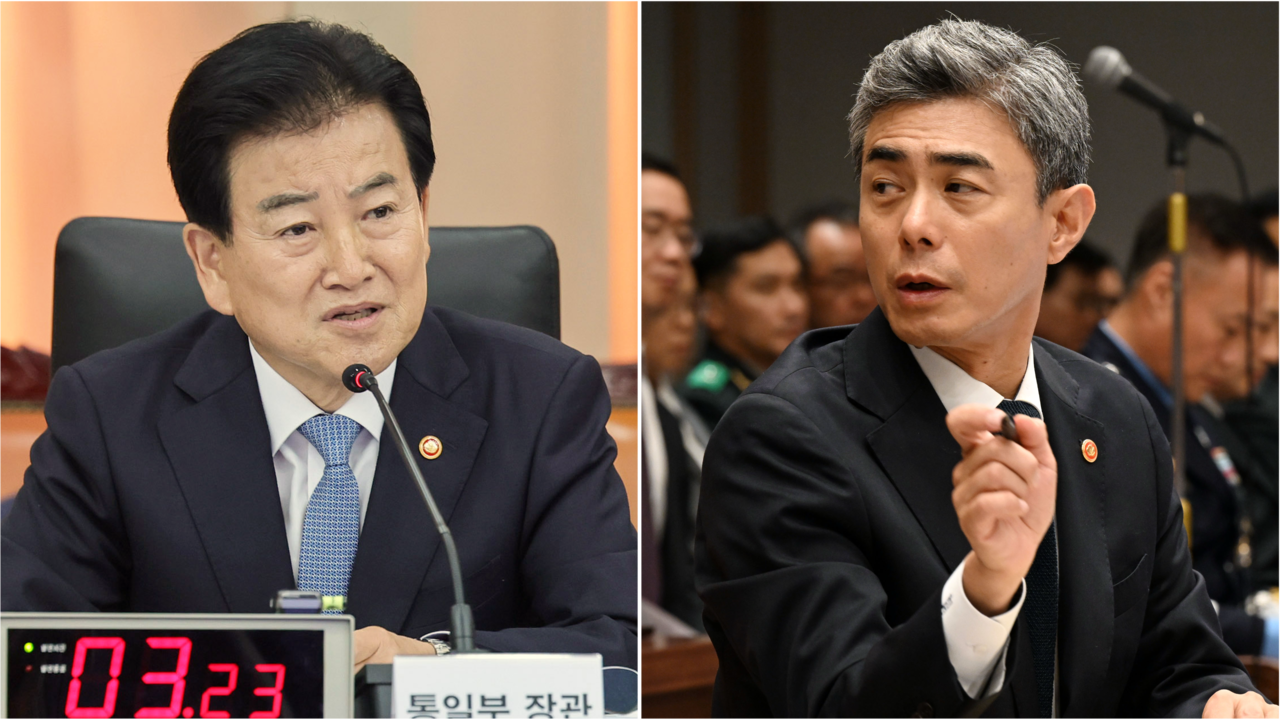
South Korea's unification and defense ministers faced interrogations at National Assembly audits Wednesday over North Korean mines found south of the inter-Korean border.
Lawmakers questioned the government's assessment of Pyongyang's intent and the military's response to explosions that seriously injured three South Korean personnel last month.
Unification Minister Chung Dong-young faced criticism from opposition lawmakers over his reluctance to characterize the Sept. 21 explosions in the Demilitarized Zone as a deliberate North Korean provocation, while Defense Minister Kang Shin-chul was pressed separately over the military's response and follow-up measures.
Controversy has continued over how to interpret the incident even after a joint investigation by the South Korean military and the US-led United Nations Command concluded that North Korean anti-personnel mines had been deliberately planted south of the Military Demarcation Line, the de facto border between North and South Korea.
During the National Assembly Foreign Affairs and Unification Committee's audit at the Unification Ministry headquarters in Seoul, Chung described the incident as an "unfortunate accident" and stressed the need to prevent a recurrence.
But asked by People Power Party Rep. Park Choong-kwon whether the explosions were an accident or a North Korean provocation, Chung said Pyongyang's intent had yet to be conclusively determined.
"There has not yet been a final announcement regarding intent, and basically it is currently defined as an explosion accident," Chung said. "It is still being verified."
The exchange highlighted a distinction at the center of the debate: Investigators have concluded that the mines were intentionally placed at their locations, but whether they were planted specifically to inflict casualties on South Korean troops has yet to be determined.
The Sept. 21 incident occurred in the western section of the DMZ when two explosions injured three South Korean military personnel who were opening a new search route in coordination with the UNC.
Investigators later found North Korean anti-personnel mines south of the MDL, while the UNC concluded that an Armistice Agreement violation had occurred.
Lawmakers also clashed over the Unification Ministry's use of the term "bukhyangmin," roughly meaning "people whose hometown is in the North," in place of the more commonly used term for North Korean defectors.
Park, himself a North Korean defector, criticized the ministry for continuing to use the term despite opposition from some defectors and demanded that it be dropped.
"If you keep calling us 'bukhyangmin,' I will call the unification minister North Korea's spokesperson, or 'Buk Dong-young,'" Park said, drawing objections from ruling party lawmakers.
Land mines and nuclear submarines
At the National Assembly National Defense Committee's audit at the Defense Ministry headquarters in Seoul, Kang said the military believed there may be several other areas south of the MDL with North Korean mines.
Asked by People Power Party Rep. Yu Yong-weon whether hundreds of North Korean mines could remain south of the MDL, Kang said the military believes there are "several" suspected areas and plans to conduct joint investigations with the UNC.
"We plan to conduct joint investigations with the UNC, firmly establish the facts and then continue taking necessary measures," Kang said.
Beyond the DMZ issue, Reform Party Floor Leader Rep. Cheon Ha-ram raised concerns over potential security vulnerabilities posed by connected electronic devices inside military facilities.
Cheon appeared at the audit wearing smart glasses and told Kang that he was recording video during the hearing. He also said he had entered the Defense Ministry compound earlier that day in a Chinese-made BYD electric vehicle equipped with multiple cameras and cellular connectivity.
Asked whether regulations currently restrict such vehicles from entering military installations, Kang acknowledged there were none.
"There are currently no regulations," Kang said, adding that the military would examine institutional and technological safeguards.
Lawmakers also questioned Kang over preparations for South Korea's planned nuclear-powered submarine program.
People Power Party Rep. Yoo Yeong-ha raised concerns about whether the Navy has enough personnel to build, maintain and operate the vessels.
"Thousands are needed, but right now we have only hundreds," Kang said, adding that the military would review personnel development, education and training ahead of the program.
The audit also touched on recent findings that front-line troops had stood guard without live ammunition loaded into their weapons, with the Defense Ministry facing questions over inconsistent ammunition-loading rules and supervision across Army units.
Wednesday marked the second day of South Korea's annual parliamentary audit, which runs through Oct. 27.
flylikekite@heraldcorp.com