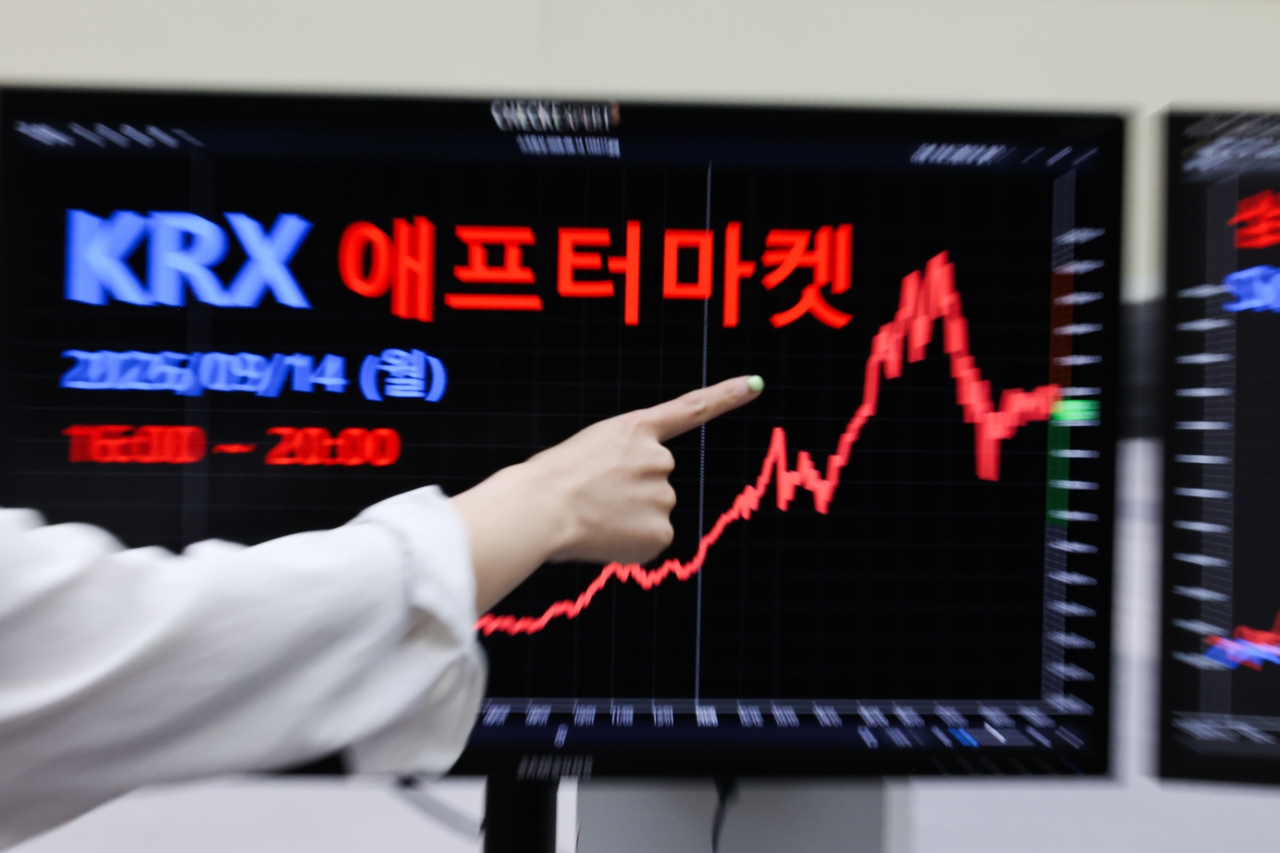
Volatility jumped and price control mechanisms were activated at a much higher level on the first day of after-hours trading on the Korea Exchange (KRX), according to the bourse operator Tuesday.
The KRX launched the after-hours trading from 4 p.m. to 8 p.m. Monday as it seeks to raise global competitiveness and expand trading opportunities for investors.
A total of 72.24 million shares worth 1.8 trillion won (US$1.3 billion) were traded during the four-hour session, compared with some 905 million shares worth 25.8 trillion won traded during Monday's regular trading session.
During the after-hours trading, so-called volatility interruption (VI) mechanisms were activated 1,637 times, compared with 400 times during the regular trading session.
Excluding duplicate cases in which static and dynamic VIs were triggered simultaneously, the figures were 1,112 times during after-hours trading and 391 times during regular trading.
The VI is a mechanism that temporarily switches a stock to a single-price auction for about two minutes when its price moves sharply within a short period, in an effort to curb excessive volatility.
Market watchers attributed the surge in volatility to a lack of liquidity as the KRX expanded the number of stocks available for after-hours trading to 2,459 from 606 on NXT's after-hours market.
Most stocks listed on the Korea Composite Stock Price Index and the KOSDAQ markets are available for trading during the after-hours session.
However, investors are banned from trading exchange-traded funds and exchange-traded notes during the four-hour session, given concerns about market volatility, the KRX said.
Despite the sharp increase in VI activations, the KRX said prices were generally formed in a stable manner. The average high-low volatility by stock was 2.9 percent for KOSPI stocks and 4.6 percent for KOSDAQ stocks during after-hours trading, compared with 4.1 percent and 5.8 percent, respectively, during regular trading.
The KRX said it had applied the same VI thresholds used during regular trading to the after-hours market for stable operations, though after-hours markets generally have lower liquidity and greater volatility.
"We will closely monitor market conditions and actively gather market feedback to help the after-hours market settle in," the bourse operator said in a release. (Yonhap)

![[Room Tone] Monopoly’s less famous cousin](https://wimg.heraldcorp.com/news/cms/2026/09/15/news-p.v1.20260427.66c40f4b14054f6a8c036bfc20e046c9_R.jpg?type=h&h=120)