The head coach of the men's national soccer team at the Asian Games said Monday he will try to capitalize on an opportunity to restore pride in the sport with a gold medal in Japan.
Lee Min-sung and his under-23 national team are pursuing South Korea's fourth consecutive Asian Games gold medal. The team will open Group D play against Qatar at 7:30 p.m. Tuesday at Nagoya City Mizuho Park Rugby Field in Nagoya, central Japan. The second match will be against Saudi Arabia at 7 p.m. Sept. 22 at the same venue.
South Korean soccer in general has been in tatters this year, with the men's senior national team becoming the lightning rod after failing to get out of the group stage at the FIFA World Cup. Lee's U-23 squad struggled at the Asian Football Confederation U-23 Asian Cup in January, falling to Japan in the semifinals and then getting upset by underdog Vietnam in the third-place contest.
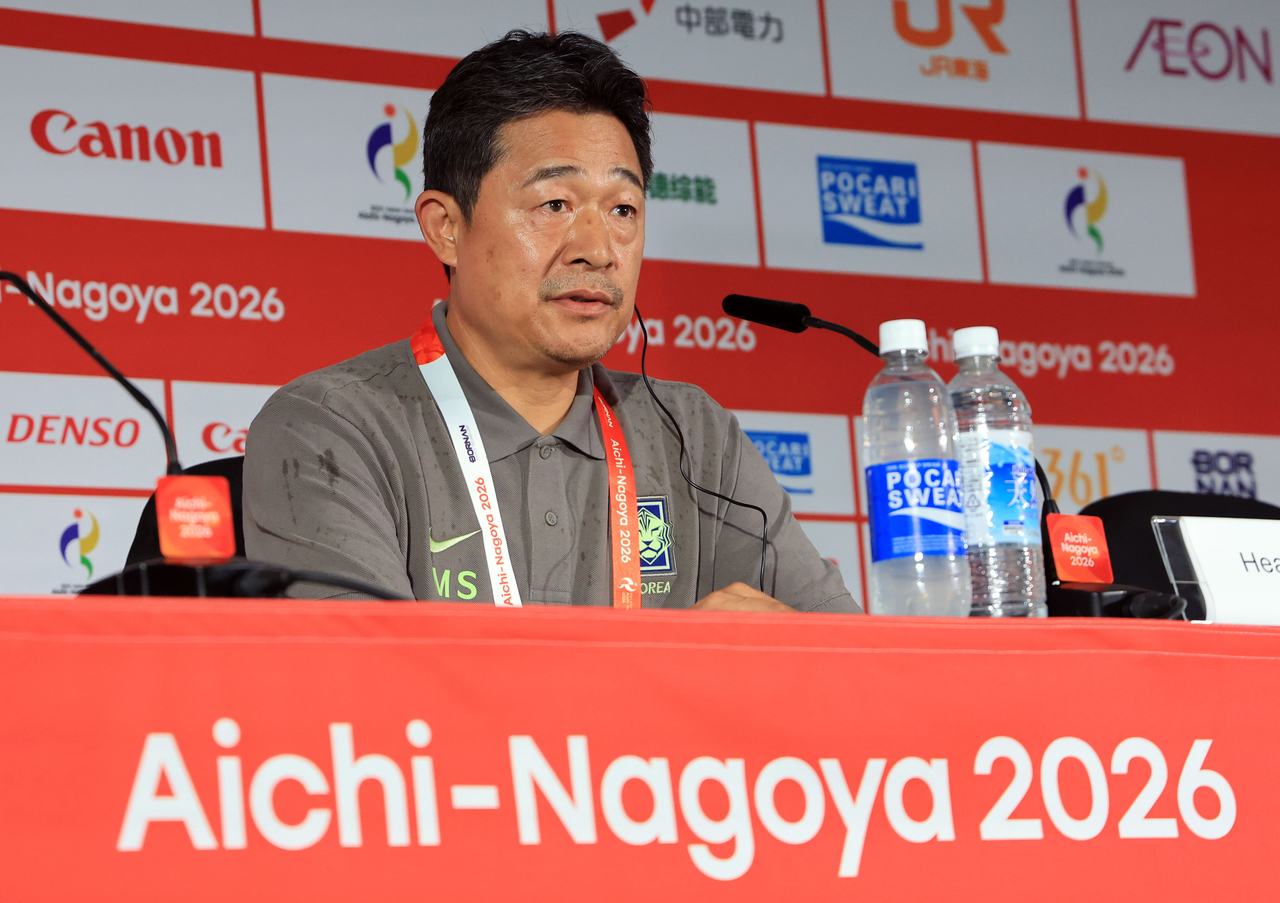
At his pre-Asian Games news conference at Nagoya City Mizuho Park Rugby Field in Nagoya, Lee said he was fully aware of scathing criticism against his team and South Korean soccer as a whole. But he also sought to take it all in stride.
"Over the past 18 months, we have heard much criticism, but I think it will ultimately help us become better," Lee said. "I also think that it is a sign of people's interest in our team. And we will do our best to win the gold medal here so that South Korean soccer can get back on its feet once again."
The men's soccer competition at the Asian Games is open to players under 23, with each nation allowed to take up to three players over that limit.
The South Korean squad here features four members of this year's FIFA World Cup team, three of whom are older than 23 -- midfielder Eom Ji-sung, 24; defender Lee Gi-hyuk, 26; midfielder Yang Hyun-jun, 24; and midfielder Bae Jun-ho, 22.
For this U-23 tournament, 15 nations have been split into three groups of four and one group of three. South Korea, Qatar and Saudi Arabia ended up in that lone group featuring three teams, meaning that they only play two group-stage matches, compared with three by all the other participants.
The top two teams from each of the four groups will advance to the quarterfinals.
"We are fully ready to take on Qatar and Saudi Arabia," Lee said. "I traveled to Qatar to watch some of their players in person. With Saudi Arabia, they mostly have new players compared to the team that we faced twice in October last year. So we will have to watch the Saudi Arabia-Qatar match to get a closer look at those new faces. But their head coach is still the same, and I don't foresee major stylistic changes."
Lee claimed his players will be ready for unpredictable weather in Nagoya. They trained in Shizuoka, east of Nagoya, for a few days earlier this month, mostly in rainy conditions. On Monday, the sky opened up minutes before the news conference before the rain gave way to sunnier conditions.
"I think playing in the rain will help us," Lee said. "The weather cooperated while we were in Shizuoka, as far as preparing us to play in rainy conditions. Our players are feeling pretty confident."
If the South Koreans win Group D, they will face the runner-up from Group C in the quarterfinals at 7:30 p.m. Sept. 25 in Nagoya. But if they finish in second place in Group D, their opponent in the quarterfinals will be the Group C winner at 2 p.m. Sept. 25, also in Nagoya.
The semifinals are set for Sept. 30 at Nagai Stadium in Osaka, some 140 kilometers west of Nagoya. The bronze medal match and the final will be played Oct. 3 at Toyota Stadium in Toyota, about 25 kilometers east of Nagoya.
Lee, whose contract will expire after the Asian Games, said he is trying to cherish each and every day with his team.
"Every day that I spend with these players is really precious," he said. "And once we play Qatar tomorrow, then we will not be able to turn back the time. So we will all try to value every game and do the best we can." (Yonhap)