

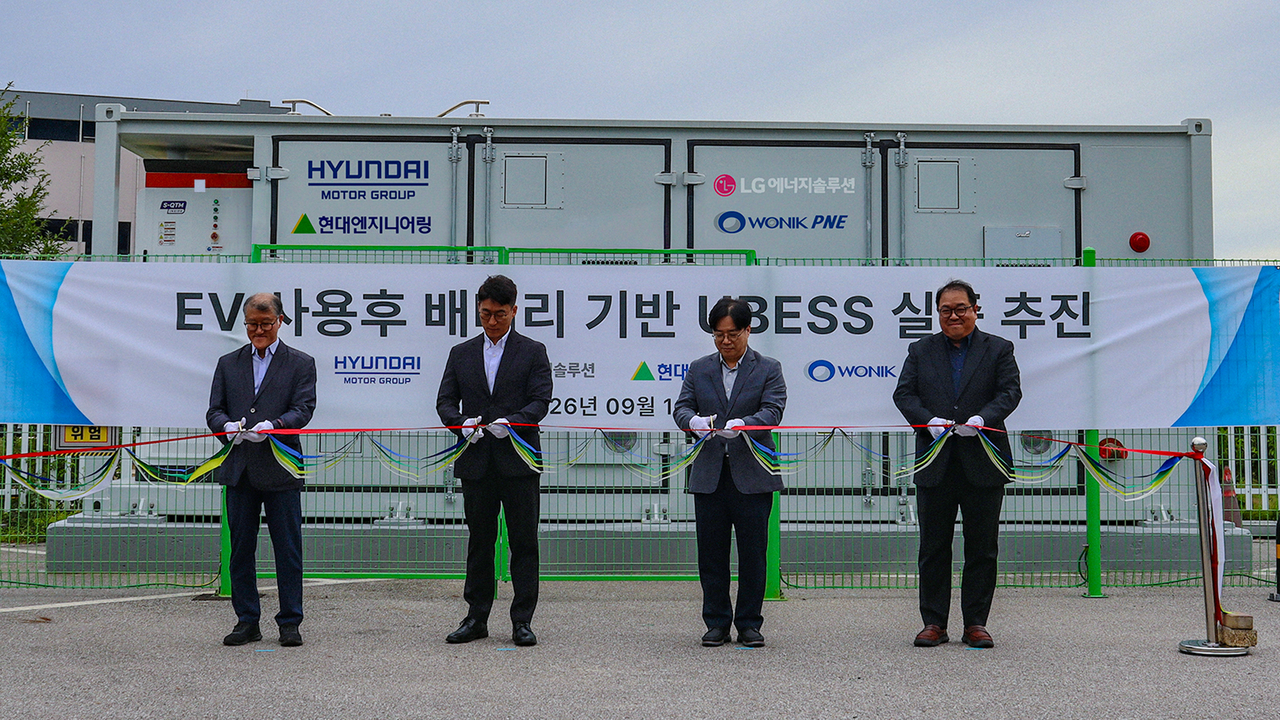
Hyundai Motor Group has joined LG Energy Solution, Hyundai Engineering and Wonik PNE to test an energy storage system that repurposes retired electric vehicle batteries to power fast-charging stations.
The five participating companies — Hyundai Motor, Kia, LG Energy Solution, Hyundai Engineering and Wonik PNE — launched the pilot Thursday at Wonik PNE’s facility in Hwaseong, Gyeonggi Province.
Hyundai Motor Group described it as Korea’s first project directly linking used batteries from Hyundai and Kia electric vehicles to EV fast-charging infrastructure.
The demonstration facility features a 200-kilowatt-hour used-battery energy storage system, or UBESS, built with battery packs recovered from EVs based on the group’s Electric-Global Modular Platform.
The system stores electricity during off-peak hours, when rates are lower, and supplies it to fast chargers during periods of high demand. The approach is intended to reduce pressure on the power grid, lower charging costs and extend the life of EV batteries.
Hyundai Motor and Kia will lead technical verification and develop potential business models. LG Energy Solution will manufacture the UBESS using the recovered battery packs and assess its performance and safety through the company’s battery diagnostic and management technologies.
Hyundai Engineering will evaluate the system’s commercial viability and integration with EV charging infrastructure, while Wonik PNE will oversee equipment operation and technical testing.
The partners will test charging and discharging control algorithms, system safety and reliability, battery performance and charging-service quality under real-world operating conditions.
hyejin2@heraldcorp.com
![[World Class] Dongguk looks to Buddhism, Hallyu and AI to shape global identity](https://wimg.heraldcorp.com/news/cms/2026/10/25/news-p.v1.20261001.4f5f085cfb5d48e7a6af0848b0d5089c_R.jpg?type=h&h=120)