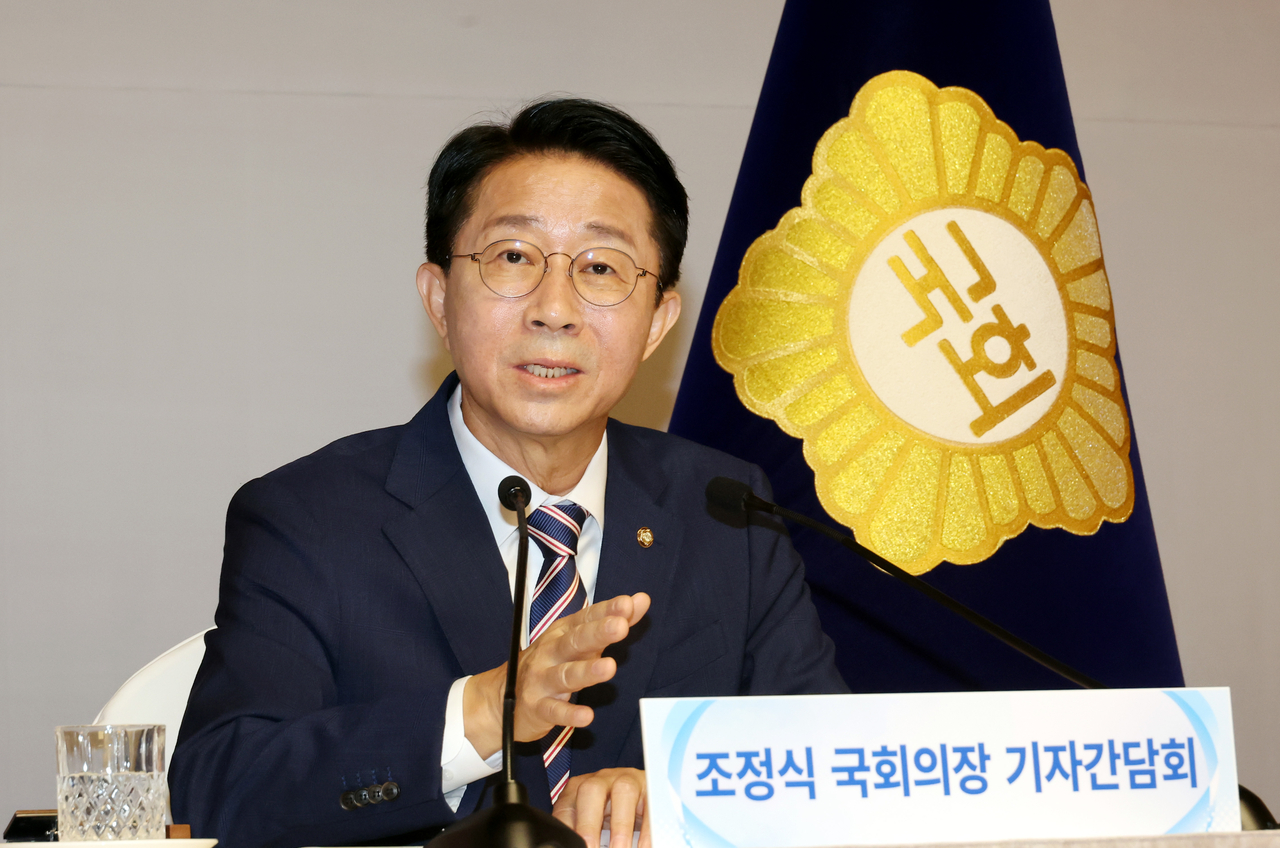
National Assembly Speaker Rep. Cho Jeong-sik said Tuesday that changes to the Constitution that affect the incumbent president's term are "up to the people," hinting at a shift in the ruling bloc's stance on the matter.
In his first news conference since assuming the role of speaker in June, the six-term lawmaker said it would be "premature to discuss" the matter of easing the term limit in the amendment debate, but did not rule out the possibility of doing so.
"I believe these matters are up to the choice of the sovereign citizens," Cho said at the National Assembly in Seoul, adding, "the issue could become a topic later if discussions regarding the power structure arise."
The remarks came in response to a question about whether the amendment is meant to extend Lee's presidential term.
Article 128 of South Korea's Constitution stipulates that any amendment that allows a president's reelection or an extended presidential term shall not apply to the incumbent president.
The ruling Democratic Party of Korea and others supportive of amending the Constitution had taken a similar position, agreeing that any changes to South Korea's presidential term — currently a single 5-year term — would not be applied to the sitting president. But some conservatives have claimed such an amendment could still lead to the extension of Lee's term, should it include changes to Article 128 of the Constitution.
Cho said that reflecting the will of the people would be a crucial element in any amendments, pledging to set up a digital platform through which residents could participate in the process.
South Korea last amended the Constitution in 1987. It provided a foundation for South Korea's democratization and helped end decades of authoritarian regimes under former leaders Park Chung-hee and Chun Doo-hwan.
Since 1987, South Korea has stopped short of reaching a bipartisan compromise for an amendment, as at least two-thirds of all lawmakers' votes are required. Passage in the parliament is considered a crucial step before the amendment proposal is put to a national referendum.
The latest vote, an amendment sought by Cho's predecessor Rep. Woo Won-shik and Democratic Party lawmakers, did not pass parliament in May. The main opposition People Power Party chose not to cooperate with the ruling party, saying the amendment could be used to extend Lee's term.
On Tuesday, People Power Party whip Rep. Jeong Jeom-sig wrote on Facebook that his party would reject requests for cooperation on an amendment aimed at extending Lee's term, adding Cho had opened an "all but useless debate."
Rep. Park Choong-kwon of the People Power Party said Cho's intention of putting the matter of Lee's term extension in the hands of citizens amounts to a "provocation that threatens the constitutional order," accusing the liberal bloc of "hiding behind the pretext of the choice of the citizens."
Cho, however, said he was "more optimistic than pessimistic." He believes 2027 will be the ideal because no national election is scheduled for that year. The next nationwide election will be the 2028 general election.
"We should push forward with the amendment proposal during this period, without rushing, but without delaying," Cho said.
He added he would strive for a bipartisan consensus before the end of next year — in part through the launch of a special parliamentary committee dedicated to a constitutional amendment — and a special advisory council under Cho.
"We still have to wait and see how far the bipartisan agreement could be reached, but I think next year is the golden time," he said.
Lee, as a presidential candidate a month before his election win in June 2025, said in a news conference that amending the Constitution in such a way to change his term limit would be "more in line with the principle of popular sovereignty" if it reflects the will of the people at the time of the amendment.
But Lee also said citizens are unlikely to tolerate a situation in which an incumbent president personally benefits from any Constitutional changes.
Jang Hyun-joo, senior secretary for public relations in the National Assembly Speaker's office, told reporters later on Tuesday that Cho was well aware of the clause in the Constitution to restrict the incumbent president's term extension or rerun for the post, refuting claims that his remarks opened the possibilities of easing Lee's term limit.
consnow@heraldcorp.com