SEOGWIPO, Jeju Island -- Security experts and policymakers called Thursday for a more pragmatic approach to North Korea's nuclear program, arguing that diplomacy must begin from the reality of Pyongyang's growing nuclear arsenal while maintaining denuclearization as the ultimate objective.
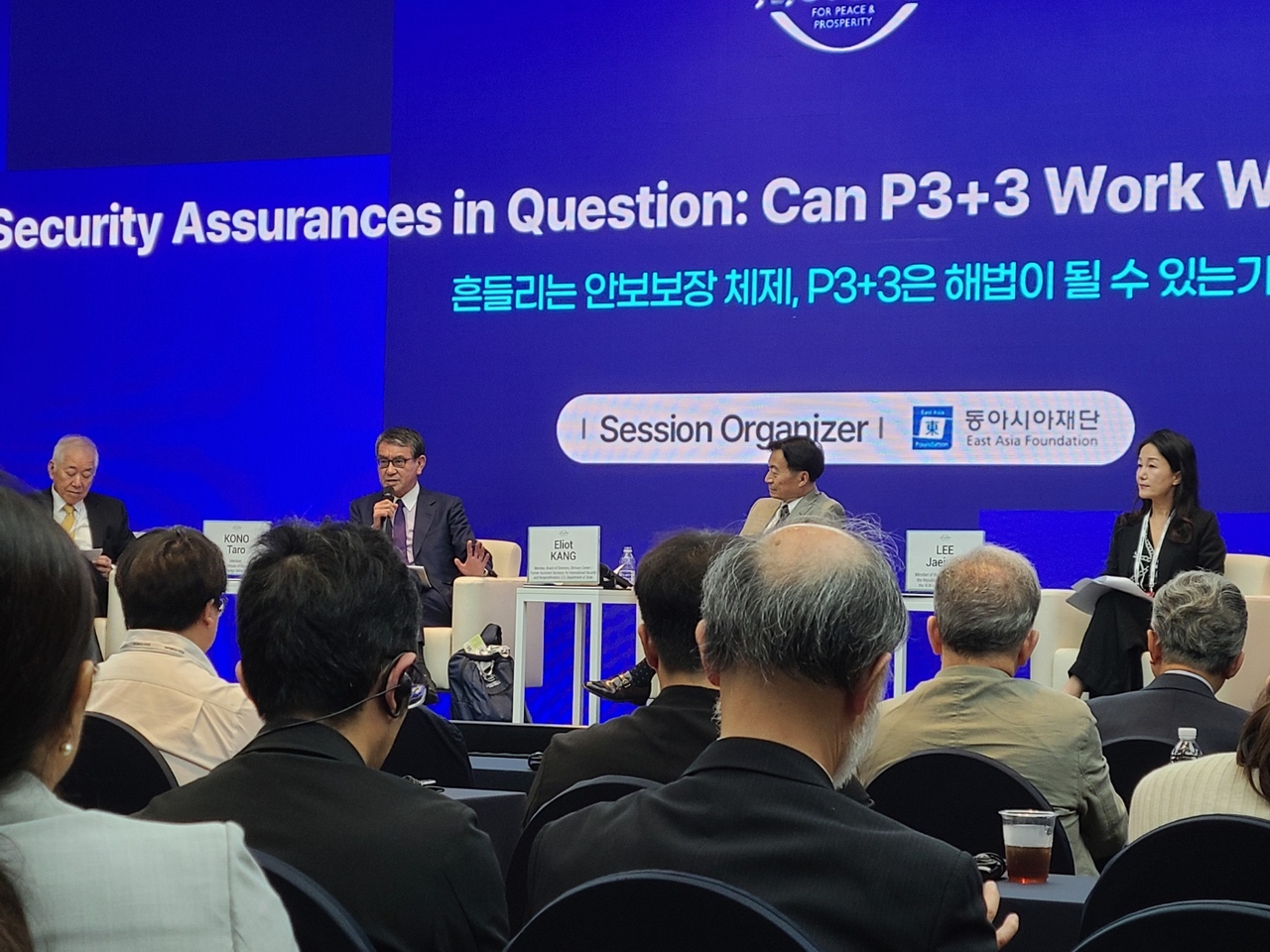
Speaking at the Jeju Forum during a session titled "Security Assurances in Question: Can P3+3 Work When Trust Is Eroding?" the panelists said the rapidly changing security environment in Northeast Asia has made the traditional approach to North Korea increasingly difficult to sustain.
Opening the discussion, Moon Chung-in, a former presidential security adviser and distinguished professor at Yonsei University, said policymakers are now divided among three approaches to North Korea.
"The traditional approach is denuclearization," Moon said. "The second school links peace-building on the Korean Peninsula to the denuclearization process."
"The third approach is that North Korea has nuclear weapons and has repeatedly said it will not give them up," he continued. "President Lee Jae Myung proposed that we cannot deny that reality. Therefore, let us pursue a freeze of North Korea's nuclear activities and then reduction of its nuclear and missile arsenals."
Moon said the discussion reflected a growing consensus that negotiations must acknowledge North Korea's existing nuclear capabilities, even if governments continue to reject Pyongyang's claim to permanent nuclear weapons status.
Former Japanese Foreign Minister Taro Kono argued that abandoning denuclearization altogether would undermine the global nuclear nonproliferation regime.
"Kim Jong-un ... would probably want to keep something to save him or save his family," Kono said. "So it will be more difficult to negotiate with North Korea about nuclear disarmament than Iran."
Kono also warned that sanctions alone are unlikely to change Pyongyang's behavior as long as China and Russia continue providing political and economic support.
"Korea and Japan can put pressure on North Korea, but the pressure can be easily eased by assistance coming from Russia and China," he said. "So we need to create some kind of six-party-talk-like mechanism."
Kono also cautioned against expecting renewed personal diplomacy between US President Donald Trump and North Korean leader Kim Jong-un to resolve the issue.
Speaking during the discussion, Kono said that dialogue between Washington and Pyongyang alone would not be sufficient to address the North Korean nuclear problem and argued that any lasting solution would require broader regional participation involving South Korea, the United States, Japan, China and Russia.
Former US Assistant Secretary of State for East Asian and Pacific Affairs Eliot Kang said that despite growing debate over alliance burden-sharing, South Korea and Japan remain indispensable allies for Washington.
"One thing I could assure you is that the Republic of Korea and Japan are absolutely critical to the security of the United States," Kang said, using the formal name of South Korea. "I don't think there could be any doubt that two of our most important allies in this region would ever be abandoned."
South Korea's ruling Democratic Party of Korea Rep. Lee Jae-jung said that Northeast Asia continues to lack the kind of multilateral security architecture that exists in Europe, making sustained dialogue increasingly difficult.
"Every time there is a North Korean nuclear crisis, a dialogue framework is created. Once the crisis eases, that framework collapses," Lee said. "P3+3 was launched through parliamentary efforts not simply to deal with nuclear issues, but to preserve channels for dialogue."
The discussion reflected growing concern that geopolitical competition among the United States, China and Russia has weakened international consensus on North Korea, with Beijing and Moscow increasingly opposing additional sanctions while Washington, Seoul and Tokyo continue to insist that denuclearization remains the guiding principle of diplomacy.
Wrapping up the discussion, Moon said the panel had broadly agreed that policymakers can no longer ignore the reality of North Korea's nuclear capabilities, even as formally recognizing the country as a nuclear weapons state remains politically and diplomatically untenable.
Moon noted that China and Russia have increasingly opposed additional pressure on Pyongyang, instead advocating the easing of sanctions and treating North Korea as a "normal" state. By contrast, South Korea, the US and Japan cannot abandon denuclearization because it remains a fundamental norm underpinning the global nuclear nonproliferation regime, he said.
Moon also echoed Kono's view that renewed dialogue between Trump and Kim alone would not resolve the issue.
"Even if Trump and Kim resume dialogue, that will not solve everything," Moon said, summarizing the discussion. "We also need some kind of six-party mechanism involving South Korea, the US, Japan, China and Russia."
mkjung@heraldcorp.com