A French teacher's question changed the award-winning pianist's approach to music
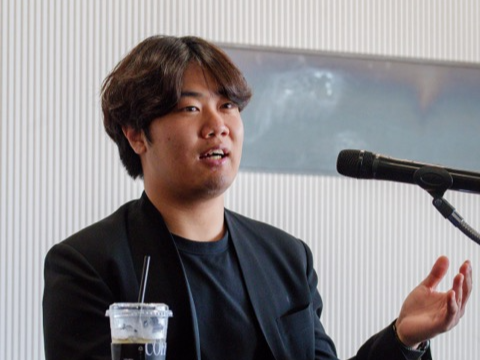
When Sun Youl arrived in France to study, his new teacher had an unusual request: promise not to practice more than three hours a day.
The teacher, French pianist Olivier Gardon, had a question for him too: If you play perfectly, without a single mistake, what are you actually getting out of it? What is all the practice even for?
"The question landed like a hard blow to the head. I realized I had been running like a machine, without even knowing why I practice," Sun told reporters in a roundtable interview on May 28. "I'm an obedient student, so I've kept to three hours a day ever since."
It is less than half of what he once put in: around seven hours a day, and as many as 12 or 13 before a competition.
So how does he fill the gap? He walks for hours, watches people, visits museums and spends more time away from the keyboard, instead reading the score at his desk.
"Music has no right answers," he said, explaining why he no longer compares himself to other players or listens to recordings of the pieces he is studying. "Only the composer knows what was intended."
That broader view of music will shape Sun's year as the Mapo Arts Center's 2026 artist in residence, or M Artist. The 25-year-old musician will give three performances during the year, beginning with a June 4 recital pairing Poulenc's "Fifteen Improvisations" with Liszt's complete "Transcendental Etudes," performing all 12 of the fiendishly difficult studies in one sitting.
The Liszt set is rarely played as a complete set, and was never written to be. Sun chose it anyway. "It demands so much stamina and technique that it wasn't really composed to be played all at once," he said. "But I wanted to take it on while I still can. It felt like it had to be now."
The number 12 was part of the appeal. The etudes are linked by key — each major is paired with its relative minor, descending in thirds across the set — and Sun came to see them as a single tonal arc. "They weren't written to be played in one breath," he said, "but I came to feel they could be."
Sun first drew Korean attention at the 2023 Isangyun Competition in Tongyeong, where he took third prize playing Prokofiev's "Piano Concerto No. 3."
The following year he swept the 2024 Gina Bachauer International Artists Piano Competition in Salt Lake City, Utah — winning gold, plus the audience choice and student jury prizes — becoming the second Korean pianist in a row to take the contest after Shin Chan-yong in 2018, and he won first prize at the Seoul International Music Competition the same year.
This year he placed second at the Ljubljana Festival International Piano Competition, also earning a special prize for his performance of a 20th-century work.
Since the 2024 Bachauer win, he has spent much of his time performing abroad, a demand the once-nervous flyer has grown into.
"I was terrified of flying, but you get used to it," he said. "I'd always dreamed of traveling the world and performing like this, but now that it's actually happening, it's turning out to be far more fun than I'd imagined."
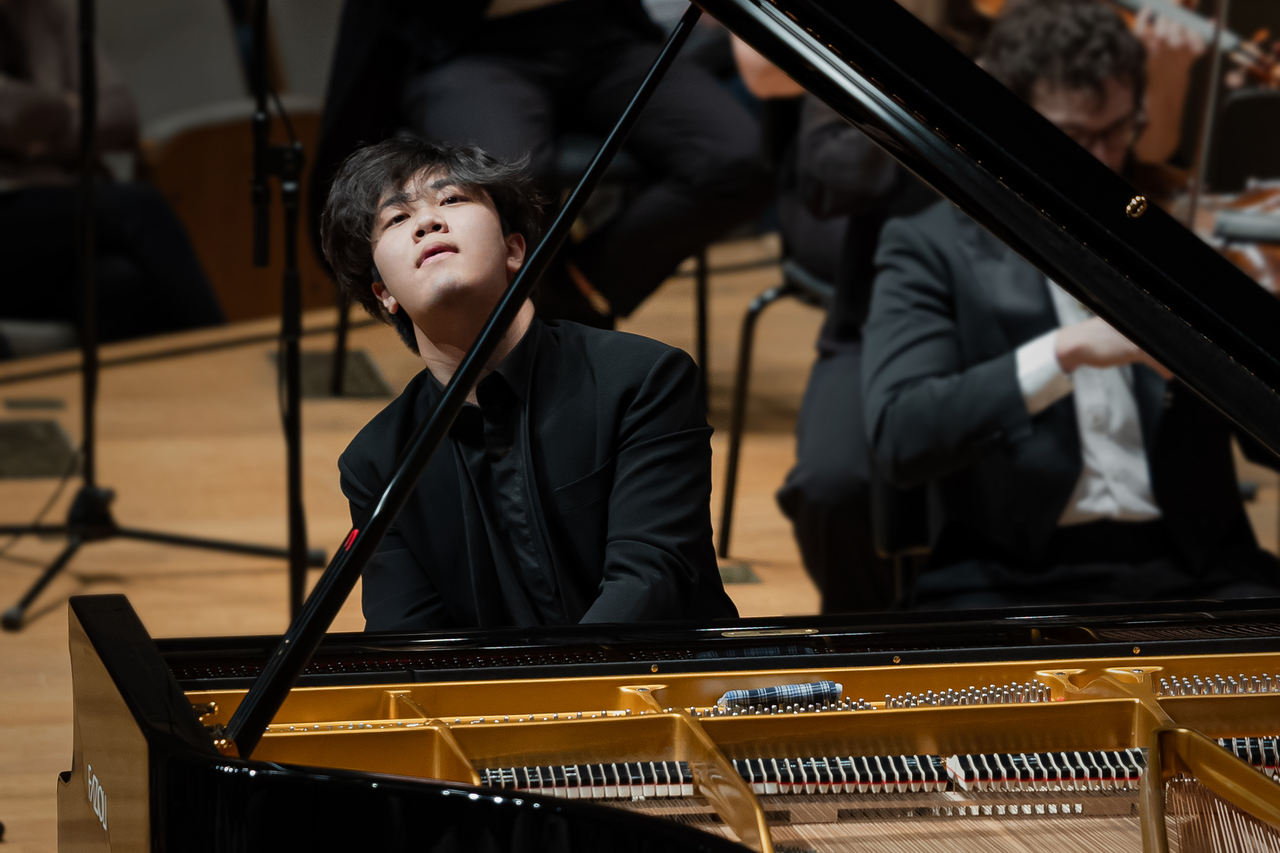
To bestow melody
His name, fittingly, means "melody" in Korean. Read character by character, it unfolds further into "to bestow melody," with "Sun" meaning "to give" and "Youl" signifying "tune."
One might assume his parents named him with the idea of raising a musician, but Sun says his mother simply loved the character Youl, long before she ever met a man surnamed Sun.
Sun's own path to the piano began in childhood, around 2010, when he was about 10. His father, a classical music lover, regularly took the family to weekend orchestral concerts, and two performances left a mark: a Beethoven concerto by Kim Dae-jin — later his teacher at the Korea National University of Arts — and a Seoul Arts Center program in which the veteran pianist Paik Kun-woo appeared with several younger players. Sun first touched a piano at 7 or 8, but those concerts were what made him beg his parents to let him become a pianist.
Sun trained at the Korea National University of Arts, entering through its gifted-student program, before moving to France in 2022. There he studied at the Schola Cantorum in Paris and the Ecole Normale de Musique de Paris, where he now works with Gardon. He is supported as an arts scholar by the Hyundai Motor Chung Mong-Koo Foundation.
What he wants, increasingly, is to broaden what audiences hear. Classical music draws more listeners than it used to, he says, but the repertoire on competition and concert stages still circles the same handful of names.
"No work is worthless," he said, arguing that lesser-known composers, women composers and figures who sit on the border between classical and jazz all deserve a hearing. "Classical is the broadest genre there is. I'd like people to enjoy a wider range of it."
One cause is close to home. At the Seoul International Music Competition, Sun encountered "Pansori Fantasy," a work by the Korean American composer Kim Texu built on pansori, the Korean narrative-singing tradition, with its characteristic janggi rhythms written into the piano part.
Playing it, he says, he felt "han," the particular Korean sense of deep-seated sorrow, for the first time at the keyboard. He later wrote to Kim asking to keep the piece in his repertoire. "I want people to know that beyond K-pop, Korea has wonderful classical composers too," he said.
gypark@heraldcorp.com