At Venice Biennale, the Hong Kong-based artist transforms mythology, astronomy and titanium into a meditation on humanity in the age of AI
Korea Herald Correspondent
VENICE, Italy -- Climbing the spiral staircase of Palazzo Contarini del Bovolo reveals a panoramic view of Venice’s rooftops and bell towers. Less crowded than the city’s major tourist landmarks, the 15th-century structure — often described as one of Venice’s hidden gems — once also served as an astronomical observation point.
“German astronomer Wilhelm Tempel, using a telescope here, made an important discovery of a previously unknown comet and nebula,” said James Putnam, curator of “Wallace Chan: Mythos,” referring to the 19th-century astronomer.

“The city was once a major center for high-quality lens production, and the optics available here were crucial for Galileo to develop his improved telescope that he gave to the Doge of Venice in 1609.”
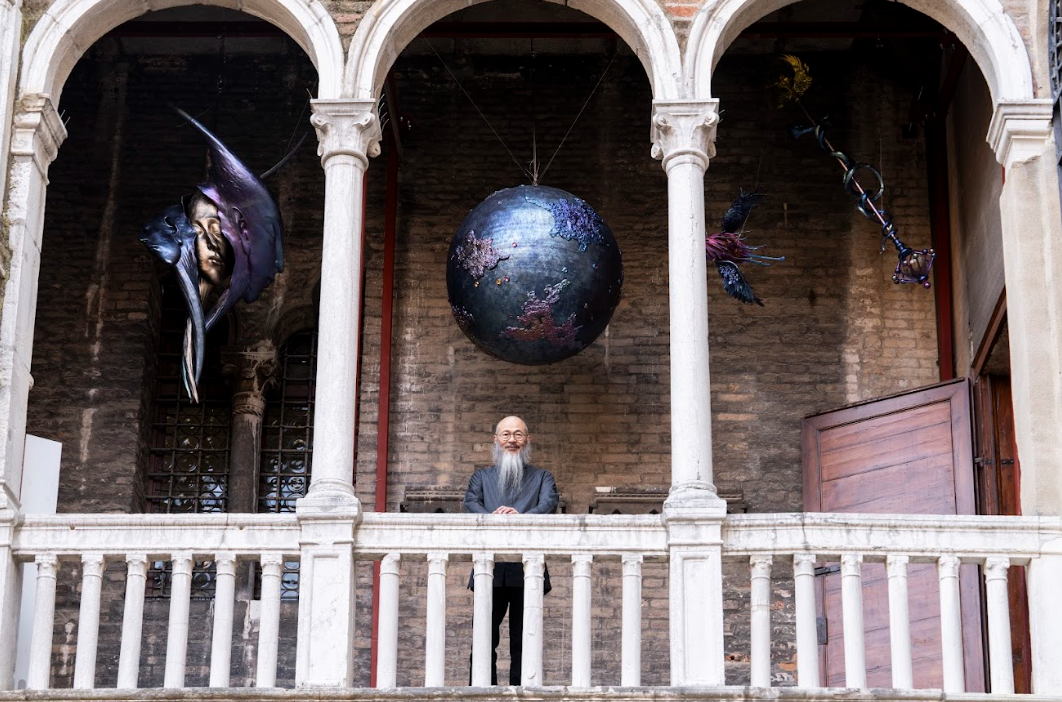
Installed throughout the tower, the exhibition “Mythos” by Hong Kong-based Chinese jewelry artist and sculptor Wallace Chan transforms the historic site into a meditation on mythology, astronomy and technology during the 2026 Venice Biennale.
Three floating titanium sculptures suspended within the tower draw inspiration from Jacopo Tintoretto’s 16th-century painting “The Three Graces and Mercury” in Venice’s Doge’s Palace. Chan reimagines the three mythological goddesses as abstract suspended faces that appear to chase one another in circles.
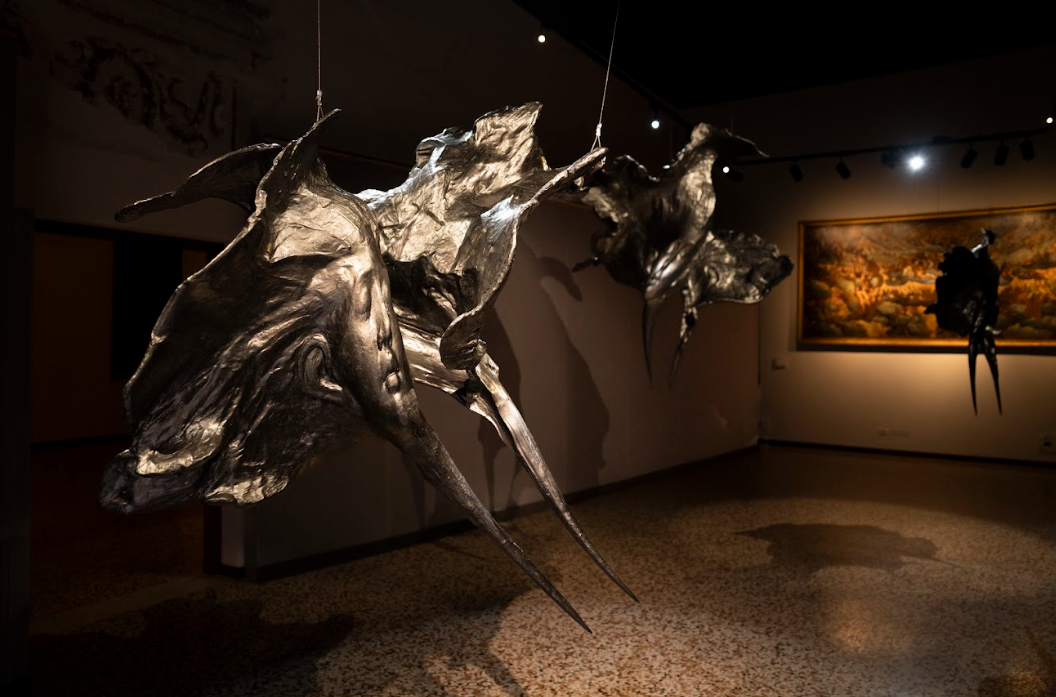
“I am very much inspired by the Greek myths,” Chan told The Korea Herald on May 7, explaining that the rotating forms of the sculptures were intended to evoke planetary motion. “They are also in a spinning motion, just as the universe spins and the planets revolve.”
Another hanging work, Chan’s Mercury sculpture, merges mythology with astronomy. Rather than depicting the Roman messenger god in human form, Chan reimagines Mercury as a floating celestial sphere suspended from the tower.
“You can go up to the top and see all of Venice from above,” Chan said. “So it’s kind of like seeing the universe in a sense.”
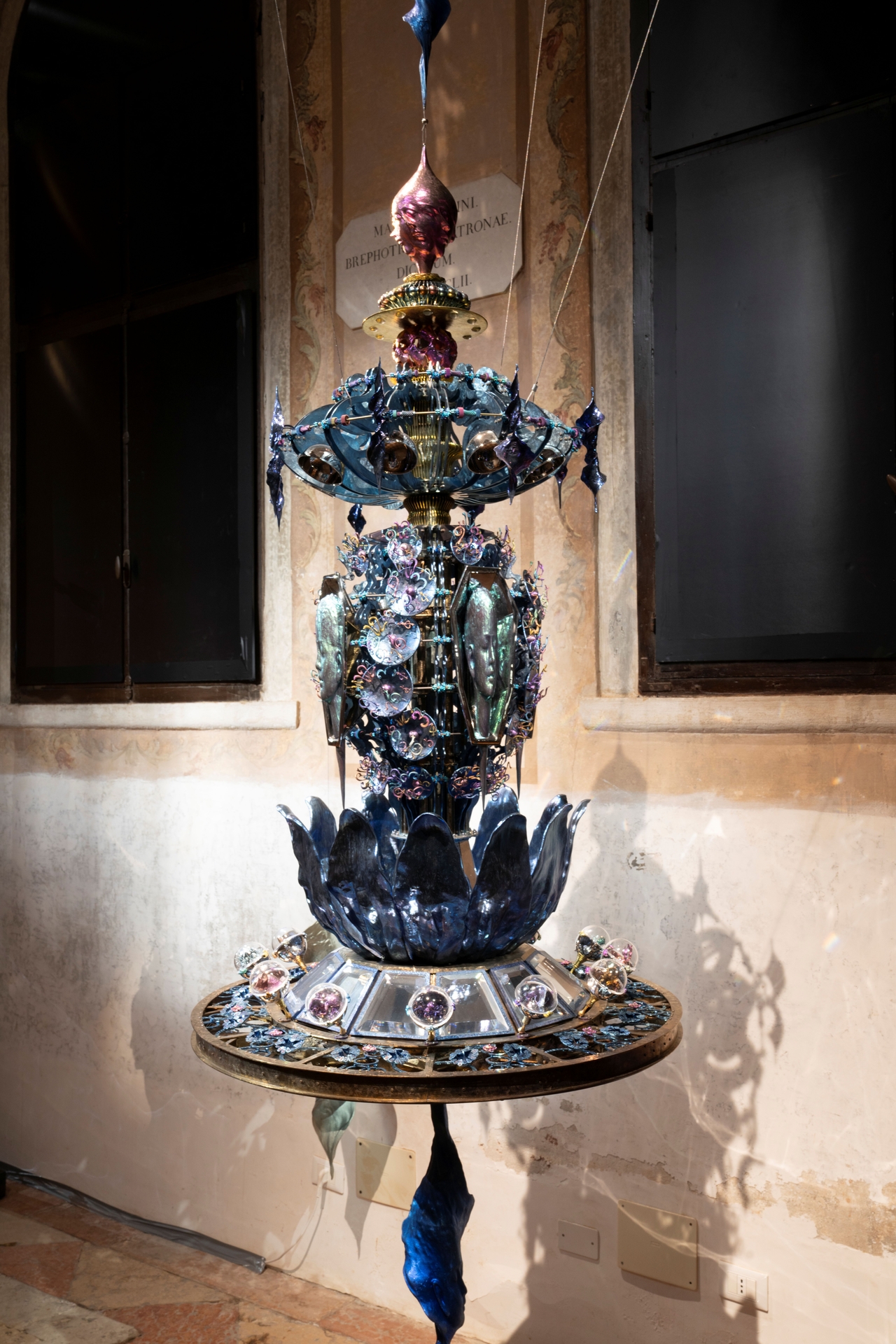
Chan’s companion exhibition, “Wallace Chan: Vessels of Other Worlds,” installed at the Santa Maria della Visitazione — also known as the Pieta Chapel or Vivaldi’s Church — continues the artist’s exploration of mythology, spirituality and technology.
Inside the dimly lit chapel, Chan’s titanium installations appear at once futuristic and spiritual — resembling futuristic spacecraft while also evoking religious altars or ritual objects.

Known internationally for pioneering jewelry techniques, Chan has increasingly expanded his sculptural practice in recent years. A large-scale exhibition opening at Shanghai’s Long Museum in July will include titanium sculptures up to 10 meters in height.
Chan’s experimental use of titanium — a material associated with aerospace engineering and advanced technology — has become central to his sculptural practice.
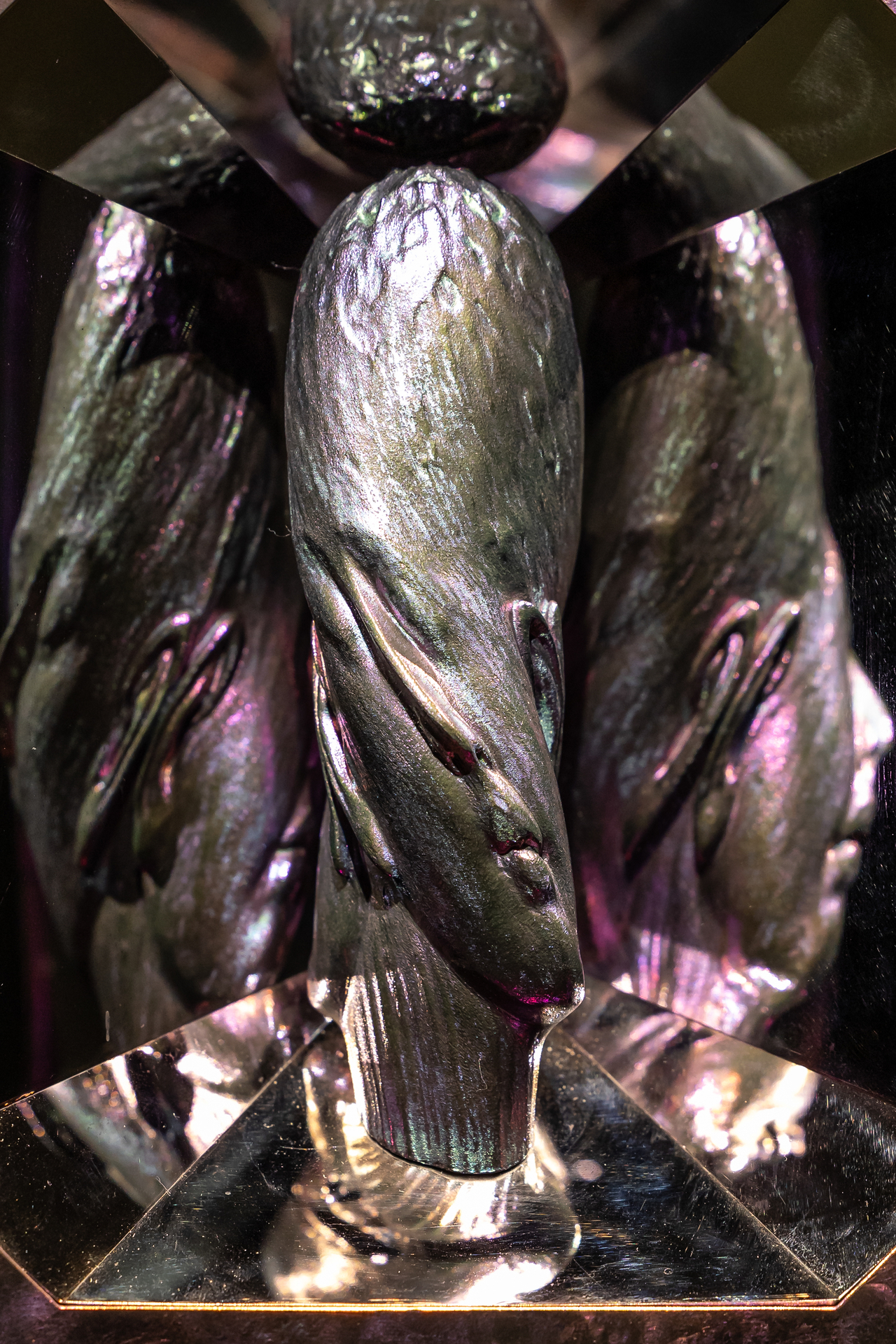
“You need to heat it up until 1,700 (Celsius) degrees in order for it to change forms,” Chan said, comparing the material’s resistance to his own personality.
“You need to give it a lot of force and heat for it to transform.”
The exhibition also incorporates Chan’s signature “Wallace Cut,” a gemstone carving technique he invented in 1987 that creates multiple reflections within transparent surfaces. Instead of crystal, Chan uses glass in several of the Venice works, allowing fragmented faces and forms to appear and disappear depending on the viewer’s perspective.
“As a person, there are many different phases,” Chan said, referring to the repeated human faces embedded within the works. The faces are intentionally genderless and ageless, representing what he described as “the neutral form of a human being.”
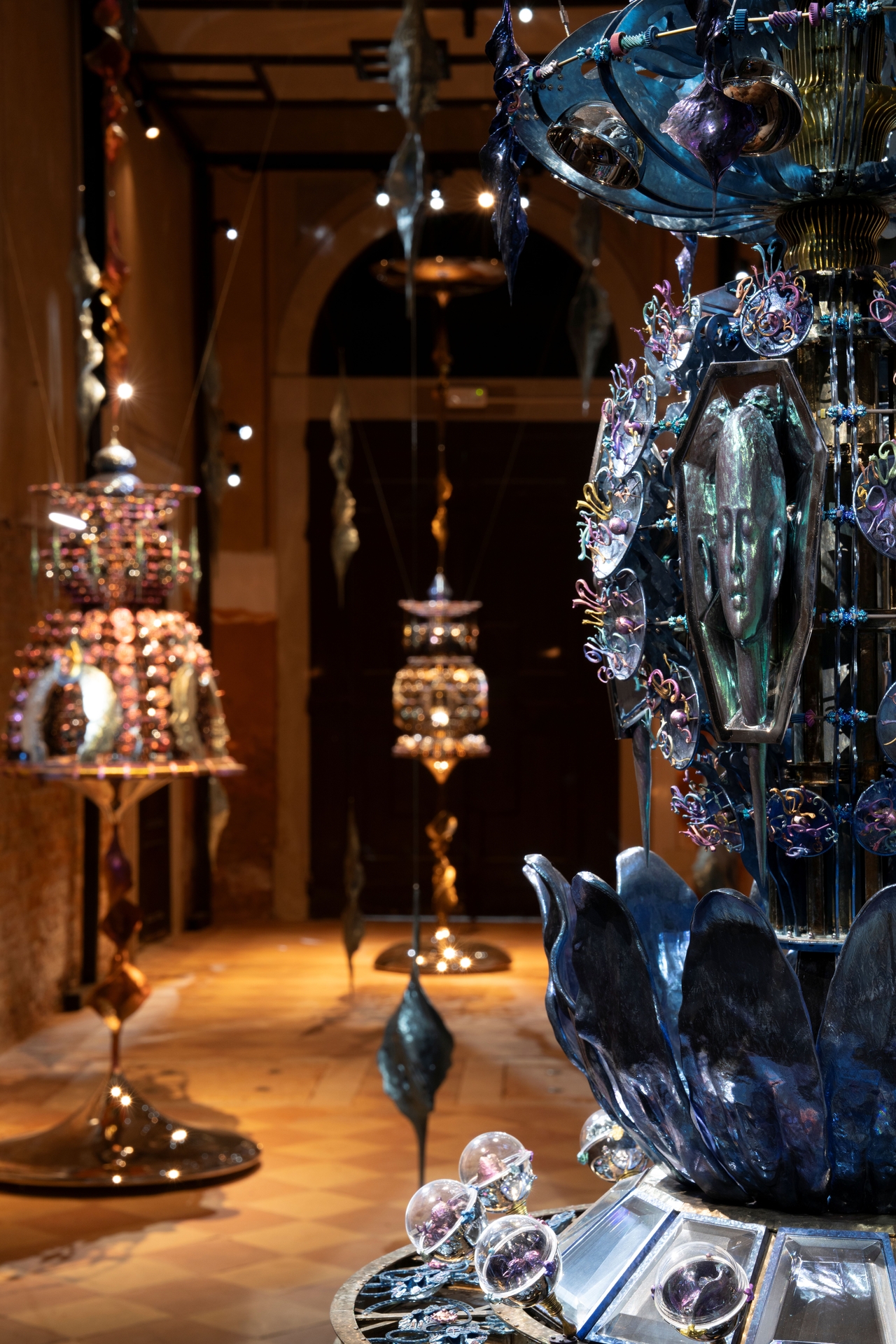
While technology remains central to Chan’s practice, the artist said technological advancement should ultimately deepen human understanding rather than replace emotional experience.
“Technology is a way to explore the intelligence of human beings, and it is entering a four-dimensional world now,” he said. “Human beings are surrounded by emotions, but for technology, for AI, what they give is only data.”
Coinciding with the 2026 Venice Biennale, held under the theme “In Minor Keys,” both “Wallace Chan: Mythos” and “Wallace Chan: Vessels of Other Worlds” run through Oct. 18 in Venice.
yunapark@heraldcorp.com

![[Exclusive] Ateez to return in November](https://wimg.heraldcorp.com/news/cms/2026/09/02/news-p.v1.20260902.76162fb0ba55493aad1c076f240d0750_R.jpg?type=h&h=120)