Korea Herald correspondent
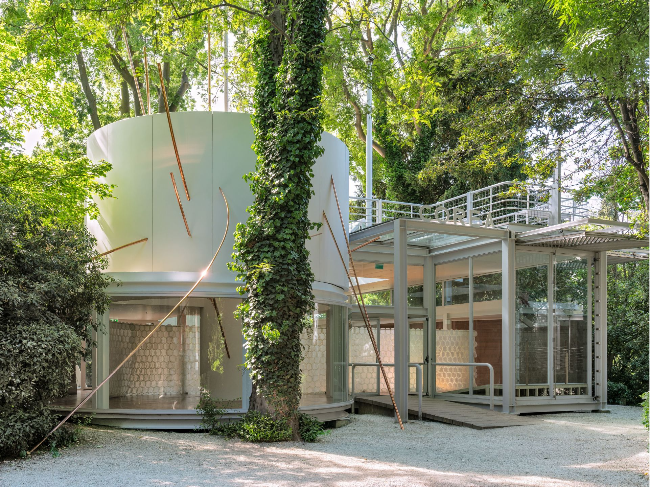
VENICE, Italy — Red pipes burst through the walls of the Korean Pavilion like acupuncture needles piercing a body to open blocked energy flows.
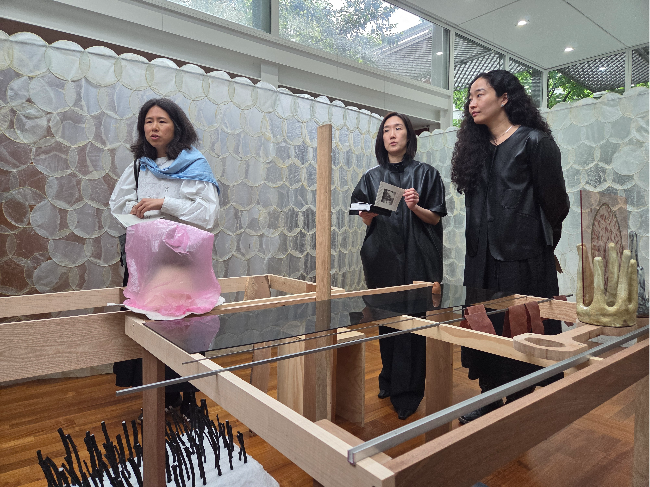
Inside, translucent organza pieces connected into skin-like cellular forms gently guide visitors through spaces for waiting, mourning, resting and gathering.
At first glance, the exhibition feels less like a conventional national pavilion than a strange living organism.
Located within Venice’s Giardini, where 32 countries stage national presentations for the Venice Biennale, the Korean Pavilion has been transformed this year into what curator Binna Choi calls a “liberation space” — a site shaped by movement, coexistence and collective care.
“The recent political turmoil in South Korea made many of us realize once again that democracy and freedom are not fixed or completed conditions,” Choi said Tuesday at the Korean Pavilion.
“I became interested in how we continue to participate in and shape society together through moments of uncertainty and division.”
But rather than making a direct political statement, the Korean Pavilion expands the question into something larger: What does “liberation” actually mean now?
Titled “Liberation Space: Fortress/Nest,” the exhibition borrows from the historical term “liberation space,” generally referring to the transitional period between Korea’s liberation from Japanese colonial rule in 1945 and the establishment of separate governments on the peninsula in 1948.
“That period is often remembered as chaotic or unfinished,” Choi said. “But instead of seeing it simply as a failed or tragic moment, I wanted to think of it as an ongoing movement that we continue to participate in and shape.”
For Choi, the recent political crisis in South Korea revealed that democracy itself remains unstable and unfinished — something continuously negotiated rather than permanently secured.
The exhibition unfolds through two contrasting installations by artists Choi Go-en and Ro Hye-ree.
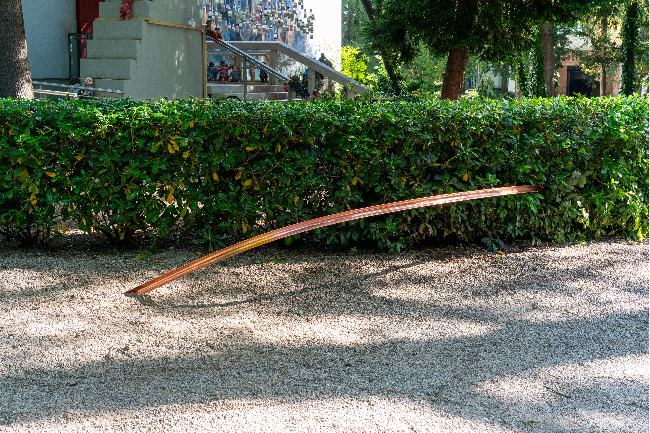
Go-en’s “Meridian” sends industrial red pipes through the pavilion’s walls, columns and stairways, reopening previously closed sections of the building. The word “Meridian” refers both to geographical lines and to the pathways energy flows through human bodies in East Asian medicine.
The artist said she has long been interested in invisible infrastructure — the hidden systems that sustain movement and circulation — which is why she often works with industrial materials such as copper and water pipes.
“Pipes are normally efficient industrial objects, but I wanted to break and bend them into something more flexible — almost like acupuncture needles piercing blocked points to reopen a flow,” the artist said.
Rather than presenting liberation as a grand political declaration, Roh’s “Bearing” projects approache it through quieter and more repetitive acts of care, endurance and coexistence.
Throughout the pavilion, visitors move through “Bearing” projects that consist of eight stations dedicated to — overlooking, living, planning, mourning, waiting, mending, remembering and sharing.
The themes suggest liberation is sustained not only through political action, but also through the everyday labor of supporting and caring for one another, according to the artist.
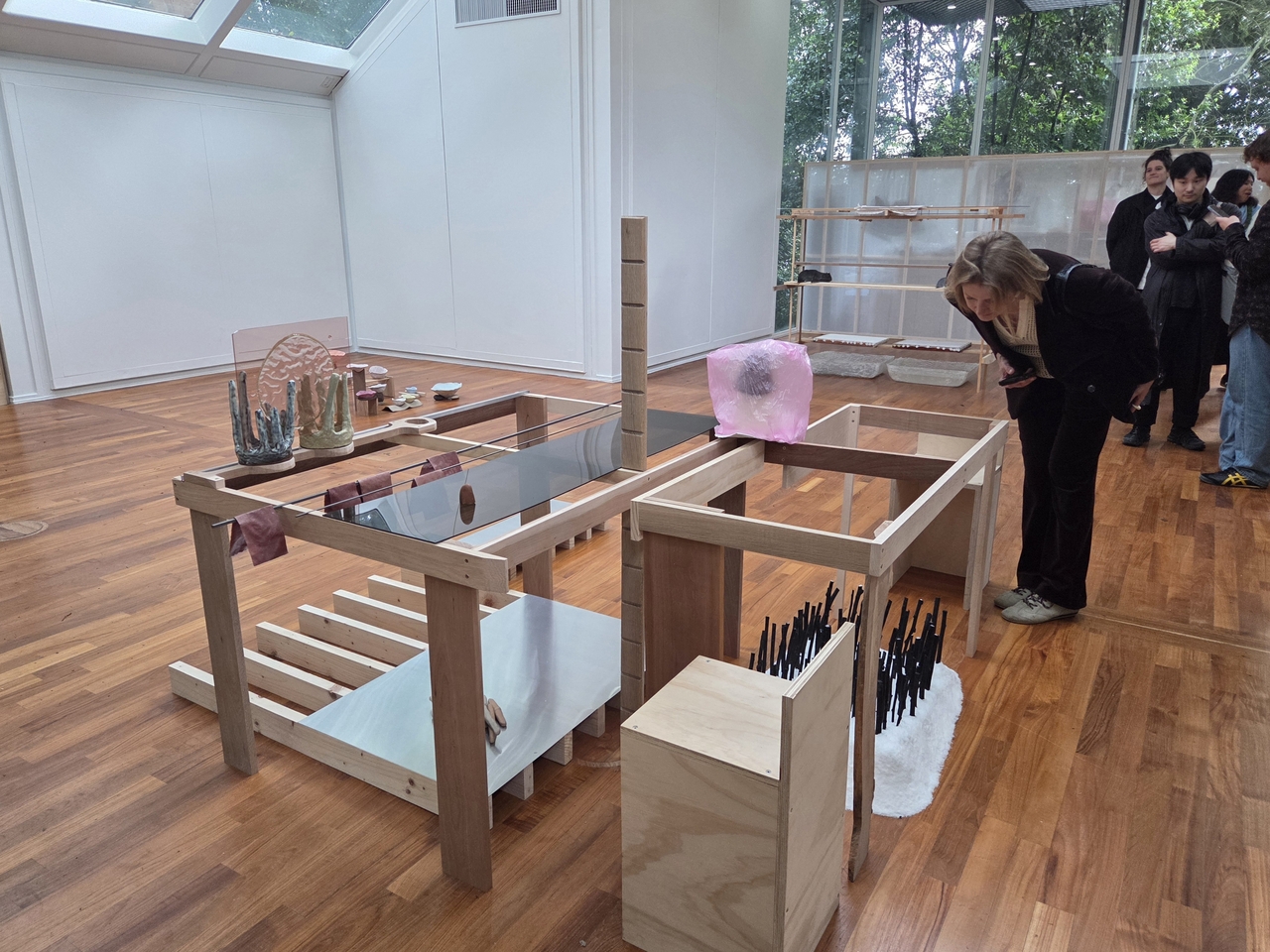
The stations were developed in collaboration with contributors including novelist Han Kang. The mourning station features the work “The Funeral” by Han that commemorates those who lost their lives during the Jeju 4.3 Uprising and Massacre (1947-1954) placed low to the ground, encouraging viewers to physically bend toward it.
“By placing the work low to the ground, I wanted visitors to naturally lean their bodies forward,” Roh said.
“I was thinking about what posture mourning might take — how we physically respond to loss and remembrance.”
yunapark@heraldcorp.com