
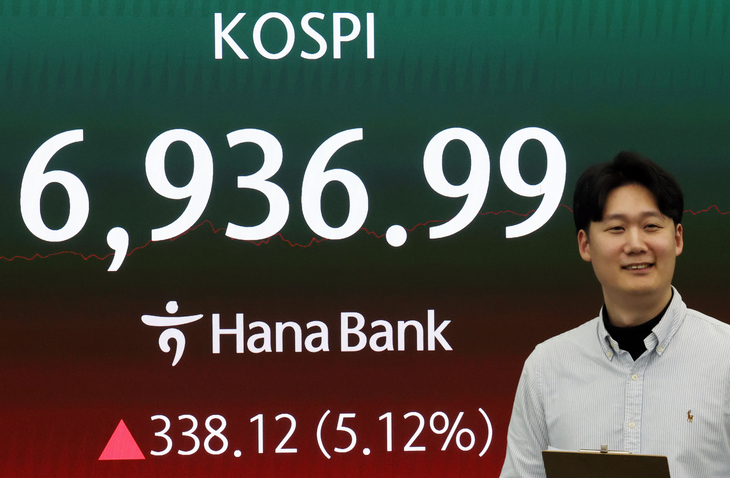
Korea’s initial public offering market remains subdued even as the benchmark Kospi nears the 7,000 mark, with new listings down sharply from a year earlier and analysts expecting the lull to persist through the first half.
According to the Korea Exchange on Tuesday, only 12 companies were listed on the Kospi and Kosdaq between January and April, compared with 27 in the same period last year.
The slowdown is even more evident on a monthly basis. Just one company went public in January, none in February, eight in March and three in April, leaving the market largely inactive outside of a brief March window.
On the main bourse, K bank was the sole listing, debuting on March 5, while most others were listed on the Kosdaq.
New listings have generally delivered strong early returns. IMBiologics, AXBIS and ESteem each surged more than fourfold from their opening prices, while Inventera and Kanaph Therapeutics doubled from their offering prices.
The sluggish IPO market stands in contrast to the broader equity rally. The Kospi has surged this year, driven by chip heavyweights Samsung Electronics and SK hynix, which have gained roughly 70-75 percent since the start of the year. The momentum, however, has yet to spill over into new listings.
Policy uncertainty has emerged as a key drag, particularly around the planned restrictions on spinoff listings — a practice criticized for diluting shareholder value at parent companies.
Financial authorities said on April 18 they would effectively ban such listings in principle as part of a broader market stabilization effort, while signaling tighter scrutiny. With details still pending, several high-profile IPO candidates — including HD Hyundai Robotics, SK Ecoplant, Hanwha Energy and CJ Olive Young — have reportedly delayed or reassessed their plans.
Geopolitical risks linked to the Middle East conflict have added caution, with companies waiting for more stable market conditions before proceeding.
Industry watchers expect the wait-and-see mood to continue. The government and exchange aim to finalize the spinoff-listing framework in the first half, with implementation possible as early as July.
For now, no major IPOs are expected in the first half, reinforcing the seasonal slowdown. Yet underlying demand remains firm, with institutional book-building and retail subscription competition ratios staying elevated, indicating growing investor appetite for new listings despite the supply shortage.
ch0221@heraldcorp.com