Samsung Electronics falls over 1 percent despite record earnings
South Korea's benchmark Kospi swung sharply Friday, opening at a record high and climbing above 6,750 points for the first time before turning course in the afternoon as foreign and institutional investors stepped up profit-taking.
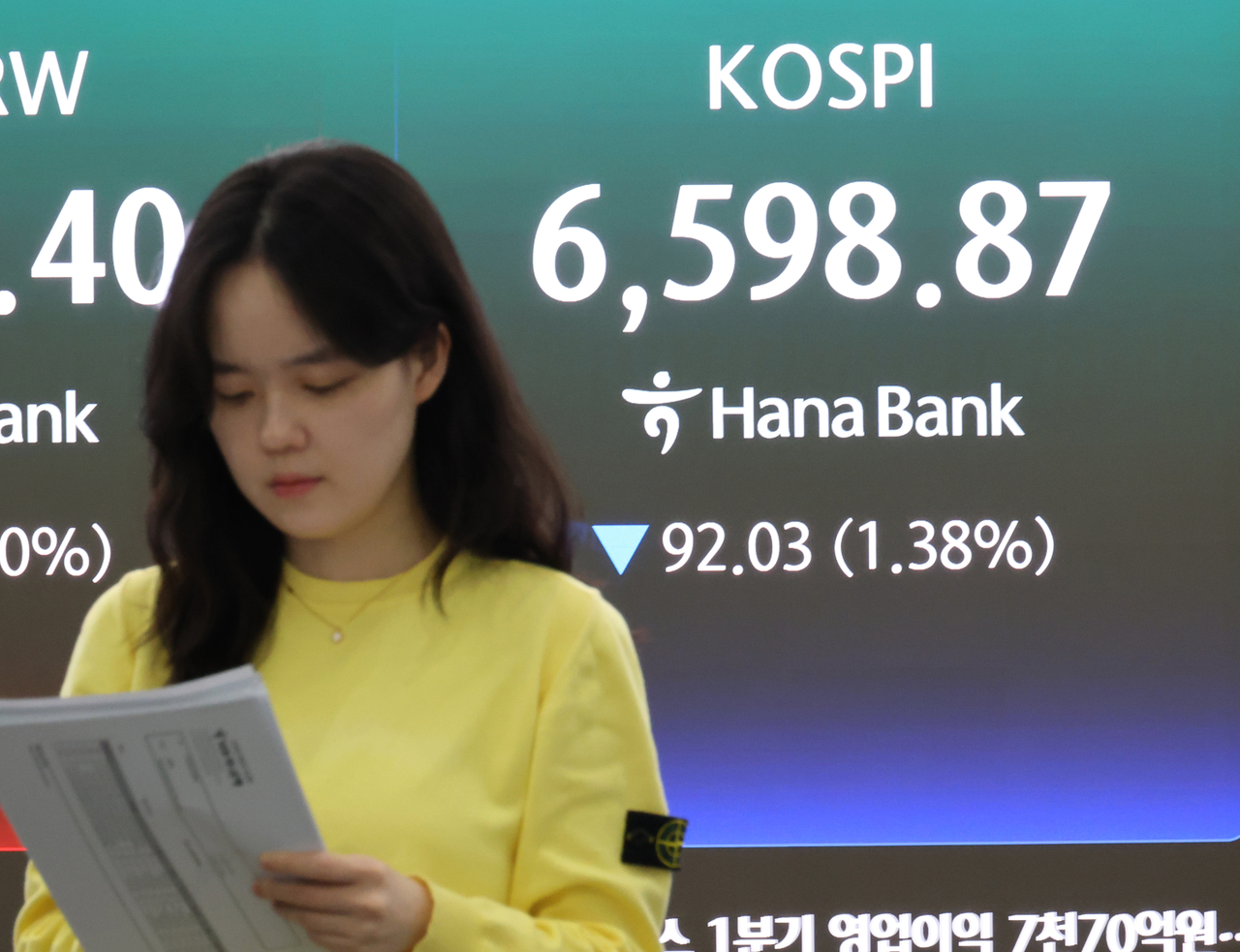
The Kospi closed regular trading at 6,598.87, down 1.4 percent from the previous day, reversing sharply after opening at a record 6,739.39 and briefly climbing to a fresh all-time intraday high of 6,750.27.
Thursday's dip snapped a three-day record-setting rally that had lifted the index 3.3 percent, as strong gains in chip stocks outweighed lingering concerns over Middle East tensions, surging oil prices and a weaker won.
Foreign investors initially fueled the rally, racking up 400 billion won ($269.9 million) in net purchases in the first 15 minutes of trading. But their flows reversed as the index lost steam, with overseas investors eventually turning net sellers and offloading a net 1.4 billion won. Institutions added to the pressure through much of the session before switching to buying, ending with a net 280 billion won in purchases.
Retail investors moved in the opposite direction. After starting the day as profit-takers, individuals stepped up buying as prices fell, absorbing the selloff by foreign and institutional investors to post nearly 1.2 trillion won in net purchases.
The retreat followed a mixed session on Wall Street, where gains were concentrated in technology shares after strong first-quarter earnings from major tech firms including Alphabet, Amazon and Microsoft. The Nasdaq Composite ended 0.04 percent higher and the Philadelphia Semiconductor Index jumped 2.35 percent, while the Dow Jones Industrial Average fell 0.57 percent and the S&P 500 slipped 0.04 percent.
Samsung Electronics' record first-quarter earnings initially fueled gains in chip stocks. The chipmaker posted 57.23 trillion won in operating profit, its highest quarterly figure on record and a more than sevenfold jump from a year earlier. Samsung shares surged as high as 230,000 won, a new all-time high, while SK hynix gained as much as 2.2 percent to 1,325,000 won. Hanmi Semiconductor also jumped as much as 8 percent, reaching a new annual high.
Both chipmakers gave up early gains, with Samsung falling more sharply despite its robust earnings. Samsung closed down 2.4 percent at 220,500 won, while SK hynix slipped 0.5 percent to 1,286,000 won.
SK hynix’s earlier rally lifted its largest shareholder, SK Square, briefly making it the third-largest company on the local market. The investment holding company’s market capitalization topped 112 trillion won at one point, overtaking Hyundai Motor, which was valued at just under 110 trillion won.
SK Square was a rare gainer among major heavyweights, closing up 1.3 percent at 841,000 won.
The US Federal Open Market Committee's decision to keep interest rates unchanged also weighed on sentiment. On Wednesday, the FOMC held rates steady at between 3.5 percent and 3.75 percent, citing deepening inflation concerns and the growing impact of the ongoing conflict in the Middle East.
The rate freeze pressured the local currency, with the won opening Friday 7.5 won weaker at 1,486.5 per US dollar and staying near that level throughout the session.
Surging oil prices also dampened investor sentiment, as concerns grew that a US blockade of Iran could drag on and reports said Washington was weighing military options. Brent crude futures for June delivery climbed as high as $126.41 a barrel in London trading, the highest intraday level since June 2022, while West Texas Intermediate briefly topped $110.
Analysts said the Seoul market was due for a short-term breather after a sharp rally, with geopolitical tensions, higher oil prices and currency volatility piling on pressure.
"The Kospi has gained more than 1,600 points, or over 33 percent, since its late-March low, leaving short-term overheating concerns and rally fatigue built up," said Lee Kyoung-min, a senior researcher at Daishin Securities. "A phase of cooling and profit-taking digestion is likely as the market tests the gap between expectations and reality during the first quarter earnings season."
Shinhan Securities analyst Noh Dong-gil put the Kospi's May trading range at 6,200 to 7,500, saying any correction would likely reflect a technical easing of overheating rather than a deterioration in fundamentals.
"The key question is how much earnings can absorb the discount gap created by the exchange rate and oil prices," noted Noh.
jwc@heraldcorp.com