

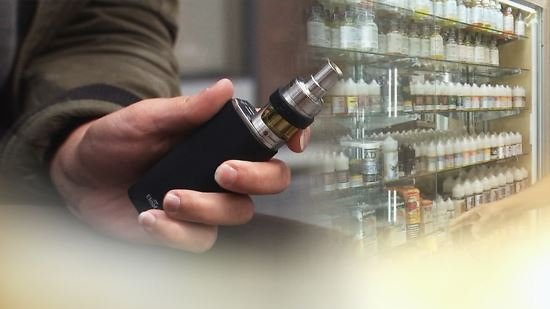
Liquid e-cigarettes will be subject to the same regulations as conventional cigarettes starting Friday, under a revision to the Tobacco Business Act passed in February.
Before the revision, liquid e-cigarettes — more commonly known as vapes — were not classified as tobacco products under South Korean law.
The Tobacco Business Act had defined tobacco products as those made from tobacco leaves and manufactured in a form suitable for smoking, sucking, inhaling vapor, chewing or sniffing .
The revised law broadens that definition to cover all products made from tobacco or nicotine, effectively classifying liquid e-cigarettes as cigarettes.
Under the expanded definition, all nicotine-based products will also be subject to the National Health Promotion Act, which requires health warnings on packaging and imposes strict limits on advertising.
The revision also places tighter controls on automated sales devices, regulating their installation based on location, distance requirements and whether the seller has obtained a retail license.
For users, the change means liquid e-cigarettes can no longer be used in designated nonsmoking areas. Until now, fines of 100,000 won ($68) imposed in no-smoking zones were often canceled when the user was found to be smoking a vape.
The tougher rules come amid concerns that liquid e-cigarettes have been sold to minors through unmanned stores and online platforms.
According to the Korea Disease Control and Prevention Agency, 1.54 percent of female students in grades six through 11 reported using liquid e-cigarettes in 2025, exceeding the share who said they smoked conventional cigarettes at 1.33 percent and heat-not-burn tobacco products at 0.32 percent.
KDCA data also showed that vape use among adults has steadily risen from 2 percent in 2016 to 3.8 percent in 2024, even as the share of adult conventional cigarette smokers fell from 23.2 percent in 2013 to 15.9 percent in 2024.
The Ministry of Health and Welfare said it would begin checking whether tobacco retailers, manufacturers and import sellers are complying with the new requirements from late April, when the revised law takes effect, and will also work with local governments and related agencies to enforce no-smoking zones.
“The government will work to ensure the revised law is quickly implemented in the field,” the ministry said.
seungku99@heraldcorp.com