Koo Yun-cheol says AI push can address growth and imbalances as Seoul seeks to host global agencies' AI units
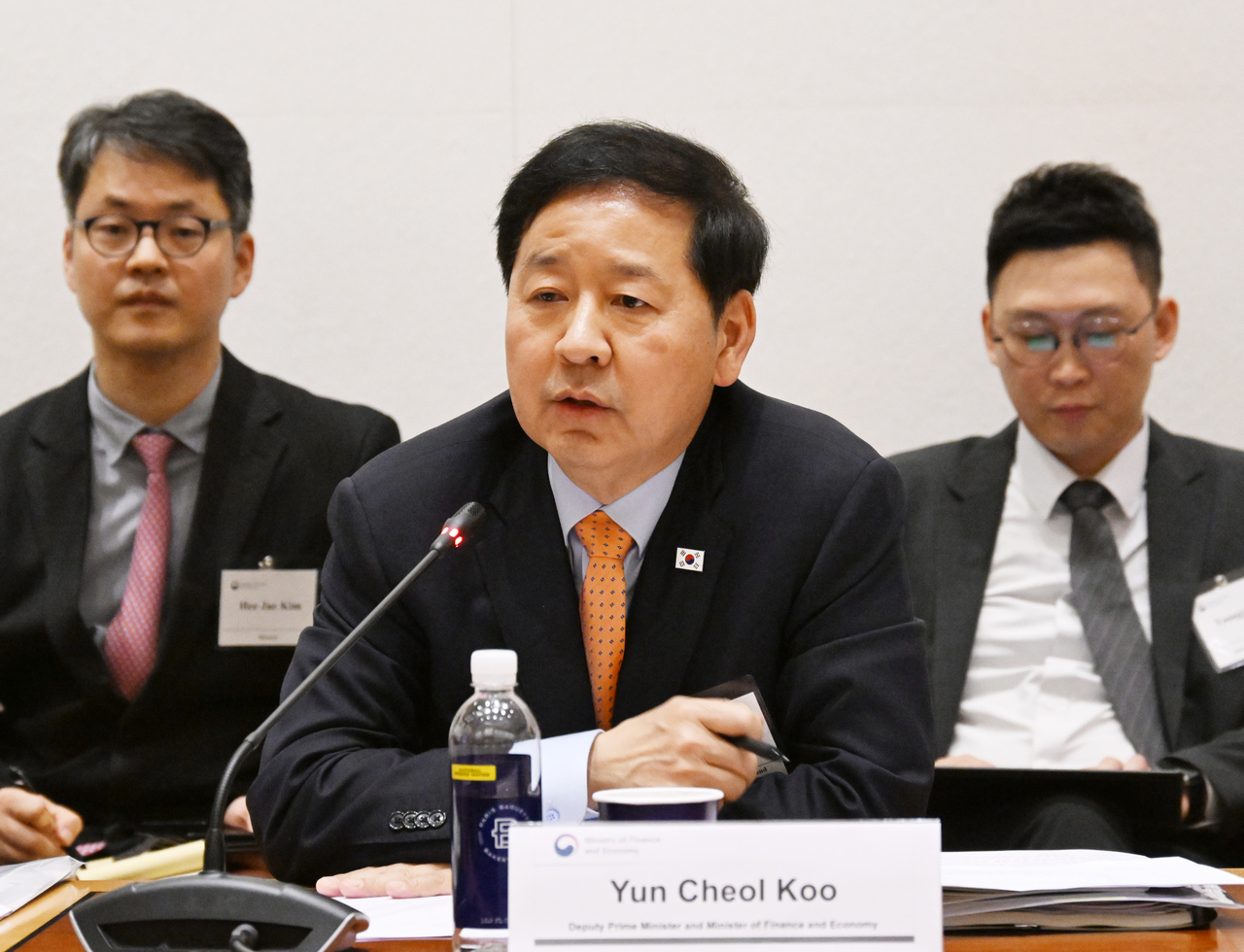
Finance Minister Koo Yun-cheol set out to turn South Korea into a global center for artificial intelligence, saying Seoul could eventually host the AI arms of United Nations agencies.
"South Korea could become the UN's AI headquarters in the long term," Koo said at a briefing with reporters in Washington on Thursday. "Korea must become the AI hub."
The vision builds on the World Bank's move to designate Korea as a hub for AI and digital transformation, marked by the December launch of the Korea-World Bank Global Digital Knowledge Center in Songdo, Incheon.
Koo said several other international institutions are also moving to establish AI hubs in Korea. This includes six UN-affiliated agencies, the Asian Development Bank, and the Inter-American Development Bank.
"We are also planning to ask the International Monetary Fund and the European Bank for Reconstruction and Development," Koo said, adding that such efforts could eventually help elevate Korea to a formal UN AI hub.
Visiting Washington for the G20 finance ministers and central bank governors meeting, Koo said AI could help address the gathering's two main themes, growth and imbalances. Broader adoption of the technology could lift the efficiency of economic activity and help ease current account imbalances, he said.
He also urged Korea to sharpen its focus on the sector. "Korean industry must also focus on AI-related chips, including memory semiconductors, high-bandwidth memory for computing and inference, power semiconductors, and sensor chips," Koo said, adding that Korea's shift toward AI and energy transformation would accelerate once the war in the Middle East ends.
Koo pointed to small language models, or SLMs, as an area where Korea could build a competitive edge. He said large language models require vast amounts of land and electricity, making it difficult for Korea to compete with the US, which has already established a technological lead. Applying SLMs to industries where Korea already has an edge, including shipbuilding, automobiles and home appliances, would be a more effective path, he added.
On talks over the $350 billion US investment fund, Koo said, "Work is underway to clarify the investment targets based on the fact sheet," adding that, to his knowledge, "there are no major differences between Seoul and Washington."
In a separate briefing on Wednesday, Koo said the headquarters of the Korea-US Strategic Investment Corporation, which will oversee execution of the $350 billion investment plan, will be set up in Sejong City, South Korea's de facto administrative capital.
Asked Thursday whether alleged forced labor at Korean salt farms could emerge as an issue in the US Trade Representative's Section 301 investigation involving South Korea, China and Japan, Koo played down the concern, saying the Labor Ministry had likely already explained the matter and submitted the necessary documents.
Koo is scheduled to meet US Treasury Secretary Scott Bessent later Friday, their first meeting since January. While the agenda was not disclosed, Koo said the two would "review a range of issues," with talks expected to cover matters including the exchange rate and the status of Korea's investment commitments in the US.
jwc@heraldcorp.com