

Concerns grow over human rights at detention centers after another alleged assault case

An Algerian detainee at the Hwaseong Immigration Detention Center has filed a state compensation suit, alleging assault by a social service worker. According to CBS No Cut News on Thursday, he is seeking 3 million won ($2,030) in damages.
Preliminary investigations found that the detainee had been ordered to enter a PC room at the detention center on Nov. 15, 2024. When he refused, the worker allegedly grabbed him by the neck and headbutted him.
The detainee, however, said he was not simply refusing the order, but was seeking protection after being threatened by another detainee.
Mobile phone use is restricted at detention centers, with detainees typically allowed limited access in a designated PC room once or twice a week.
The plaintiff said he refused to enter the room because another detainee who had previously attacked him on two separate occasions was also there. He claims the social service worker failed to take any protective measures.
The plaintiff also contends that even if he had violated certain rules, the use of physical force exceeded the scope of lawful official duty.
“I was threatened by other detainees, so I went into the hallway to ask for protection,” the plaintiff said. “I tried to explain the situation using my phone, but the workers repeatedly told me to go back into the room, then suddenly used physical force and profanity.”
The Korean government has argued that the worker’s actions constituted a legitimate performance of official duty. In a written submission, the government said the incident occurred in the course of maintaining order at the detention center. It said the use of physical force was unavoidable because the plaintiff had violated mobile phone-related rules and disobeyed staff instructions.
“Their foreheads collided during a physical standoff,” the government said in its submission. It added that when the plaintiff refused to comply, the worker again instructed him to follow the facility’s rules and pushed the back of his neck to guide him into the PC room.
Prosecutors who conducted a preliminary investigation did not view the incident as justified, finding that it constituted assault under criminal law. They nevertheless granted the worker a suspension of indictment, taking into account that it was a first offense.
The plaintiff’s side asserts that if the act had truly constituted legitimate official duty, prosecutors would have concluded that no crime had occurred.
The case has also raised concerns over the management of immigration detention centers, as the social service worker involved had reportedly been assigned to assist at the facility’s disciplinary unit.
Unlike career public officials, social service workers are generally not subject to the same level of professional training or systematic instruction required for such duties.
In the complaint, the plaintiff’s side argues that authorities should have provided thorough human rights education and exercised careful supervision when assigning personnel to immigration detention centers, where the risk of abuse is high.
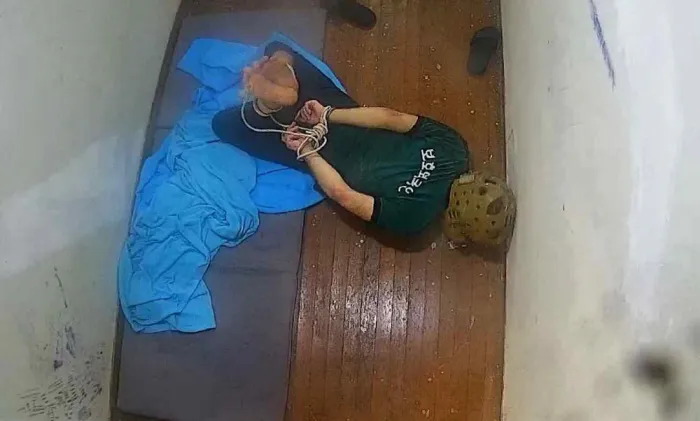
Civic groups have also called for a broader review of detention center operations, as the Hwaseong facility has faced repeated controversy over human rights violations even after the state was found liable in the 2021 “shrimp posture” abuse case.
In that case, a Moroccan detainee was left for an extended period in solitary confinement while inappropriately restrained with his hands and feet tied together behind his back. Officials were found to have used equipment not permitted under relevant regulations, including ankle shackles and cable ties.
A court later ruled that the treatment unlawfully violated the detainee’s bodily freedom and human dignity, holding the state liable for damages.
seungku99@heraldcorp.com