
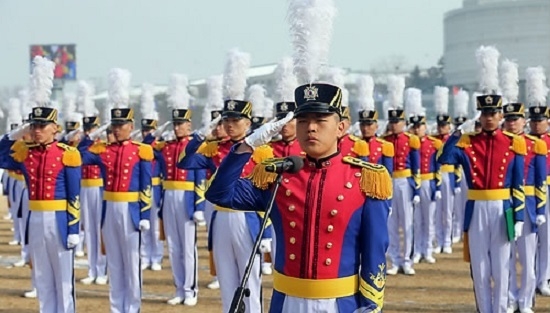
Defense Minister Ahn Gyu-back said Tuesday that the government is considering integrating South Korea’s three service academies, as part of broader efforts to improve officer training and respond to a shrinking applicant pool.
Speaking at a press briefing in Seoul, Ahn said the current system — in which the Korea Military Academy, the Republic of Korea Naval Academy and the Air Force Academy operate separately — faces structural limitations.
Each academy operates on a relatively small scale, making it difficult to fully benefit from stronger competition, faculty concentration and broader academic exchange, he said.
Ahn also raised concerns over the declining academic level of incoming cadets, saying that in recent years some admitted students fall into the lower percentile range compared to the broader college applicant pool — a marked shift from the past, when top-performing students once chose military academies.
In earlier decades, when demographic pressure was less severe, military academies attracted some of the country’s highest-performing students, partly due to stable career prospects and full state support for tuition.
However, that trend has reversed in recent years, as private-sector wages have risen sharply while military pay has lagged, discouraging talented applicants. Dropout rates among cadets have also increased.
Ahn said the issue of integrating the three academies has long been discussed across administrations, regardless of political orientation, but has yet to be implemented.
The proposal comes as South Korea faces a rapid decline in the school-age population, raising concerns over the quality and size of future officer recruitment.
According to Ahn, the three academies currently admit a combined total of around 700 cadets per year, a figure he said is significantly smaller than that of major civilian universities.
Under a possible integration model, cadets would undergo common liberal arts and foundational education in the first two years and move into specialized training by service in the latter half of their studies.
“The military can no longer rely on a system designed for a different era,” Ahn said. “Without fundamental qualitative change, it will become difficult to recruit outstanding cadets in the future.”
He added that the Defense Ministry is reviewing multiple options, including the possible location of an integrated academy, and plans to disclose more detailed proposals following the release of a related study.
It remains unclear whether the proposal can secure a broad public consensus, given the military academies’ long-standing role as key pipelines for leadership in South Korea.
For instance, Rep. Kang Sun-young of the main opposition People Power Party is a retired two-star Army general and a graduate of the Korea Military Academy. Rep. Kim Byung-joo of the ruling Democratic Party of Korea is a retired four-star Army general who previously led the South Korea-US Combined Forces Command. Rep. Boo Seung-chan of the Democratic Party also graduated from the Air Force Academy and served as a major.
Ahn, who served as a defense service member under the conscription system and graduated from Sungkyunkwan University, became defense minister in 2025, marking the first civilian to hold the post in 64 years.
flylikekite@heraldcorp.com