
Samsung, SK hynix power rally on foreign buying
Foreign investors scooped up shares amounting to roughly 2.5 trillion won ($1.7 billion) on the South Korean benchmark Kospi on Wednesday, marking a shift back to net buying after the US and Iran agreed to a conditional two-week ceasefire.
The buying spree helped drive the index up more than 6 percent.
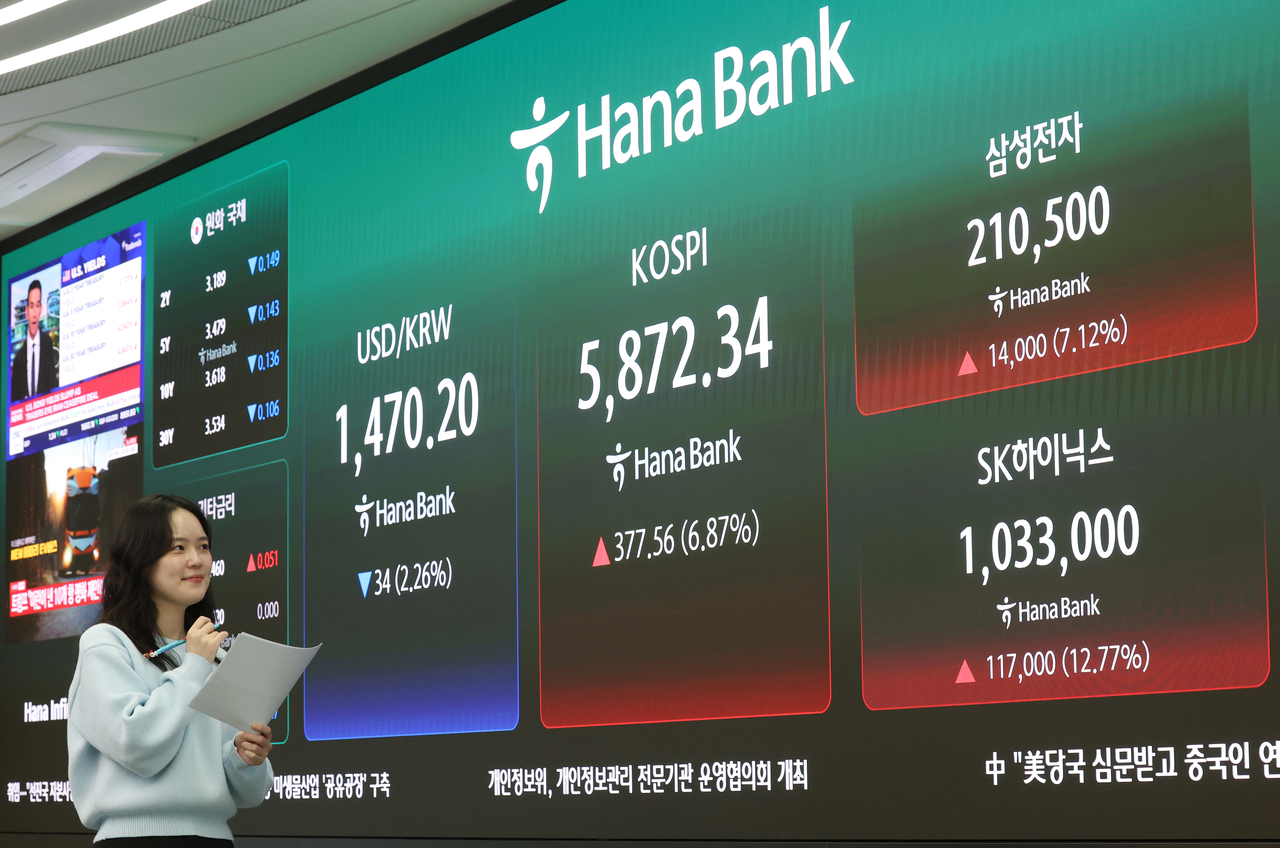
The main board Kospi closed at 5,872.34, up 6.87 percent from the previous session. The index opened strong, up 5.64 percent from the previous session, and extended gains to rise above the 5,900 threshold during trading. The secondary Kosdaq also advanced 5.12 percent, closing trading at 1,089.85.
Amid sharp buying demand, a buy-side sidecar was triggered on both bourses in early trading, halting programmed buy orders for five minutes.
While retail investors net sold 5.41 trillion won ($3.68 billion) on the main board in a profit-taking move, institutional investors logged net buying 2.71 trillion won.
Foreign investors, who recorded net selling of a record 35.88 trillion won on the main board in March and 21.07 trillion won in February, showed signs of a gradual return on the day, posting a net purchase of 2.43 trillion won. They have bought a net 2.75 trillion won so far this month, including Wednesday's trading.
The 2.43 trillion won net buying was the largest daily purchase since Feb. 12, when offshore investors logged net purchases of 2.99 trillion won. Meanwhile, they scooped up 240 billion won on the Kosdaq.
SK hynix was the most heavily bought stock by foreign investors, who posted net purchases of 1.25 trillion won. Samsung Electronics followed, with net buying of 505 billion won.
The buying lifted the heavyweight shares, sending SK hynix up 12.77 percent to 1.03 million won and Samsung Electronics up 7.12 percent to 210,500 won.
The won also strengthened against the dollar as risk sentiment improved alongside a drop in international oil prices, settling daytime trading at 1,470.6 per dollar. The won appreciated 33.6 won per dollar from the previous session's close.
It marked the strongest closing level of the won in daytime trading since March 11. The won strengthened past the 1,500-per-dollar level for the first time in 10 trading days since March 25.
Some, however, cautioned against excessive optimism, noting that the US and Iran have only agreed to a temporary ceasefire.
“A measured approach is needed, as the ceasefire does not mark the end of the conflict,” said Kim Seok-hwan, an analyst at Mirae Asset Securities.
“Key risks include the effective reopening of the Strait of Hormuz, potential transit fee disputes and possible unilateral action by Israel.”
silverstar@heraldcorp.com