

Experts say stronger community-based backing is needed to support the growing number of migrant-background students
Migrant children in South Korea are being turned away from nearby schools or forced into long commutes due to a lack of language support, exposing gaps in a system struggling to keep pace with a sharp rise in foreign-background students.
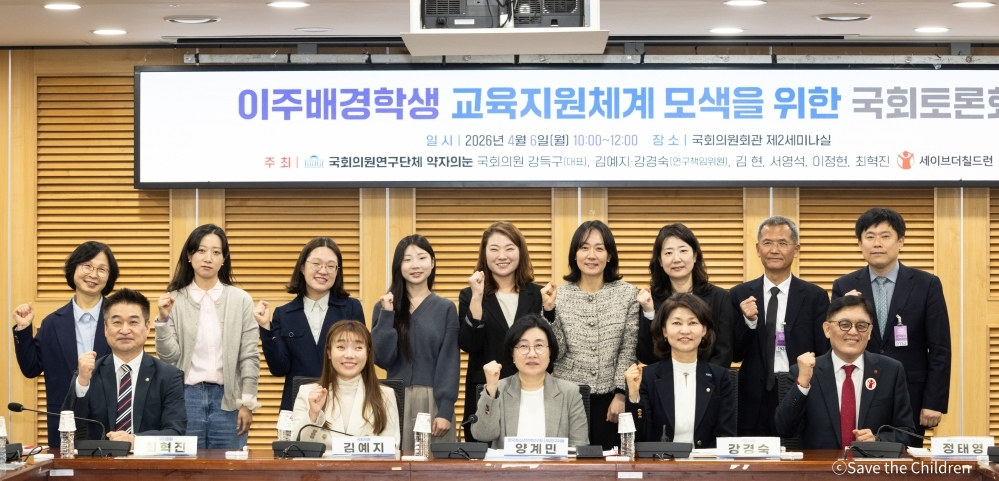
At a National Assembly discussion on Monday co-hosted by Save the Children and a lawmakers’ research group, students, teachers and support providers said many children from migrant backgrounds face barriers at every stage of their education — from enrollment to planning for university or work.
Barriers at entry
An 8-year-old Vietnamese student who recently moved to Korea was unable to enroll in a nearby elementary school because it did not offer Vietnamese interpretation. Instead, the child was told to attend a school an hour away that could provide support in the language.
“The school said it only offered Russian interpreters and that they could not support Vietnamese, telling the student to go to a different school,” said Eun Soo-yeon, an official at the Ansan Global Youth Center. “The student had to take the bus for one hour every day to attend a different school.”
Such cases are not isolated. In Gyeonggi Province, a Thai student who arrived at age nine was forced to commute up to two hours daily after a local school declined to accept the student due to limited support capacity.
Learning under strain
Even when students manage to enroll, language barriers continue to shape their school experience. One Vietnamese student was assessed in Korean despite lacking proficiency and was not allowed to use an artificial intelligence translation tool during class, according to a support provider.
Others fall behind academically or socially. A student who struggled to learn Korean had to repeat a grade and later found it difficult to build friendships.
Some are excluded from scholarships or welfare programs, while others say they have little guidance on how to plan for university or work due to limited access to information.
Uncertain futures ahead
Visa status uncertainties can further disrupt education. One student who entered a specialized high school after demonstrating talent in arts and sports faced the risk of having to leave the country upon turning 18, when their dependent family visa expired.
Students who arrive later in childhood often face delayed entry into the public education system, and schools with high concentrations of migrant-background students report shortages of staff and support resources.
“These students face an invisible wall as soon as they enter public education, up until they graduate and decide on their careers,” Eun said. “Those who come to Korea later experience delayed entrance to the public education system due to limited Korean proficiency, and schools with a high concentration of students from migrant backgrounds experience a shortage of manpower and support.”
Students speak out
Ogay Ruf, a 19-year-old university student from Kazakhstan, said she struggled to adapt after moving to Korea at age nine, despite having been an active student in her home country.
“I was very active in Kazakhstan and was even class president,” Ruf said. “After coming to Korea, I started to become more quiet and avoid situations where I had to speak in front of people.”
Ruf said she was mocked by peers, found Korea’s school system unfamiliar, and spent years questioning whether she truly belonged in either country.
“The problems multicultural students face should not be considered an individual problem of whether they are able to adapt,” she said. “Rather, it is an issue encompassing relationship-building, study environments and access to information.”
Teachers under pressure
The number of students from migrant backgrounds has risen sharply in recent years, even as South Korea’s overall student population declines, adding pressure on schools that are often ill-equipped to respond.
Teachers say they are increasingly struggling to manage classrooms where students have widely varying levels of Korean proficiency. In a survey, 57.3 percent reported experiencing classroom difficulties linked to communication barriers, along with challenges in guiding students and communicating with parents.
“There are many children who do not understand the language,” one middle school teacher said. “But asking us to teach those students is too much to ask of teachers.”
Calls for reform
Experts said the current approach, which places most of the burden on individual schools, is reaching its limits.
“An integrated approach based on school-community cooperation is needed, rather than one centered only on schools,” Eun said, calling for a joint case management system and tailored support across different stages of life.
They also called for a dedicated legal framework to support the education of students from migrant backgrounds, warning that without systemic changes, the gaps are likely to widen as the number of such students continues to grow.
seungku99@heraldcorp.com