Asan Medical Center uses percutaneous coronary intervention support robot to treat patient
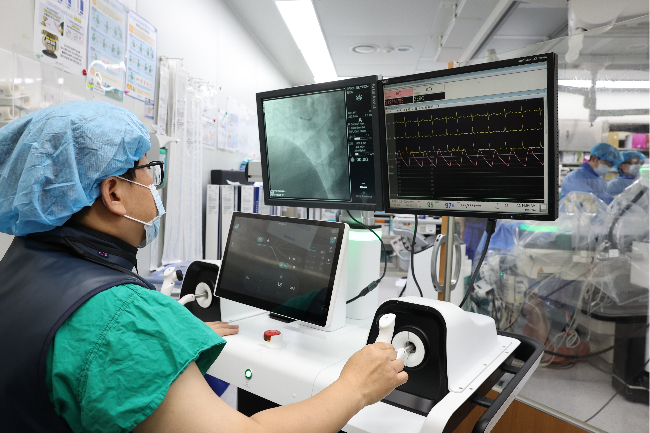
Asan Medical Center said Monday it recently successfully treated a patient with angina using a percutaneous coronary intervention support robot, marking the beginning of physical artificial intelligence in the Korean medical sector.
According to Asan Medical Center, a team led by Ahn Jung-min treated a 56-year-old patient who had a complex coronary lesion with the Aviar — Korea’s first PCI support robot developed with the hospital’s technological expertise and knowledge. The patient recovered without complications and was discharged just one day after the procedure.
The case was one of the first real-world clinical applications of a Korean-developed robotic system in coronary interventions, an area in which imported technologies and robots from the United States, Germany and France have long dominated.
Aviar, which was initially developed in 2019, has undergone multiple upgrades before receiving regulatory approval from the Ministry of Food and Drug Safety in February 2023. It has since been tested in clinical research settings at major hospitals and was eventually designated as an innovative medical technology in December 2024.
Asan Medical Center pointed out that Aviar’s world-first multichannel platform sets it apart from foreign technologies as it can simultaneously mount and control up to five interventional devices, including guidewires, balloons and stents, to allow physicians to perform highly precise procedures even in extremely difficult surgeries.
Incorporating real-time AI-based imaging guidance to enhance procedural accuracy while reducing the use of contrast agents, Aviar also features an AI-driven computing system to further assist decision-making by analyzing vascular curvature and providing real-time procedural data.
“The success of this procedure demonstrates that Korean-developed PCI robots are both safe and highly precise,” said Ahn. “We will continue to accumulate clinical evidence and advance robotic-assisted techniques to expand their application across a wider range of procedures.”
hwkan@heraldcorp.com


