Focus on delivery spans semiconductor projects, capital mobilization and local governance
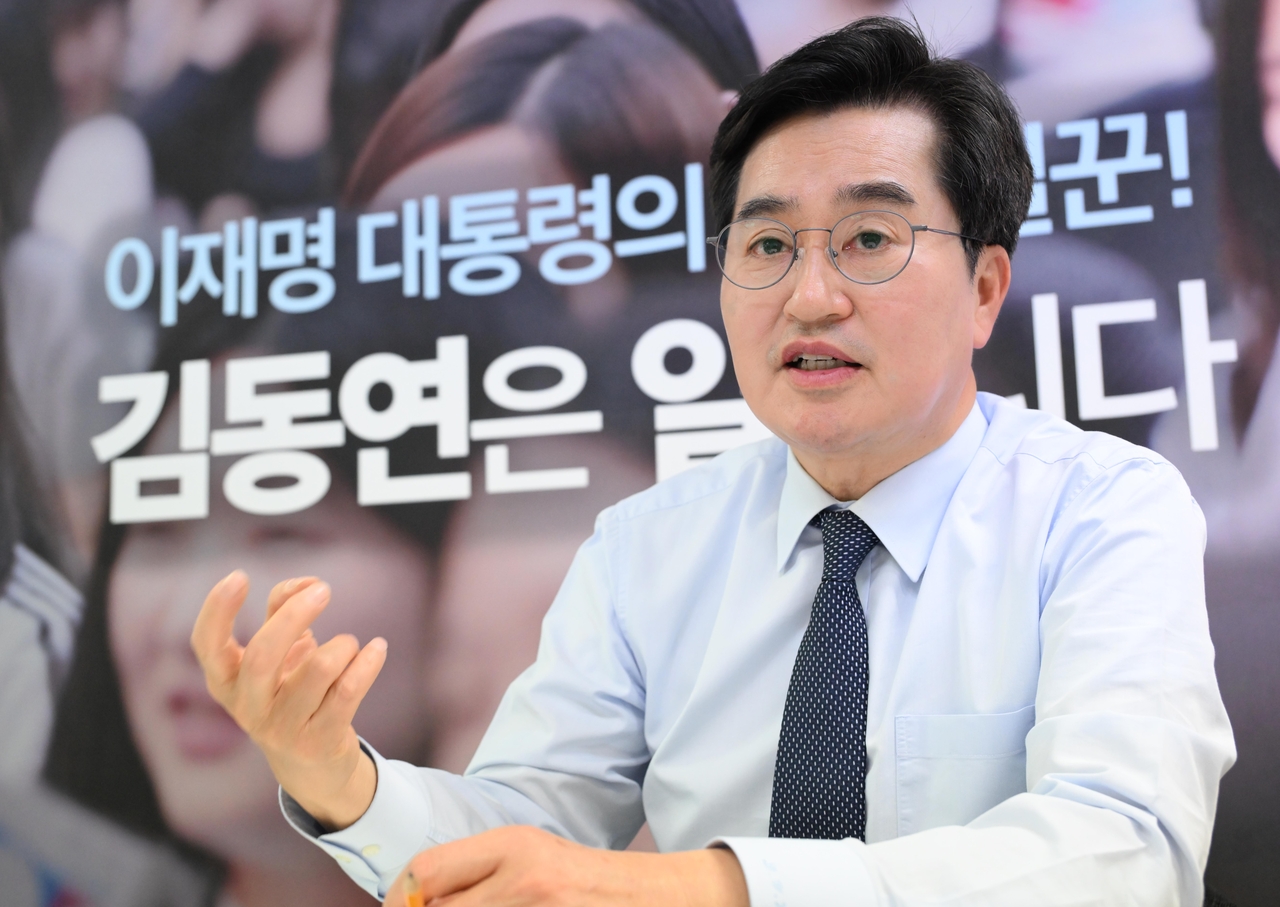
As South Korea grapples with how to secure its semiconductor future amid rising regional competition, the governor of Gyeonggi Province posits that continuity, not disruption, is what the country’s most industrialized region needs.
Kim Dong-yeon, incumbent governor of the province and its 13.7 million population, is currently suspended from duty after registering for the Democratic Party of Korea primary ahead of the June 3 local elections.
He is seeking to extend his tenure by pointing to projects already underway, arguing that changing course now would come at an economic cost.
“The SK hynix industrial complex in Yongin has resolved land issues, and the required 5.5 gigawatts of power has been fully secured,” he said in an interview with The Korea Herald on March 26 at his campaign office in Suwon.
Semiconductor project at center of debate
At the heart of Kim’s argument is a semiconductor cluster in Yongin, anchored by SK hynix and a planned national industrial complex involving Samsung Electronics.
The project is central to Korea’s effort to maintain its edge in advanced chips, an industry where delays can quickly erode competitiveness. But it has also become the subject of political debate; calls from some regional and political actors to relocate parts of the development have raised concerns over delays, infrastructure readiness and investment certainty.
“By installing underground transmission lines alongside road construction, the construction period has been reduced from 10 years to five, while costs have been cut by about 30 percent,” he said.
The SK hynix complex is scheduled for completion in 2027. The Samsung-led project remains at an earlier stage, with land compensation underway and power supply — expected to reach about 10 gigawatts — still a key constraint.
“Over the past four years, we have secured 1.7 gigawatts of renewable energy through the RE100 initiative,” he said. “By combining accumulated renewable capacity with further expansion, we will be able to fully meet the remaining demand by the time the project is completed in 2031.”
Track record in economic policymaking
Kim’s focus on execution reflects a career that spans both national and regional policymaking.
He served as Korea’s finance minister and deputy prime minister from June 2017 to December 2018, overseeing macroeconomic policy before moving into local government — a background that underpins his emphasis on investment structure and measurable outcomes.
“Over the past three years, despite serving as a governor from the opposition, I have spoken through tangible results,” he said. “It has been a period in which I proved what a ‘working governor’ can deliver.”
Beyond semiconductors, Kim is advancing a broader model aimed at connecting large-scale investment with household-level gains.
“Our first core pledge is the ‘1 billion won asset project’ for Gyeonggi residents,” he said. “We will build a foundation for asset formation, supported by three funds — infrastructure, energy and startups — that can deliver stable returns.”
The plan would channel public and private capital into long-term funds, with returns distributed to residents.
“The infrastructure fund is a key policy to return profits that have gone to overseas investors back to Gyeonggi residents,” he said. “We will establish a provincial investment corporation to design and operate these funds.”
“Infrastructure funds are more stable than conventional financial products and offer relatively higher interest rates,” he added. “Residents will be able to earn stable annual returns of around 5 to 6 percent over 20 to 30 years.”
Redefining role of local government
Kim also positioned his policy agenda within a broader vision of decentralization, arguing that local governments must play a more active role in shaping economic outcomes.
“Since taking office, I have focused on how to put decentralization into practice,” he said.
He highlighted what he calls an “ABC strategy,” artificial intelligence, bio, chips and climate tech, alongside expansionary fiscal policy and social programs.
“Gyeonggi has delivered results across AI, bio, semiconductors and climate tech, while pursuing proactive fiscal strategies such as integrated care and emergency caregiving support,” he said.
“The role of local government is to create tangible changes in people’s lives through policies they can actually feel.”
Extending policy model
Gyeonggi, which has the largest foreign resident population among South Korea’s regions, has also sought to frame immigration as part of its economic strategy, treating migrant workers and multicultural families as part of its long-term workforce.
“This is not about charity,” Kim said. “These residents are part of our competitiveness and our future workforce.”
With the June election approaching, the semiconductor cluster has become a focal point not only of industrial policy but also of political contest.
Kim’s argument, however, centers on continuity — extending a policy framework that links industrial development, investment and social policy.
“The slogan ‘Kim Dong-yeon works’ reflects my commitment to improving people’s lives through practical, results-driven administration,” he said.
hnpark@heraldcorp.com


![[World Class] HUFS bets on Songdo, AI to redefine what a global university can do](https://wimg.heraldcorp.com/news/cms/2026/10/18/news-p.v1.20260930.7e4dbeacfc1d4d16848c0e2a441c04e6_R.jpg?type=h&h=120)