
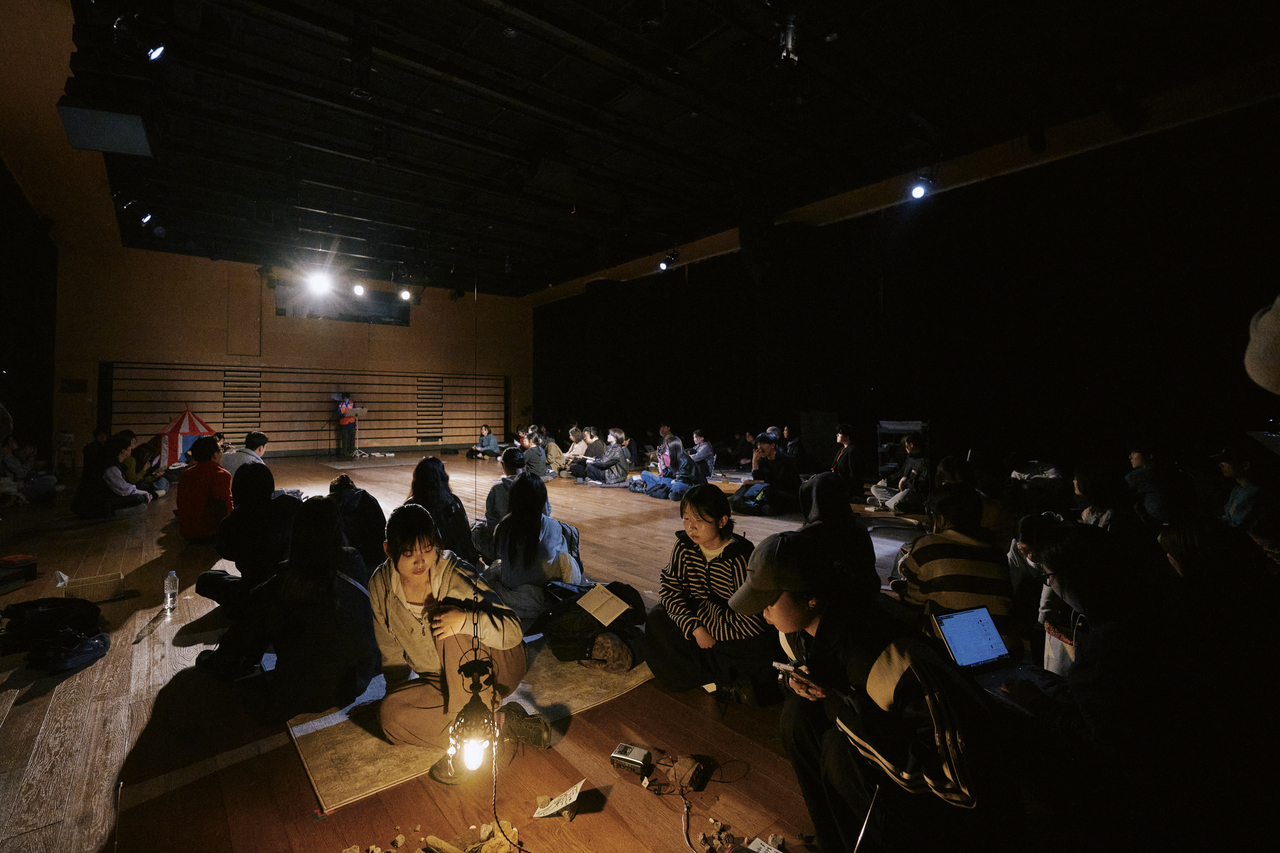
An unusual performance unfolded in Seoul last weekend — one that drew attention on social media for offering free overnight stays in the Hannam-dong area. “Pavilion 72,” presented by the National Theater Company of Korea, began at 6 p.m. on Thursday and ran continuously for 72 hours until Sunday evening at the Zoom Arts Center in Yongsan-gu. Some audience members stayed as long as 12 to 15 hours at a stretch.
A performer in a construction safety vest opens by delivering lines from Wagner’s “The Ring of the Nibelung” in a booming voice. Soon, another actor, lying in a sleeping bag in the corner, takes over, lowering the volume. Elsewhere, a third performer picks up the text, murmuring the lines as if singing.
Their recitation is frequently drowned out by other sounds that cut in unpredictably, making it difficult to follow any narrative thread. In one corner, several old radios emit bursts of noise, activated by motion sensors when audience members reach out to touch them. Over the course of the performance, hundreds of sonic fragments play on their own cycles.

There are no seats or a stage in this rehearsal-like space. Audience members sit or lie down, turning toward whatever direction the sounds seem to come from. Some scroll through their phones, chat or close their eyes and drift into sleep — at times adding their own noises to the environment. One person even holds a handstand.
“Pavilion 72” is part of a creative track launched last year by the National Theater Company of Korea to support experimental work that challenges theatrical conventions. Selected artists are given 180 days to develop their ideas, culminating in what the company calls a “final presentation.”
This 72-hour piece was created by Kayip (Lee Woo-jun), a composer, sound designer and media artist whose work spans film, theater and visual art. Over a career of more than two decades, Kayip has consistently explored the intersection of sound and narrative.
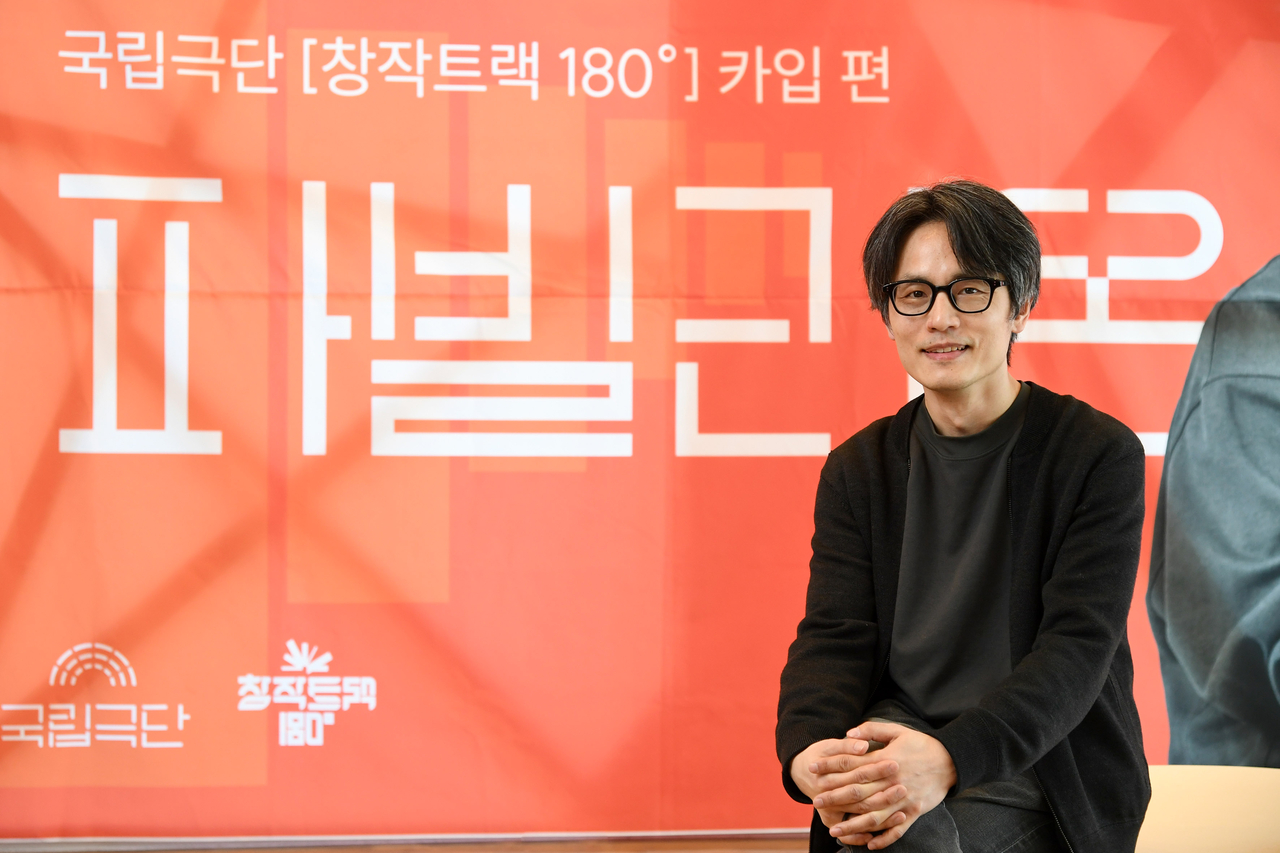
In a group interview before the showcase, Kayip recalled a turning point: “A few years ago, during rehearsals, technical issues forced us to run a piece without sound. Watching the rehearsal unfold in silence gave me a completely new sensation,” he said. “That’s when I began to ask whether performance could exist without sound, and what kind of relationship between sound and performance might enrich both.”
The result of that inquiry -- into the hierarchies among sound and the interplay of different sensory experiences -- is “Pavilion 72.”
He described the work as evoking the drifting quality of ASMR. Each sound, including the recitation of Wagner’s “The Ring of the Nibelung,” forms a distinct layer, as multiple sonic elements overlap. Unpredictable interruptions by the audience are also part of the performance.
“Numerous sounds emerge, overlap and disappear, each on its own cycle. Depending on how they encounter one another, they can produce entirely different outcomes.”
Throughout the project, Kayip questioned not only auditory elements but also the conventions and hierarchies of theater, extending the work’s running time to prompt a reconsideration of the form itself.
“Seventy-two hours is also the so-called golden time in disaster situations -- the amount of time it can take for human cognition to reorganize under conditions of isolation.”
The presentation will extend beyond the physical space. Kayip plans to compile recordings made on site into a final work to be released online in late April.
hwangdh@heraldcorp.com


![[World Class] HUFS bets on Songdo, AI to redefine what a global university can do](https://wimg.heraldcorp.com/news/cms/2026/10/18/news-p.v1.20260930.7e4dbeacfc1d4d16848c0e2a441c04e6_R.jpg?type=h&h=120)