
South Korea’s military should redesign its facility protection standards on the assumption that drone attacks cannot be fully intercepted, a state-run think tank said, noting that rapid advances in drone technology are outpacing existing countermeasures.
Gwak Han-seong, a senior researcher at the Korea Institute for Defense Analyses, in a report co-authored with Kang Min-kyu, argued that current counter-drone systems are insufficient to fully stop incoming threats.
Those limitations are already evident in the performance of existing counter-drone systems, particularly against swarm or low-flying attacks where complete interception is not feasible, he said.
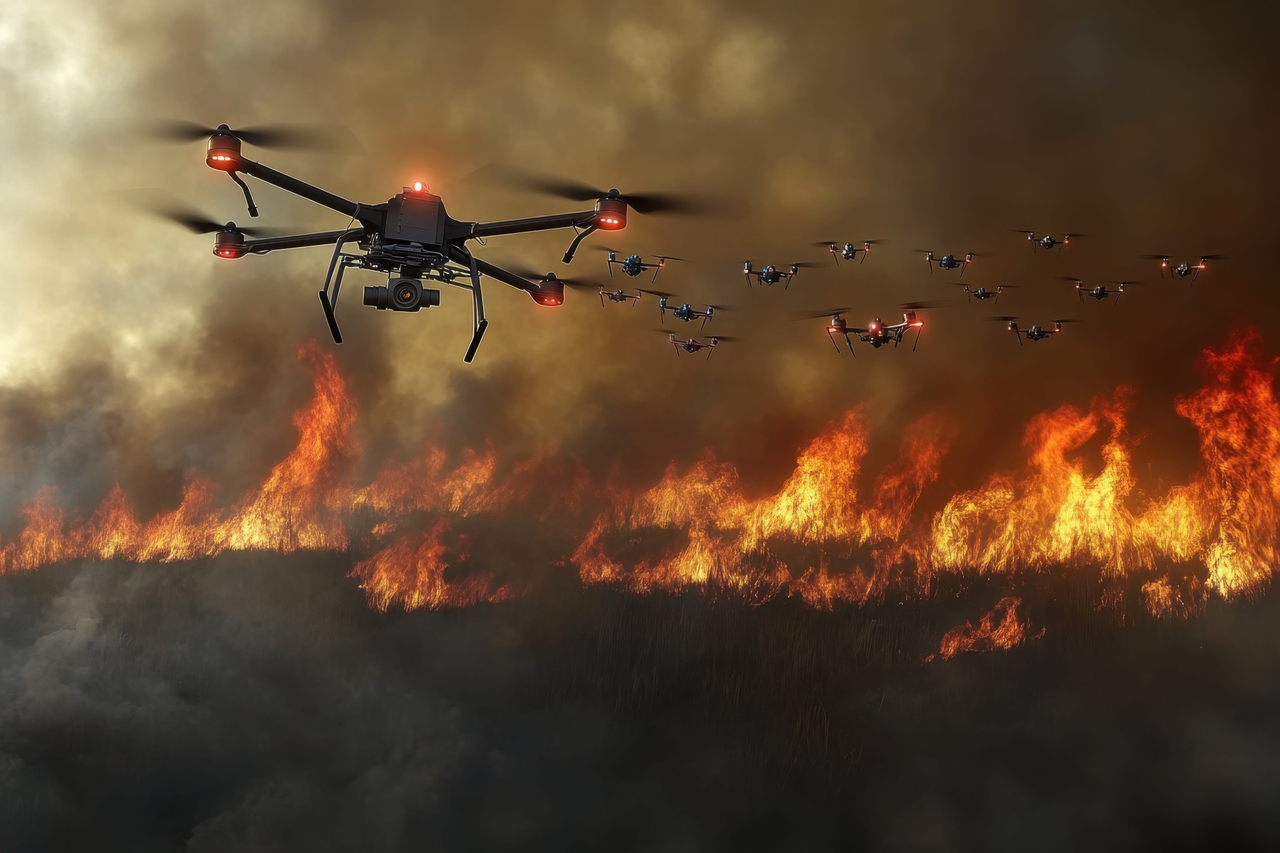
According to the report, many drones are difficult to detect because they fly at very low altitudes and are made of materials that reflect little radar signal. Some can also navigate autonomously without relying on external communication, making them harder to track or disrupt.
Even when countermeasures are deployed, their effectiveness remains limited: jamming systems may fail against drones using encrypted or frequency-hopping communications, while laser or electromagnetic pulse weapon systems typically operate only at short range and are designed to engage one target at a time.
“Anti-drone systems are inherently reactive and tend to evolve only after drone technologies advance,” Gwak said, adding these constraints limit the effectiveness of interception-based defenses.
Instead, Gwak stressed the need to assess risks and expected damage in scenarios where drones cause defenses to fail.
South Korea has developed counter-drone capabilities based on a “detect-identify-neutralize” framework, deploying radar, electronic warfare systems and interceptor assets to protect key facilities.
“Current blast-resistant design standards are based on conventional threats such as aerial bombardment and artillery strikes and do not account for emerging threats like drone attacks,” Gwak said.
The study found that existing protection standards are largely based on single-explosion scenarios derived from conventional weapons. Drone attacks, by contrast, can involve repeated strikes, varying detonation distances and direct impact force.
The report also warned that current protection standards for military infrastructure may not be sufficient to withstand such threats. Conventional reinforced concrete structures in South Korea are typically built with wall thicknesses of 20 to 30 centimeters, which falls short of what is needed to withstand even small drone attacks.
Even the smallest attack drones would require a minimum wall thickness of about 40.9 centimeters to prevent structural failure, meaning most existing facilities fall below the required threshold, the report said.
In particular, larger platforms such as the modified MQM-107 could potentially destroy standard facilities. The urgency of such changes reflects evolving battlefield realities.
The report noted that in recent conflicts, including the war in Ukraine and tensions in the Middle East, drones have been widely used to strike infrastructure and military assets.
For instance, systems such as the US Switchblade series, China’s DFX-100 and Russia’s Geran-2 carry warheads weighing roughly 15 to 50 kilograms, can inflict significant damage even in a single strike.
The report said that North Korea is also expanding its drone capabilities, with Pyongyang estimated to operate around 1,000 unmanned systems ranging from reconnaissance platforms to attack drones.
Among them, models such as the Banghyeon I and II, VR-3, and modified MQM-107 are believed to be convertible into attack platforms capable of carrying payloads ranging from about 20 kilograms to over 400 kilograms. Given their payload capacity, such systems would exceed the protection limits of most existing military structures in South Korea, the report suggested.
The report also noted blast distance as a key factor, with even a few meters significantly reducing damage. Larger drones could still inflict severe destruction — or even total collapse — depending on payload size.
“If the military fails to adequately prepare for drone attacks, it could face unexpected damage and rapid shifts in battlefield conditions,” Gwak said.
flylikekite@heraldcorp.com