
FSC chief says government will use crisis to push bold reforms and strengthen capital market fundamentals
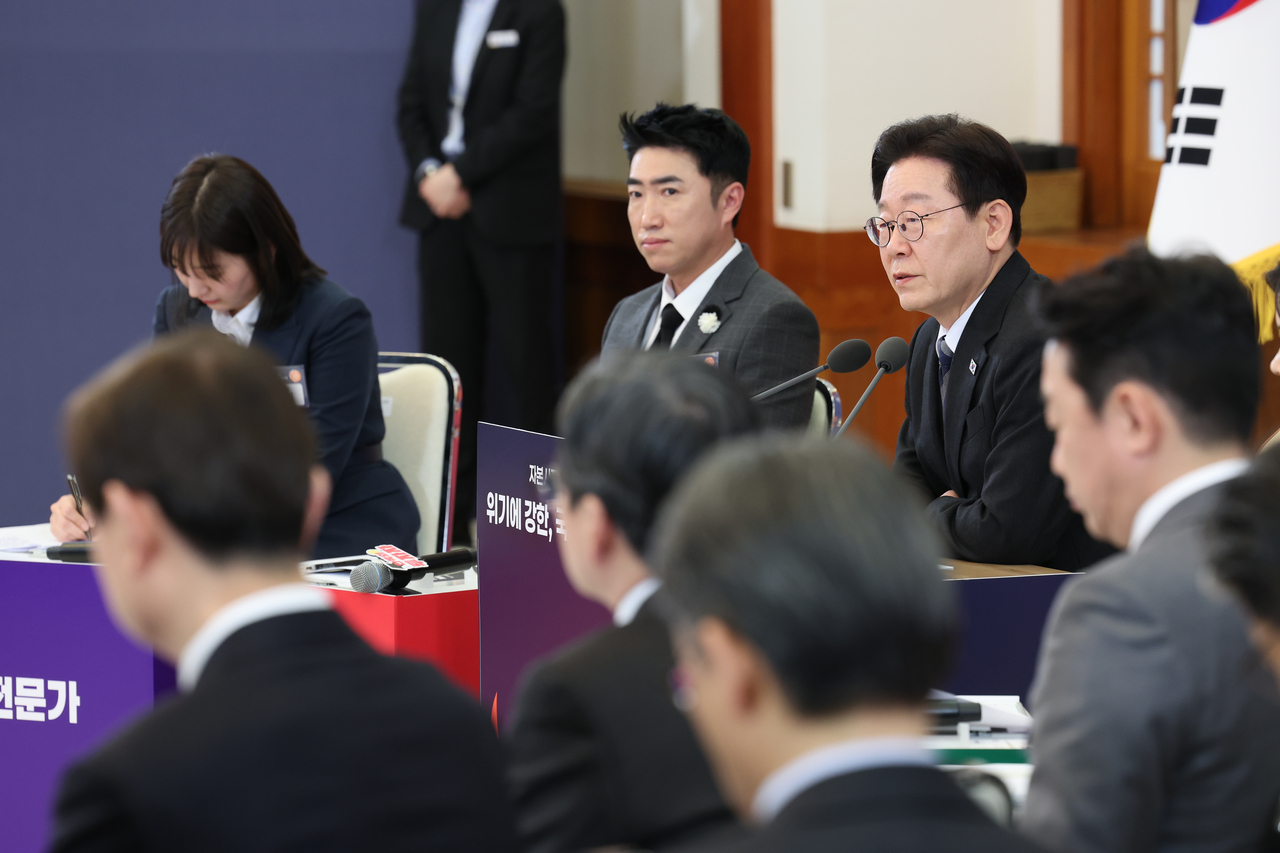
President Lee Jae Myung on Wednesday called for a sweeping overhaul of the country’s capital markets, vowing to tackle chronic governance flaws and market distortions to turn the long-standing “Korea discount” into a “Korea premium.”
Lee underscored at the meeting at Cheong Wa Dae that “shifting to productive finance is a very important priority in national policy.” A broad cross-section of market participants attended the meeting, including Kosdaq- and Konex-listed firms, startups, institutional investors, analysts and individual investors.
"Under the Korea discount ... (stocks) have been discounted for decades simply because they are listed on the Korean stock exchange," Lee said.
“Depending on what we do, we can move beyond the Korea discount and achieve not just fair valuation, but even a Korea premium,” Lee added.
Lee said the Korea discount was driven by four broad factors: corporate governance problems; a lack of market transparency and fairness, including stock manipulation; policy uncertainty, and geopolitical risks stemming from tensions on the Korean Peninsula.
Among them, Lee said that “the issue of geopolitical risk is, in fact, greatly exaggerated compared to what is generally perceived.”
“There is also an aspect in which political circles have unfairly exploited it, unnecessarily amplifying tension and anxiety. This is a problem that can be sufficiently resolved with even a little effort,” Lee explained.
Lee reiterated that "capital market normalization and revitalization are truly important elements for the development of South Korea’s economy and industry.”
“This could also significantly alleviate the problems caused by the excessive concentration in property, which is an issue I have recently been paying particularly close attention to,” Lee said.
Lee has consistently called for sweeping reforms to address the structural distortions behind the Korea discount on stocks. In his first field visit after taking office, he chose to visit the Korea Exchange — a move that underscored his strong determination to fundamentally overhaul South Korea’s capital market.
Lee added that the capital market turmoil stemming from the crisis in the Middle East was an opportunity for structural overhaul.
“At times like this, resolving the necessary measures and reform tasks is the way to prepare for a new start,” Lee said during the meeting held under the slogan, “A capital market strong in crisis and trusted by the people.”
In a statement, Cheong Wa Dae explained the meeting aimed "to review measures responding to the recent increase in financial market volatility, while also discussing fundamental ways to improve the capital market’s underlying structure by turning the crisis into an opportunity."
Financial Services Commission Chairman Lee Eog-weon presented a package of structural reform measures aimed at strengthening the foundations of the capital market.
The government plans to prioritize short-term efforts to contain external shocks stemming from the conflict in the Middle East, while advancing four key policy pillars aimed at improving the fundamentals of the capital market: restoring trust, strengthening shareholder protection, fostering innovation and improving market accessibility.
Chairman Lee said during the meeting that “what matters more is fundamentally improving the structure of the capital market. Crises can return at any time, and the key is to build a market structure that does not falter in the face of shocks.”
"The direction the capital market of the Republic of Korea should take is to create a virtuous circle in which the development of the capital market drives corporate growth and expands household wealth at the same time," the chairman said, referring to South Korea by its official name.
“The government will use this crisis as an opportunity to boldly push ahead with reform measures aimed at improving the fundamentals of the capital market.”
Under this framework, financial authorities plan to accelerate the delisting of underperforming firms, effectively ban duplicate listings through stricter screening, and revitalize Konex — a junior bourse for early-stage startups and small firms — as well as Kosdaq, South Korea’s main market for growth and tech-oriented companies.
The financial authorities also plan to introduce new financial products designed to encourage long-term investment and deliver tangible benefits to individual investors.
Wednesday's meeting was held at Cheong Wa Dae at 2 p.m., bringing together 47 participants from the public and private sectors.
Attendees from the government and related agencies included Financial Supervisory Service Gov. Lee Chan-jin, Lee Seung-woo, head of the joint response team for eradicating stock manipulation, Korea Exchange Chairman Jeong Eun-ho and Korea Financial Investment Association Chairman Hwang Seong-yeop.
dagyumji@heraldcorp.com