
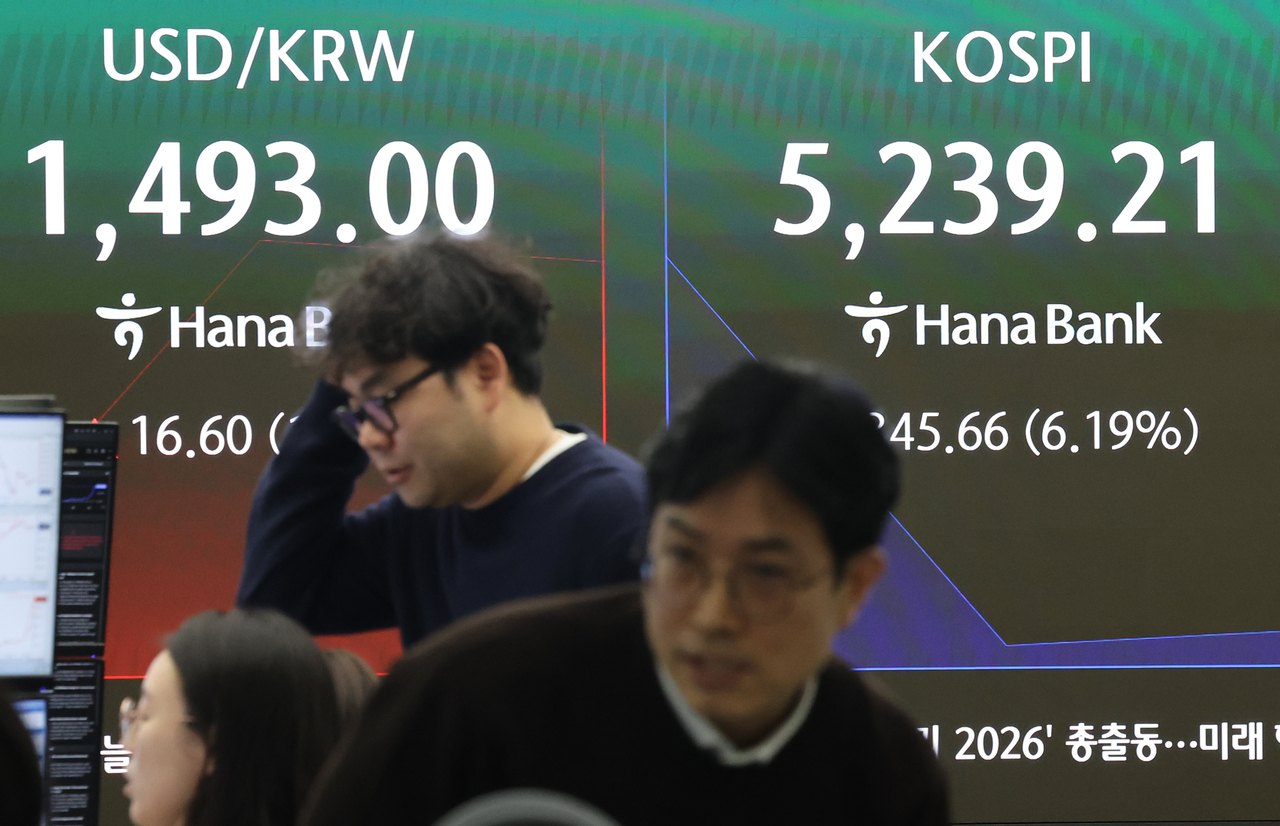
South Korea’s benchmark Kospi plunged in early trading Monday as surging oil prices triggered by the US-Israel war with Iran rattled global markets, prompting the activation of a sell-side sidecar designed to curb excessive volatility. The Korean won also weakened sharply against the dollar.
The Kospi opened at 5,265.37, down 5.72 percent from the previous session, and extended losses to as low as 5,171.53 in early trading.
As of 9:35 a.m., the index was trading at 5,234.82, down 6.27 percent.
A sell-side sidecar was triggered on the main bourse at 9:06 a.m., halting program sell orders for five minutes. The mechanism is activated when Kospi 200 futures drop 5 percent or more from the previous session and the decline persists for at least one minute.
At the time of activation, Kospi 200 futures had fallen 6.49 percent.
Heavy losses in blue-chip technology shares weighed on the benchmark. Samsung Electronics dropped 7.49 percent to 174,100 won ($116), while SK hynix plunged 8.23 percent to 848,000 won.
Foreign and institutional investors led the sell-off, offloading a net 873.5 billion won and 584.3 billion won worth of shares, respectively. Retail investors were net buyers, purchasing a net 1.44 trillion won.
The tech-heavy Kosdaq also fell sharply, opening down 5.04 percent at 1,096.48. As of 9:35 a.m., it stood at 1,100.92, down 4.66 percent from the previous session.
The Korean won also weakened significantly. The currency opened at 1,493.0 won per dollar, down 16.6 won from the previous session.
The level marks the weakest daytime trading level for the won since March 12, 2009, during the global financial crisis, when the currency briefly touched an intraday low of 1,500 won per dollar.
As of 9:35 a.m., the won was trading at 1,494.38 per dollar.
silverstar@heraldcorp.com