
Policy lender to anchor W2.1tr restructuring package while rolling out five-year strategic investment plan
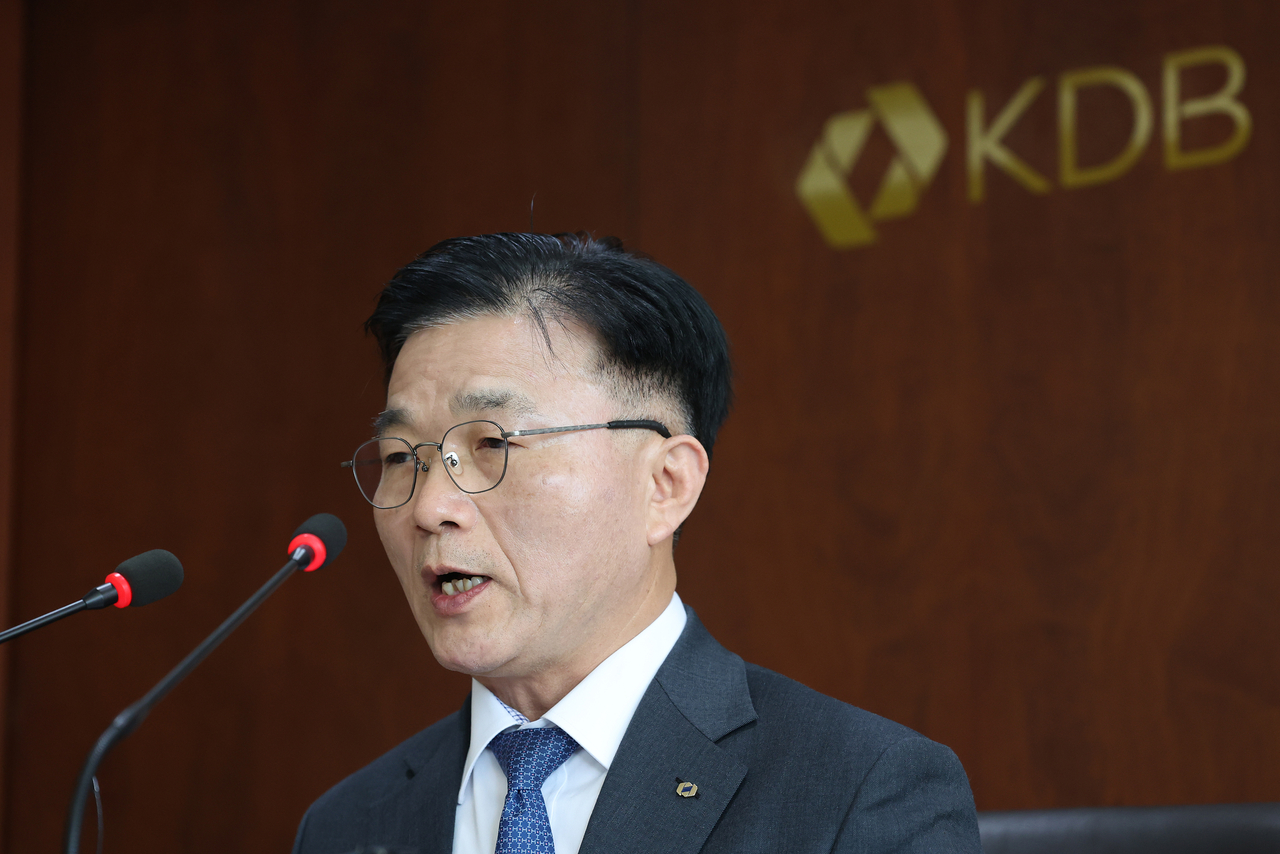
Korea Development Bank Chairman and CEO Park Sang-jin on Wednesday threw the lender’s weight behind the government’s 2.1 trillion won ($1.46 billion) support package for the country’s first petrochemical restructuring, pledging to lead the overhaul of the Daesan complex as lead policy lender.
Speaking at his first press conference since taking office in August, Park said KDB would take on over 40 percent of the 1 trillion won in fresh funding earmarked for the restructuring of the Daesan complex involving Lotte Chemical Corp. and HD Hyundai Chemical.
“This project marks the first preemptive reform in a key industry carried out through cooperation among the government, industry and financial institutions,” Park said. “As a policy lender, we will support the improvement and revival of core industries facing structural challenges.”
KDB commits W430b fresh funding
Earlier Wednesday, the Ministry of Trade, Industry and Resources formally unveiled the 2.1 trillion won package at a ministerial meeting on industrial competitiveness, marking the first approval under a sector-wide restructuring roadmap announced six months ago to encourage voluntary consolidation across the oversupplied petrochemical industry.
Under the plan, Lotte Chemical will spin off its Daesan naphtha cracking center in Seosan, South Chungcheong Province, and merge it with HD Hyundai Chemical, a joint venture between Lotte Chemical and HD Hyundai Oilbank. The two shareholders will each inject 600 billion won into the new entity, taking equal stakes.
Operations at Lotte’s naphtha cracking center will be halted and downstream facilities scaled back, cutting annual ethylene capacity by 1.1 million metric tons. The combined company aims to pivot toward higher-margin specialty products and eco-friendly output using alternative feedstocks such as ethane and bionaphtha.
Authorities will provide up to 2 trillion won in financial backing, including converting up to 1 trillion won in existing loans into perpetual bonds. Of the 1 trillion won in fresh funding, KDB will supply about 430 billion won for facility investment and research and development.
Around 7.9 trillion won in debt covered under the restructuring agreement will receive repayment deferrals through 2028, while lending terms are maintained.
Park said detailed financing terms would be finalized through a creditor council.
“Petrochemicals are a core upstream industry. If the front-end collapses, downstream sectors inevitably suffer,” he said, calling on creditor banks to cooperate to ensure the industry’s self-restructuring efforts move forward.
The Daesan approval is expected to accelerate similar restructuring talks in Yeosu, South Jeolla Province, and Ulsan, where producers including Yeochun NCC, LG Chem, GS Caltex and SK Geo Centric are exploring consolidation options.
W250tr growth program, venture push
Beyond petrochemicals, Park used the briefing to outline his broader policy agenda as the first internal candidate to head the state-run lender in its history.
He pledged to fast-track approvals under the 150 trillion won National Growth Fund, targeting 30 trillion won in project approvals this year and expanding support for regional projects. KDB will also roll out a separate 250 trillion won “KDB Next Korea” program over five years, channeling funds into strategic industries, regional finance and restructuring of legacy sectors.
Park said the bank is in talks with regulators to ease risk-weighted asset calculations for policy-driven investments, arguing that excessive capital charges could constrain productive finance. Discussions with supervisory authorities are ongoing, with a decision expected as early as March.
Park also signaled a broader shift toward expanding KDB’s investment function to channel more risk capital into emerging industries.
While acknowledging criticism that policy lending still leans on collateral and financial statements, he said KDB has been moving toward a credit- and innovation-based screening framework for new industries since 2018. According to Park, KDB currently invests about 500 billion won annually in startups and venture firms and commits up to 8 trillion won each year to fund formations.
"Under this system, KDB has built a virtuous cycle in which early-stage equity investment supports growth, followed by debt financing once companies reach stable revenue and profitability," Parks said, adding, “We will continue to strengthen our investment-led approach to create an environment where innovative companies can grow."
HMM dilemma: Busan relocation before sale
On HMM, Korea’s leading shipping line, Park said relocation of its headquarters to Busan remains the immediate priority, following President Lee Jae Myung’s push to move the company out of Seoul. Any sale would be considered only after the relocation is completed and in coordination with Korea Ocean Business Corp., which holds around a 35 percent stake alongside KDB, as well as relevant ministries.
HMM is expected to decide on the relocation at a shareholders' meeting next month.
Looking back on more than three decades at KDB, during which he witnessed cycles of crisis and recovery across Korea’s core industries, Park underscored the lender’s institutional responsibility to stand at the forefront of structural reform.
“KDB has grown alongside Korea’s industrial development, and there has rarely been a time without challenges,” he said. “As the nation’s leading policy lender, we will devote all our capabilities to strengthening corporate competitiveness and contributing to easing polarization and lifting Korea’s potential growth.”
jwc@heraldcorp.com