South Korea’s War Memorial is facing criticism over its description of the birthplace of Gen. Hong Beom-do as historical records regarding his origins remain disputed.
Hong is an independence fighter who led armed resistance against Japanese forces during the late Joseon era (1392-1910) and early Japanese colonial period (1910-1945).
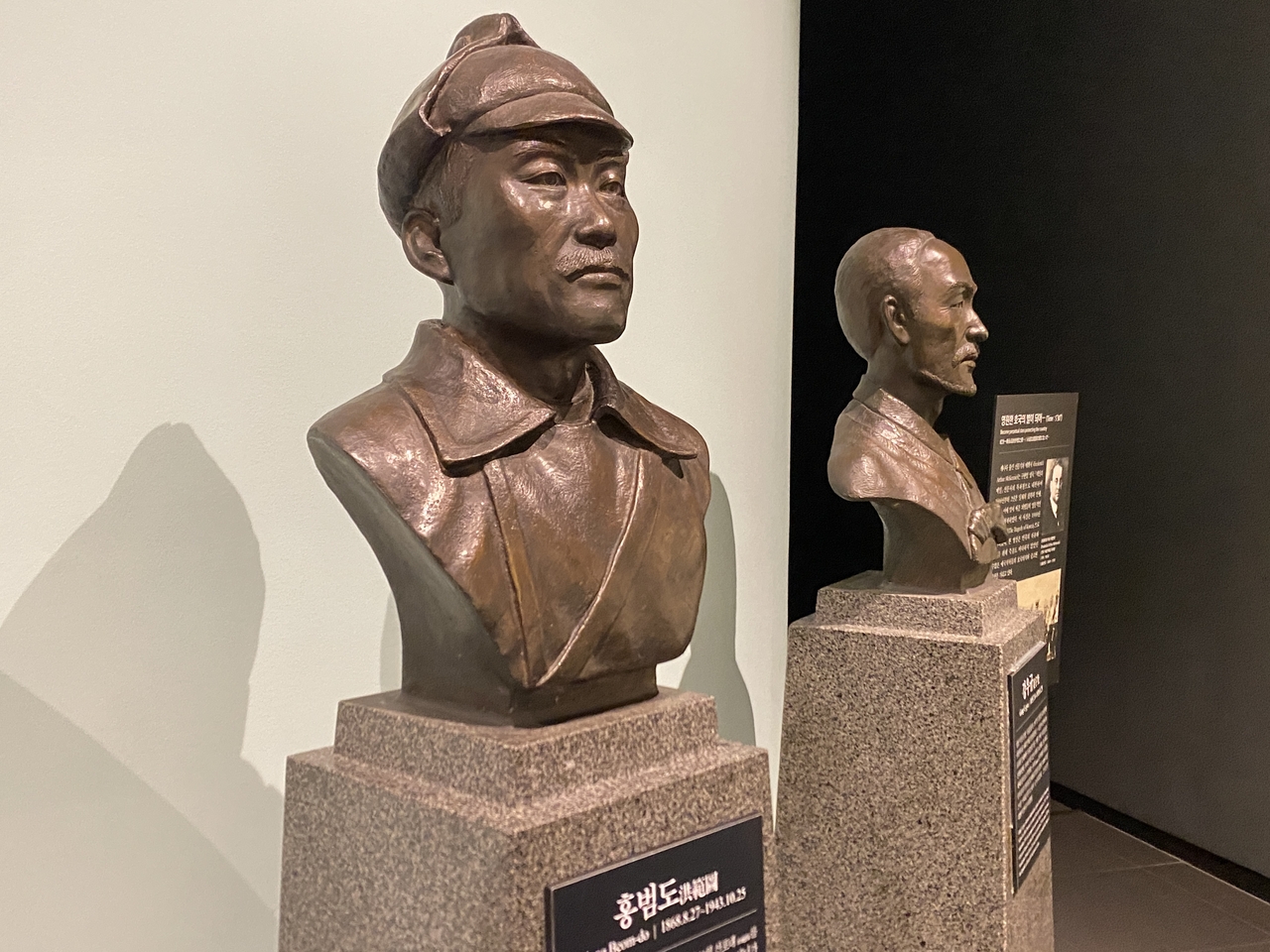
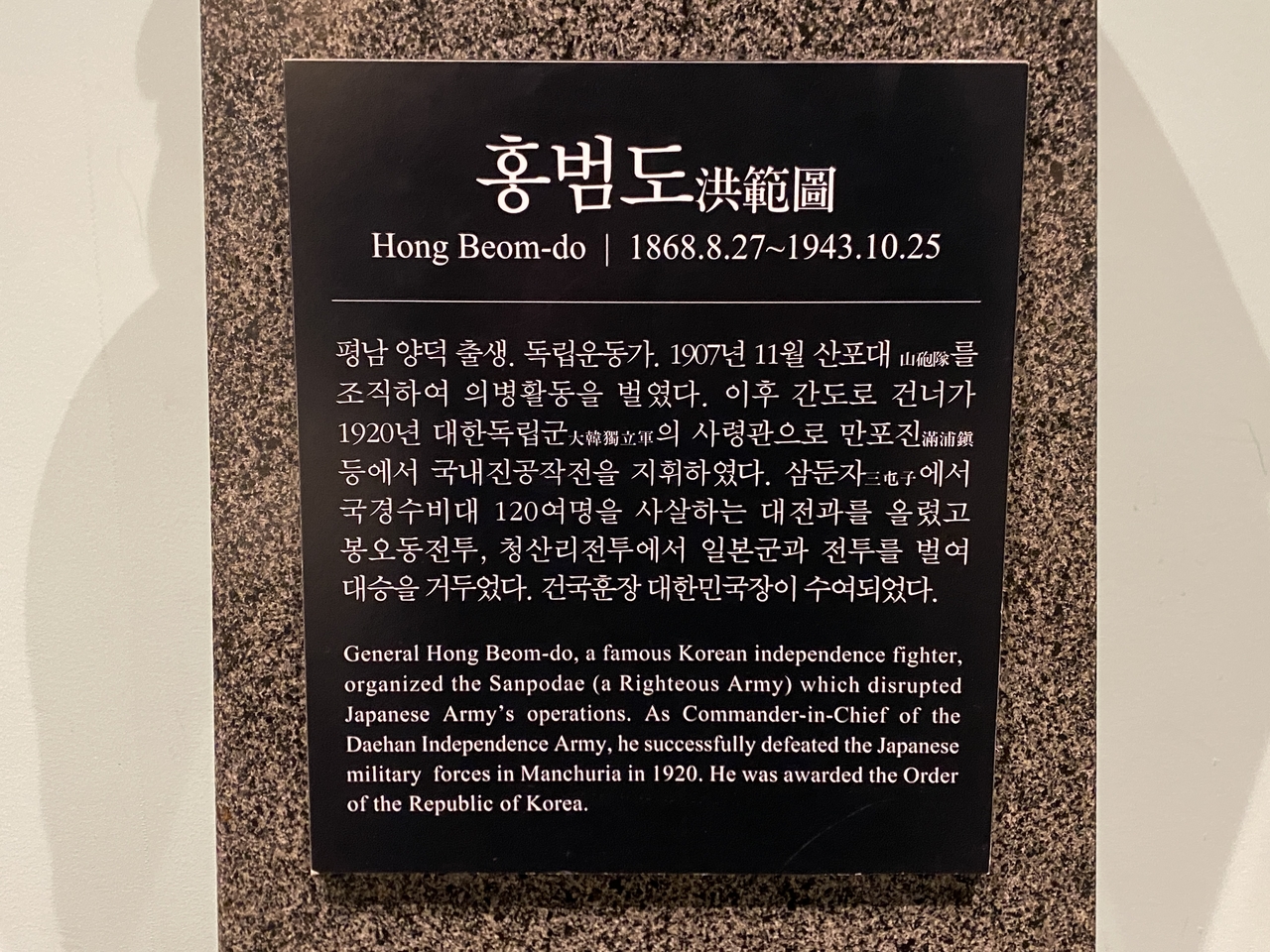
A description attached to Hong’s bust at the memorial’s headquarters in Yongsan, central Seoul, states that he was born in Andok, South Pyongan Province, in what is now North Korea. The War Memorial operates under the Defense Ministry.
However, Hong’s journal, stored at the Independence Hall of Korea under the Ministry of Patriots and Veterans Affairs, indicates that he was born in Pyongyang.
Pyongyang and Andok, which are around 80 kilometers apart, were separate administrative districts in the late Joseon era.
The Hong Beom-do General Memorial Society, a private commemorative organization dedicated to the independence fighter, also lists Hong’s birthplace as Pyongyang on its website.
Ban Byung-ryul, a history professor at Hankuk University of Foreign Studies who participated in reviewing Hong’s profile for the memorial society, argued that his diary should take precedence as a primary historical source.
“In 1995, artifacts and historical materials related to Gen. Hong Beom-do that had been kept in Kazakhstan and other former Soviet regions were brought to Korea. His journal was included in the collection,” Ban told The Korea Herald.
“The journal contains notes written by Hong himself as well as records transcribed by his aides based on his statements. Given that Hong directly engaged in its content, Pyongyang should be considered his birthplace.”
The diary traces Hong’s life from his birth through his participation in righteous army activities, major independence battles such as Cheongsan-ri, and his later years — including the forced relocation of Koreans from Russia to Central Asia in 1937 under Joseph Stalin.
While the original diary has not been located, a manuscript transcribed by his aide Jang Tae-chun and his wife Lee Ham-deok is preserved at the Independence Hall of Korea.
According to the War Memorial, the sculpture was established in 1995. Its reference was drawn from the Encyclopedia of Korean Culture compiled by the Academy of Korean Studies in Seoul, released in print volumes between 1991 and 2001.
Across government-affiliated institutions, three sculptures of Hong stand — at the Defense Ministry, Korea Military Academy and the War Memorial.
Controversy
Hong has also been at the center of historical and political controversy — particularly over his later association with Soviet-aligned partisan forces after relocating to the Russian Far East in the early 1920s.
Despite such debates, former President Moon Jae-in publicly honored Hong as a symbol of Korea’s armed independence struggle, highlighting his leadership in major anti-Japanese battles including Cheongsan-ri.
Hong’s remains were repatriated from Kazakhstan to South Korea in 2021 and laid to rest at Daejeon National Cemetery.
Under the Yoon Suk Yeol administration, however, the Korea Military Academy attempted to relocate Hong’s bust from its campus, arguing that his Soviet-aligned background and ideological associations could be inappropriate for cadet education.
The move drew mounting criticism from civic groups and historians and was ultimately shelved, leaving the sculpture in place.
Negligence?
Government records themselves show inconsistencies regarding Hong’s birthplace.
When Hong’s remains were repatriated to Korea, the Ministry of Patriots and Veterans Affairs described his birthplace only as an “unknown location, North Pyongan Province.” The ministry-run online honors database carries the same entry.
Meanwhile, the Dictionary of Korean Independence Activists, published by the ministry, introduces Andok as one account while also presenting three competing theories — South Pyongan Province, North Pyongan Province and Pyongyang.
Discrepancies extend to basic biographical data as well. The memorial society lists Hong’s birth year as 1868, while Independence Hall records 1869. The War Memorial sculpture also states 1868.
Song Yang-seop, a history professor at Korea University, said such gaps cannot be dismissed as minor clerical differences.
“A gap on the scale of Pyongyang versus Andeok cannot be seen as trivial,” Song said.
“Gen. Hong is not a figure so distant in history that such basic information should remain inconsistent. We need to examine practical evidence and cross-verify sources.”
Asked about the possibility of revising the birthplace description, the War Memorial of Korea said, “If the need for correction is verified, we will take appropriate measures.”
“Provided the issue is not deemed controversial, making revisions would not be difficult,” it added.
flylikekite@heraldcorp.com

![[Exclusive] Ateez to return in November](https://wimg.heraldcorp.com/news/cms/2026/09/02/news-p.v1.20260902.76162fb0ba55493aad1c076f240d0750_R.jpg?type=h&h=120)