
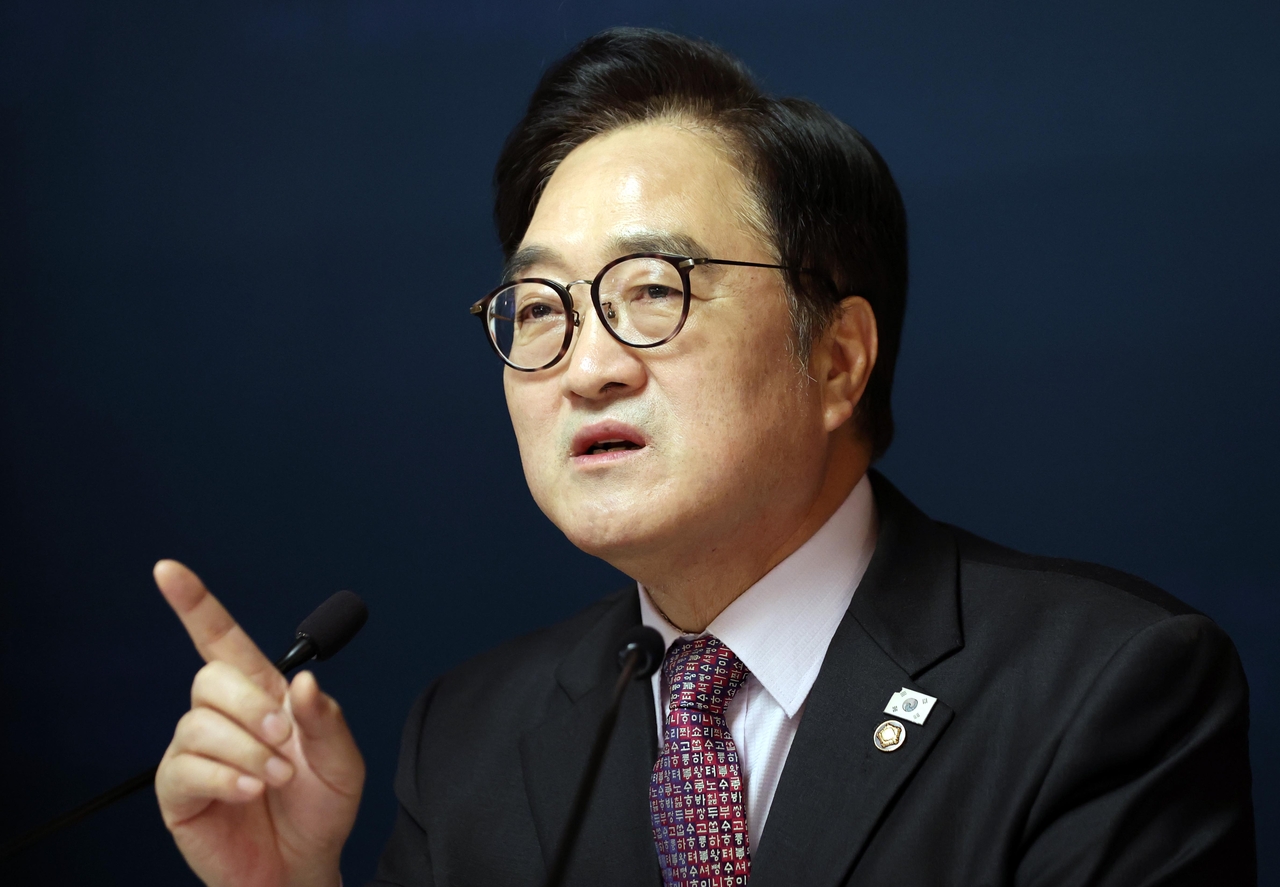
Rep. Woo Won-shik, speaker of the National Assembly, on Thursday renewed calls for a referendum in June to amend the Constitution for the first time in about four decades, speaking at a news conference.
As a prerequisite, Woo said South Korea's Referendum Act must be revised. The five-term lawmaker, whose term as Assembly speaker ends in May, said he would spare no effort to pass the revision within this month.
"I have set around the Lunar New Year holiday in mid-February as the deadline to revise the Referendum Act so that the referendum and local elections can be held simultaneously," Woo told reporters at the National Assembly in Seoul.
Lawmakers from both sides of the aisle have proposed bills to revise the law, including measures to lift voting restrictions on overseas Koreans without registered addresses in South Korea, to lower the minimum voting age for referendums from 19 to 18 — bringing it in line with other elections following a 2020 revision — and to allow early voting in referendums.
In particular, restrictions on overseas Koreans' voting rights based on whether they maintain a domestic address were ruled unconstitutional in 2014, yet the Referendum Act has yet to be amended accordingly.
"Without the revision, a constitutional amendment is impossible," Woo said.
He added that bipartisan consensus is not an absolute requirement for revising the Referendum Act, saying he would move to table the bill even if the ruling Democratic Party of Korea pushes it through using its majority, without the consent of the main opposition People Power Party.
"If I simply sit back because the two rival parties failed to reach a compromise, is that neutrality? I don't think so," said Woo, who was as a Democratic Party lawmaker before becoming Assembly speaker.
Woo, who struck the gavel to lift former President Yoon Suk Yeol's martial law three hours after Yoon's declaration, suggested that a constitutional amendment should uphold the spirit of the 1980 Gwangju Uprising, grant the National Assembly authority to approve martial law and promote decentralization of power concentrated in the Greater Seoul area.
In particular, the inclusion of the spirit of the 1980 movement "will ensure that South Korea is guided by democratic principles," Woo said, adding that "we recognized many loopholes in the Constitution, even though we managed to block the imposition of martial law to safeguard its democratic foundations."
As a result, this year's amendment — expected to be the 10th in South Korean history — would focus on minimal changes, with the aim of "opening the door to future amendments."
The last constitutional referendum in South Korea was held in 1987, when amendments introduced direct presidential elections and barred presidents from seeking a second term.
consnow@heraldcorp.com