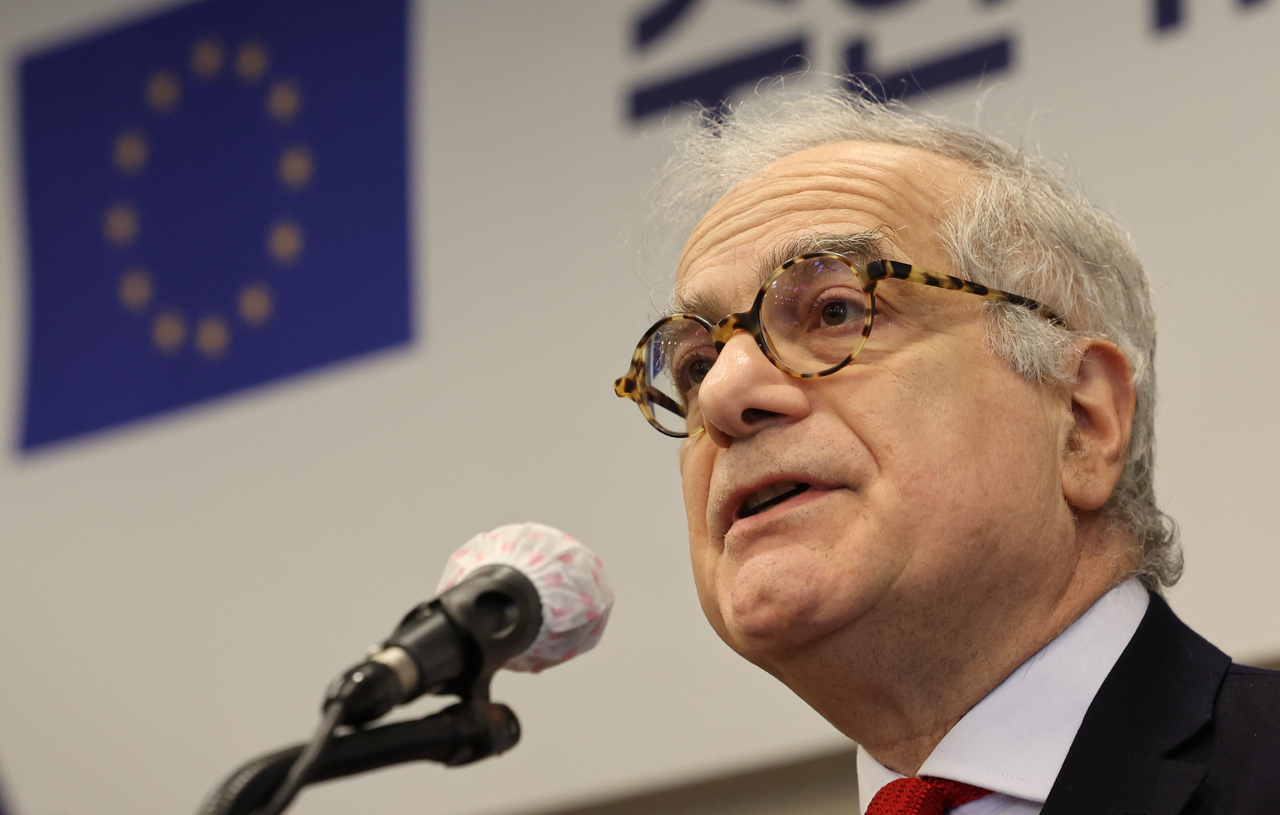
South Korea and the European Union are preparing to launch a new dialogue channel dedicated to supply chain cooperation, the EU’s ambassador said Friday.
The two countries aim to strengthen bilateral partnerships amid growing uncertainty in the global order largely shaped by US-China competition.
Speaking to reporters in Seoul, EU ambassador to South Korea Ugo Astuto said supply chain resilience has become “more important than ever,” adding that Seoul and Brussels are set to establish a dedicated dialogue mechanism on the issue.
“The first meeting is expected to take place in the near future,” Astuto said. “Through regular exchanges and the sharing of best practices, Korea and the EU are working together to reduce dependence on specific countries and diversify supply chain channels.”
Without providing further details — including who will attend or what items would be discussed — Astuto said the inaugural meeting would take a broad, strategic approach rather than focusing on specific areas.
“It is still difficult to go into concrete details, but there is strong interest on both sides,” he said. “This will be a forum for in-depth discussions on supply chain challenges.”
Instead, Astuto added that the new dialogue channel is separate from the second Korea-EU Strategic Dialogue held in Brussels on Jan. 22 between South Korean Foreign Minister Cho Hyun and EU High Representative for Foreign Affairs and Security Policy Kaja Kallas.
On defense industry cooperation, Astuto said European countries have increasingly recognized the need to strengthen their own defense capabilities after Russia’s 2022 invasion of Ukraine.
“Against calls to increase defense spending, a number of policies and institutional measures have been introduced,” he said, adding that South Korean defense firms’ engagement with individual EU member states has already produced “positive outcomes,” particularly in weapons development.
As defense spending has surged across Europe, South Korea’s defense industry has expanded. Firms such as LIG Nex1, a missile and precision-guided weapons manufacturer, and Hanwha Aerospace, a producer of artillery systems and aerospace engines, are seeing stronger demand from European customers.
Addressing Arctic shipping routes — an agenda the Lee Jae Myung administration is pushing forward — Astuto said the EU is maintaining three core principles: protecting the Arctic’s fragile environment, preserving peace in the region, and respecting the rights of Indigenous peoples and citizens of Arctic states.
“We are preparing a package to maintain Arctic security and will continue to build partnerships with the US, NATO, Norway, Iceland and others,” he said. “I believe the Korean government is also well aware of the EU’s three-pillar approach, and within this framework, dialogue with Korea is possible.”
On North Korea, Astuto said Pyongyang’s reported deployment of troops to support Russia’s war effort in Ukraine — in exchange for political and financial backing — underscores the growing links between security dynamics in the Indo-Pacific and Europe.
“This demonstrates that European and Indo-Pacific security are interconnected,” he said. “The EU and South Korea must work together for the global common good.”
Friday’s press conference marked Astuto’s first since assuming his post in September.
An Italian national, Astuto is a career diplomat who previously served in Italy’s Foreign Ministry, the European External Action Service, as Italy’s deputy director-general for Asia, and as ambassador to India and Bhutan.
flylikekite@heraldcorp.com

![[Exclusive] Ateez to return in November](https://wimg.heraldcorp.com/news/cms/2026/09/02/news-p.v1.20260902.76162fb0ba55493aad1c076f240d0750_R.jpg?type=h&h=120)